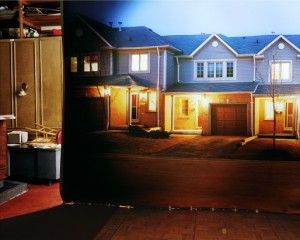
Categories
BOOKS CONTEXT INVISIBLE CITY TEXT

Invisible City: The Text

As well as showing Invisible City in its entirety here, we see that the text is just as important to try and get a sense of the book and Schles’ vision. So here is the text featured in the book alongside the full video for your viewing pleasure!

Opening text:

Cities are a product of time. They are the molds in which men’s lifetimes have cooled and congealed, giving lasting shape, by way of art, to moments that would otherwise vanish with the living and leave no means of renewal or wider participation behind them. In the city, time becomes visible: buildings and monuments and public ways, more open than the written record, more subject to the gaze of many men than the scattered artifacts of the countryside, leave an imprint upon the minds even of the ignorant or the indifferent. Through the material fact of preservation, time challenges time, time clashes with time: habits and values carryover beyond the living group, streaking with different strata of time the character of any single generation. Layer upon layer, past times preserve themselves in the city until life itself is finally threatened with suffocation… Lewis Mumford The Culture of Cities


Back of the book text:

Steadily, for the past generation, a transformation has been going on in every department of thought: a re-location of interest from mechanism to organism, a change from a world in which material bodies and mechanical motion alone were real to a world in which invisible rays and emanations, in which human projections and dreams, are as real as any immediately visible or external phenomenon – as real and on occasion more important.
Lewis Mumford, The Culture of Cities

A man becomes confused, gradually, with the forms of his destiny; a man is, by and large, his circumstances. More than a decipherer or an avenger, more than a priest or a god, I was one imprisoned. From the tireless labyrinth of dreams I returned as if to my home to the harsh prison.. I blessed its dampness, I blessed its tiger, I blessed the crevice of light, I blessed my old suffering body, I blessed the darkness and the stone.
Borges Labyrinths

All is imaginary – family, office, friends, the street, all imaginary, far away or close at hand, the woman; the truth that lies closest, however, is only this: that you are beating your head against the wall of a windowless
and doorless cell.
Kafka Diaries (1921)

This metropolitan world then, is a world where flesh and, blood is less real than paper and ink·and celluloid. It is a world where the great masses of people, unable to have direct contact with more satisfying means of living, take life vicariously, as readers, spectators, passive observers: a world where people watch shadow-heroes and heroines in order to forget their own clumsiness or coldness in love, where they behold brutal men crushing out life in a strike riot, a wrestling ring or a military assault, while they lack the nerve even to resist the petty tyranny of their immediate boss: where they hysterically cheer the flag of their political state, and in their neighborhood, their trades union, their church, fail to perform the most elementary duties of citizenship.

Living thus, year in and year out at second hand, remote from the nature that is outside them and no Ie remote from the nature within, handicapped as lovers and as parents by the routine of the metropolis and by the constant specter of insecurity and death that hovers over its bold towers and shadowed streets living thus the mass of inhabitants remain in a state bordering on the pathological.
[Nb – The quote continues, but I did not include this part in the book, although it might be interesting to see it here:] – Ken Schles
They become the victims of phantasms, fears, obsessions, which bind them to ancestral patterns of behavior. At the very point where super-mechanization takes hold of economic production and social intercourse, a treacherous superstition, a savage irrationality, reappear in the metropolis. But these reversionary modes of behavior, though they are speedily rationalized in pseudo-philosophies, do not remain on paper: they seek an outlet. The sadistic gangster, the bestial fascist, the homicidal vigilante, the law-offending policeman burst volcanically through the crust of metropolitan life. They challenge the dream city with an even lower order of ‘reality’.
Lewis Mumford, The Culture of Cities (p.258)

…reality itself, entirely impregnated by an aesthetic which is inseparable from its own structure, has been confused with its own image. Reality no longer has the time to take on the appearance of reality. It no longer even surpasses fiction: it captures every dream even before it takes on the appearance of a dream. Schizophrenic vertigo of these serial signs, for which no counterfeit, no sublimation is possible, immanent in their repetition – who could say what the reality is that these signs simulate?
Jean Baudrillard, Simulations

All he wanted was to hold the photograph in his fingers again, or at least to see it.
‘It exists!’ he cried.
‘No,’ said O’Brien.

He stepped across the room. There was a memory hole in the opposite wall. O’Brien lifted the grating. Unseen, the frail slip of paper was whirling away on the current of warm air; it was vanishing in a flash of flame. O’Brien turned away from the wall.
‘Ashes,’ he said. ‘Not even identifiable ashes. Dust. It does not exist. It never existed.’
‘But it did exist! It does exist! It exists in memory. I remember it. You remember it.’
‘I do not remember it,’ said O’Brien.

Winston’s heart sank. That was doublethink. He had a feeling of deadly helplessness. If he could have been certain that O’Brien was lying, it would not have seemed to matter. But it was perfectly possible that O’Brien had really forgotten the photograph. And if so, then already he would have forgotten his denial of remembering it, and forgotten the act of forgetting. How could one be sure that it was simple trickery? Perhaps that lunatic dislocation in the mind could really happen: that was the thought that defeated him.

O’Brien was looking down at him speculatively. More than ever he had the air of a teacher taking pains with a wayward but promising child.
‘There is a Party slogan dealing with the control of the past,’ he said. ‘Repeat it, if you please.’

‘”Who controls the past controls the future: who controls the present controls the past,”‘ repeated Winston obediently.
George Orwell, 1984

 

Categories
BOOKS MEET-UPS NEWS THOUGHTS ON BOOKS

Meet-up Map – An update and improved ease of use!

The Photo Book Club Meet-up map has now had over 10,000 hits and a smattering of people adding themselves to the map in order to meet up with like minded ‘photobook-folk’. We also have the first few meetings shown on the map so make sure you check out if they are near you!

Some people have contacted me having trouble with adding themselves onto the map and so in order to make this smoother, I have created a form below and on the Meet-up page which when filled in, will be sent to myself in order to add you to the map.

If you are planning to host or organize a meeting, pop an email to matt@photobookclub.org and we shall add this to the map as well as publicize it on the website.

Note
The map is still public and can be edited by anyone, this public nature also means that the information you provide can be seen by other users. If you would rather, you can provide a website instead of direct contact information, and a rough location rather than your house!

[customcontact form=1]

Categories
BOOKS EVENTS

One half of the photo Book Club at London Design Festival

As already announced last month, I will be speaking at the London Design Festival’s ‘Story of Books’ event this September in London. The event has some great speakers lined up and will promote discussion around the future and changing form of the book.

I will be looking closely at the photography book in particular and ways in which I see it developing, as well as the huge support we have had for the Photo Book Club, and for the physical books and stores that we all love.

I would be keen to hear Photo Book Club readers thoughts on the state/future of books and so you can get involved with discussion via the twitter hashtag #storyofbooks or in the comments section below.

If you would like to attend, you can get your tickets from this website. The talk takes place on September 17th at the Department of Anthropology, University College London from 10.30am – 3.00pm.

– Matt

Categories
SUMMARY

Cafe Lehmitz: A Summary

Thanks to all who have contributed to the discussion on Anders Petersen’s ‘Cafe Lehmitz’. It has been a really busy month! We have compiled an archive of the posts below for future reference and will also be listed under the reading list page.

Anders Petersen talks about his SOHO projects – video
Synopsis – Anders Petersen – ‘Cafe Lehmitz’
5b4 looks at the editions of Cafe Lehmitz
Key editions and other books by Anders Petersen
A personal reflection by Wayne Ford
A personal reflection by Matt Johnston
Stan Banos on the technical proficiency in Cafe Lehmitz
Cafe Lehmitz inDepth by Wayne Ford
Aggie Morganti on the warmth, honesty and heart of Cafe Lehmitz
A Personal reflection by Aya Takada

There is no book in August as we explain here, but in September we will be looking at Ken Schles’ ‘Invisible City’

Categories
BOOKS EVENTS MEET-UPS

Photo Book Club Meet-up Map

A Photo Book Club suggests physical meetings, and it is something we have always wanted to be part of, and help facilitate. And so you can now find a map on the ‘Meet-ups’ page which we hope to get populated with people and meeting places.

Wayne and I will take part in potentially the first meeting this September as part of Photobook London although if anyone has a meeting before let us know!

The map can be seen below and can be edited by anyone


View The Photo Book Club ‘Meet-up Map’ in a larger map

Categories
COMMENTS REFLECTION

Cafe Lehmitz, a personal reflection by Matt Johnston

The following is a personal reflection from Matt Johnston on his first viewing of Cafe Lehmitz, if you have a reflection you would like to add, then do so in the comments below or email mail@photobookclub.org

I should have first seen Cafe Lehmitz back at university when my tutor suggest I see Petersen’s view of a single beer house in Hamburg for inspiration. I have to confess i didn’t see it then (sorry Jonathan!) as I was quickly distracted by the bright lights, ball parks and endless roads of American photography.

©ANDERS PETERSEN

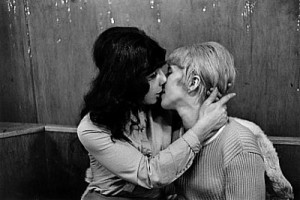
And so my first viewing of ‘Lehmitz’ was only a month ago. The raw power of the striking, rich-black images grabbed me straight away, but it was the refreshingly honest and simple premise of the story that most appealed. I loved the idea I was seeing someone who first came as a visitor and soon became embraced by the seemingly dysfunctional family he depicted.

©ANDERS PETERSEN

I would never had made the images Petersen made here, and I don’t know many photographers who would have. The technical skill can be taught, but the way he went about gaining trust, meeting people and producing this ‘family album’ is something only Petersen knows.

– Matt Johnston


Categories
EVENTS NEWS

August’s book is……

Actually, there is no book for August! We were planning to look at Nan Goldin’s ‘Ballad of Sexual Dependency’ but have recently agreed to several events in September, and so are going to take a month out.

We will be looking at Goldin’s masterpiece in October now, and September itself will be a special month, with Ken Schles joining us to get involved with the discussion of his book ‘Invisible City’.

And so what are these events? Well, more details will follow shortly and be posted here, but for now we can say they involve the two following exciting projects.

– Matt Johnston


Categories
COMMENTS

Technical proficiency in Cafe Lehmitz – Stan Banos

Thanks to Stans Banos of ‘Reciprocity Failure‘ who commented this week on the technical proficiency Petersen demonstrates with the 35mm images in Cafe Lehmitz.

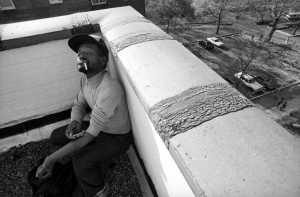
Banos pointed to several other artists who have captured moments under available light in a similar fashion, the comments, and a selection of images are shown below.

Stan Banos
Something that rarely, if ever, gets mentioned is that one of the reasons that Cafe Lehmitz remains so powerful and poignant to this very day is that the technical proficiency of the work alone is simply incredible. Early on, it really set the bar for what “availble light” work could aspire to be at its very pinnacle with a simple 35mm camera- and it was rarely duplicated in the years since…

Matt Johnston
Stan, you are absolutely right, the technical proficiency Petersen shows in Lehmitz is something i must say i overlooked on my first looks through the book. I would be keen to hear some of the projects you think have come close to the Lehmitz standard? I would suggest Invisible City by Ken Schles (which we look at in Sept) is another groundbreaking ‘available light’ piece of work.

Stan Banos
Good question. First off, it’s much easier to get top quality available light (ie- just enough existing light to record a worthwhile image) work today with full frame digital sensors. And although I can’t think of any (film) projects offhand of that particular (technical) quality that involve the sole use of available light photography, I’m sure they must exist. Admittedly, I’m not a great fan of available light work since 35mm by its very nature is pushing the limits of technical quality under the best of circumstances. That said, Henry Wessel’s 35mm prints (although not “available light”) are some of the most technically amazing and pristine wonders that can compete with any format for sheer technical (and aesthetic) beauty. And you need not go further than Cocaine True, Cocaine Blue to sample top notch work that features a considerable amount of available light work.

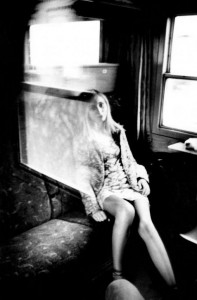
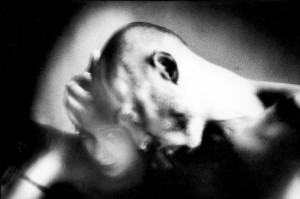
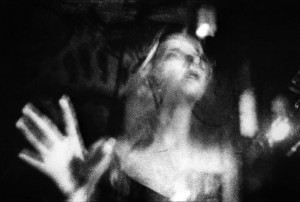
The work by Ken Schles has a different, more dreamy like aesthetic than Cafe Lehmitz that more closely resembles the work by another exemplary available light photographer, Michael Ackerman.


Anders Petersen

©ANDERS PETERSEN
©ANDERS PETERSEN
©ANDERS PETERSEN

Eugene Richards

©EUGENE RICHARDS
©EUGENE RICHARDS
©EUGENE RICHARDS

Michael Ackerman

©MICHAEL ACKERMAN
©MICHAEL ACKERMAN
©MICHAEL ACKERMAN

Ken Schles

©KEN SCHLES
©KEN SCHLES
©KEN SCHLES

We looked at Eugene Richards’ ‘Cocaine True, Cocaine Blue’ a couple of months back, the archive can be found here

And we will be looking at Ken Schles’s ‘Invisible City’ in September, so plenty of food for thought here!

– Matt Johnston


Categories
COMMENTS

Out of Sorts in ‘The Valley’

To me, There is something out of sorts about the scenes in Larry 
Sultan’s ‘The Valley’. And it is not the naked house guests or their crew 
members that are lighting, filming, resting, and sweating around the 
porn scenes.

Instead it is the homes and artifacts within them that seem out of 
place. The choice of art hanging on the wall and furnishings dressing 
the home all come under a new scrutiny when juxtaposed with the
 writhing bodies of many fantasies now occupying ‘family spaces’. I wonder, like Sultan, whether the 
real fantasy taking place here is that of the perfect American home.

 Each one we enter has a similar, slightly sterile feel. We see the
 pools, gazebos, patios, large sofas and TV’s that appear on the
 quintessential ‘dream home checklist’ but not much else.
The addition of fictitious backdrops in gardens and living rooms creates a feeling that the each house is just part of an elaborate set for the filming of real-life.

The
 personality Sultan does show us of these homes seems tired, the girls 
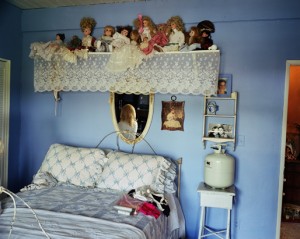
bedroom with neglected dolls now sitting on a shelf, a drum kit
 gathering dust and a bed with no sheets that has certainly seen better
days. It is these rooms, kept out of view of the directors camera but picked up by Sultan’s that offer a melancholy feel to the viewing experience of the book. It reminds us of all the dreams and items once cherished as well as that which would be deemed unpleasant to others that are now gathering dust, or else pushed aside from the gaze of any possible visitors in so many homes.

These are not the locations chosen by the director, and neither are
they chosen to be displayed by the home owner. Both the director and
home owner want to show the same thing, a representation of success,
and of a fantasy, but without any personal effects or clutter that
would tarnish the ‘scene’.

– Matt Johnston

Categories
BOOKS

July’s book is: Cafe Lehmitz by Anders Petersen

In July, The Photo Book Club will be looking at Anders Petersen’s ‘Cafe Lehmitz’ in which Peterson photographed the frequenters of the beer hall ‘Cafe Lehmitz’ in Hamburg.

The book is easy to get hold of in it’s latest incarnation from Schirmer as well as other editions available in varying rarity. An Amazon UK link to the book can be found here.
An Amazon US link can be found here.

If you would like to contribute to July’s discussion then drop us an email: mail@photobookclub.org

'Cafe Lehmitz' by Anders Petersen

And, as a sneak peek at a Photo Book Club ‘Special Edition’ coming in September:
We will be looking at Ken Schles’ seminal book ‘Invisible City’ with the photographer himself taking part. So get any questions in to us so we can put them to Ken.

More details soon…