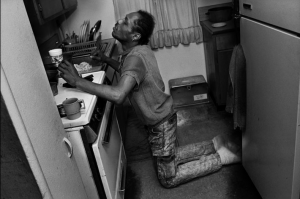
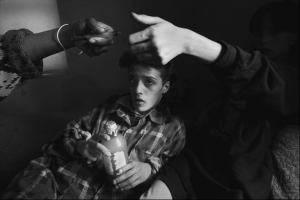
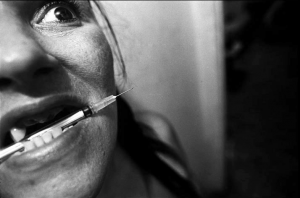
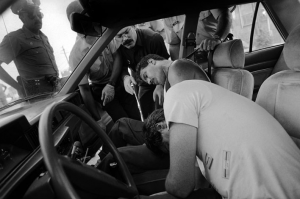
In July, The Photo Book Club will be looking at Anders Petersen’s ‘Cafe Lehmitz’ in which Peterson photographed the frequenters of the beer hall ‘Cafe Lehmitz’ in Hamburg.
If you would like to contribute to July’s discussion then drop us an email: mail@photobookclub.org
'Cafe Lehmitz' by Anders Petersen
And, as a sneak peek at a Photo Book Club ‘Special Edition’ coming in September:
We will be looking at Ken Schles’ seminal book ‘Invisible City’ with the photographer himself taking part. So get any questions in to us so we can put them to Ken.
More details soon…
‘The Valley’ is not that easily accessible, hence our low-fi cover to cover video of the book. But another option for those looking for an introduction to Sultan’s work could consider the recent Steidl publication ‘Katherine Avenue’. The post below come from Wayne Ford’s fantastic Posterous blog.
Above Mom in Doorway, 1992, from Pictures from Home. (Courtesy of Steidl).
‘The San Fernando Valley is both the place where Larry Sultan (1946-2009) spent his childhood and the notional central point of reference of his artistic work,’ says Martin German in his introduction to Katherine Avenue, ‘In the three groups of works he produced between 1984 and 2009, namely Pictures from Home, The Valley and Homeland, he interweaves visible and invisible aspects of life there with the landscapes of his personal memories.’
Sultan, one of the most influential American photographers of his generation, studied political sciences before enrolling in a photography course at the San Francisco Art Institute under Robert Heinecken (1932-2006) in the late 1960s, reflecting upon this period German says, ‘This was the time when photography formed a bond with conceptual art, to whose marriage Sultan would soon render significant contributions.’
In 1972, Sultan met Mike Mandel with whom he would collaborate on a series of billboard collages that would continue well into the 1990s, through which the pair explored the ‘documentary value of images.’ In 1975, and over the next two years, Sultan and Mandel began working on Evidence (1977), a now seminal artists book that bought together 59 photographs selected from various governmental, research and scientific archives that were then arranged in a non-narrative sequence, removed from the original context and with no captions, Evidence is a complex and demanding work, ‘Thus Evidence not only alludes to the bureaucratic and scientific rituals that legitimated the daily business of the federal authorities in the period shortly after the Vietnam War, but more importantly also refers to the assumptions we make regarding truth and imagery,’ says German.
Above Sharon Wild, 2001, from The Valley. (Courtesy of Steidl).
The questions raised by Evidence would inform and influence much of Sultan’s subsequent work, in 1984 he began Pictures from Home (1992), here alongside the photographs of his parents and their daily middle-class routines and rituals, Sultan presents recordings, notes on conversations and stills from family movies along with other memorabilia to investigate the consequences of neo-liberal economic policies.
Reflecting upon his series, Sultan said, ‘I realize that beyond the rolls of film and the few good pictures, the demands of my project and my confusion about its meaning, is the wish to take photography literally. To stop time. I want my parents to live forever.’
In 1999, Sultan was commissioned to document a day in the life of a porn director, whilst known as the home of the American movie industry, the San Fernando valley is also home to the porn industry, were production companies hire private homes for their film shoots, which typically take a few days. This commission turned into The Valley, a series that Sultan worked on until 2003, looking out into the valley, with its upper-middle class tracht homes, Sultan focuses on the periphery of the films sets, presenting the sets and actors as ‘meta-theatre’ says German.
‘While the film crew and “talent” are hard at work in the living room I wander through the rest of the house peering into the lives of the people who suddenly left home. I feel like a forensic photographer searching out evidence in a crime scene. But what is the crime?’
Above Mulholland Drive #2, 2000, from The Valley. (Courtesy of Steidl).
With his final series Homeland, Sultan departs from the domestic exteriors and interiors of the San Fernando Valley, and uses the landscape around San Francisco, where he had lived since the 1970s. In these images Sultan employs day laborers — gardeners, builders and domestic workers — from Central America as actors, photographing them in what he calls ‘marginal spaces and transitional zones invisible to most of us.’ In these images Sultan, directs the ‘men’s actions and gestures while drawing from multiple sources,’ and amalgam of his ‘own childhood wanderings in this landscape as well as interpretations of their experiences as exiles.’
Above Batting Cage, 2007, from Homeland. (Courtesy of Steidl).
Term is coming to a close at Coventry University but the #fromthelibrary sessions run by the Photo Book Club have been a success with the first year students. We have discussed a whole host of books and many that I had never encountered before were brought along from the library shelves, which was great to see.
I am looking forward to runnig more of these session in conjunction with the Photo Book Club, if anyone is interested – send me an email matt@photobookclub.org
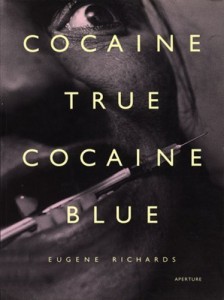
We are coming to then end of May and ‘Cocaine True, Cocaine Blue’ by Eugene Richards, i know many have been in touch for recommendations of other books by Richards to check out. So here is a comprehensive list for you to enjoy.
Throughout June, the Photo Book Club will be looking at Larry Sultan’s ‘The Valley’, a body of work exploring the porn sets in Los Angeles’s San Fernando Valley–the Silicon(e) Valley of the porn industry.
I’m generally sympathetic to Brent Staple’s critique of “Cocaine True, Cocaine Blue” (now, as I was in 1994). He’s right to insist that the book can’t be properly evaluated without situating it within a society and culture that has been shaped, consciously and unconsciously, by racist ideologies and practices. It does seem to me, however, that the general thrust of his argument misses the most essential point.
Yes, it’s a problem that the faces in the book are overwhelmingly black and brown, although the cocaine problem — contra Richard’s self-defense — wasn’t confined to African-American and Latino communities. Drug use by whites may have been hidden — harder to see and to photograph because of the defenses that social class and racial privilege can erect — but it was a major element in the crisis of the mid-90s. Richards (and the writer Edward Barnes, with whom he worked) certainly should have foregrounded this fact. Not to do so was to reinforce ever-prevalent racist stereotypes about who uses illegal drugs and who doesn’t.
Staples alludes to, but does not develop, a much more important critique when he says that “Photographs can shock and dismay, but are useless to explain such complicated matters as economic decline [which underpinned the demand for drugs].” This is the heart of the matter.
Photographs, as every theorist and most photographers will tell you, are very good at showing us how things look, but very bad at explaining why they look that way. Documentary work, however, must be as much about the “why” as the “how.” Pretty pictures, scorching pictures, gut-wrenching pictures aren’t enough. Context and analysis are just as important. And this is where Richards fails utterly. Or, perhaps, “fails” is the wrong word. He doesn’t even try.
I’m tempted to say that it was rashly irresponsible for Richards to have published the book without attempting to explain the crisis he captured in his images. This was not, after all, an exercise in fine art photography. It’s documentary, and its purpose is to help us to understand the world in which we live.
Instead, I fear, many readers came (and come) away knowing less about the drug crisis, rather than more. In the absence of analysis and explanation from Richards, many people would have fallen back on ideas already circulating in the culture. A great many — not all — of those notions would have been deeply racist.
It’s not so much that Richards’ images are decontextualized, it’s that their context would too often have been America’s reflexively racist culture, rather than its history and political-economy. As a result, the photos reinforce, rather than undermine, stereotypes of black and Latino depravity and criminality.
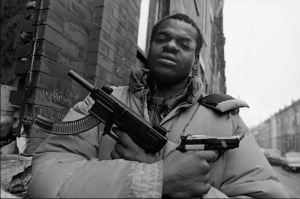
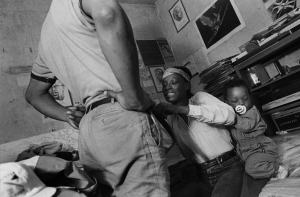
It is fair to say that upon it’s release, Eugene Richards’ ‘Cocaine True, Cocaine Blue’ had a mixed reception from both the public and critics. Richards’ depiction of a predominantly black, poor, deprived community was seen by some to ignore the bigger issue of drug use in 90’s America, which was not exclusive to any class, or race.
Those who argued that Richards’ portrayal was biased, and that he was using sensationalism to sell photojournalism cited Richards’ use of cocaine as well as the fact that he had reportedly provided one subject with clean syringes as reason to doubt the validity of the images.
The arguments of bias, drug use and sensationalism in ‘Cocaine True, Cocaine Blue’ are best represented in two NY Times articles, along with both a letter from Richards to the article author, and one in reply to Richards.
Links to these articles and letters can be seen below, along with select quotes from each piece of text
‘Like most of his kind, Mr. Richards is a voyeur, obsessed with the grisly. He is a master of the brutal image, though his is a cold, distant brutality that whispers instead of shouting.’
‘Take note of the needle; it could well be one of those that Mr. Richards says he bought Mariella because the ones she owned were too dull for proper use. Note also that Mr. Richards smoked his share of crack to get a feel for the subject.’
‘Reading and looking, I couldn’t help wonder: why are nearly all of the people in these photographs black? The vast majority of drug addicts in America are white. This could be said of any phenomenon in the United States, of course, but why is the white aspect of drug addiction so consistently invisible?’
‘when I had completed my photographs, I delivered disposable syringes from a diabetic friend to Mariella. I did so after witnessing her jamming a bent needle first into her arm, then her neck. I knew that this woman I cared for would soon be using the syringes of others in that AIDS-plagued neighborhood.’
‘I did indeed reveal to Richard B. Woodward, the author of that article, that I had tried crack back in 1986, long before working on “Cocaine True Cocaine Blue,” but never again.’
‘Look, “Cocaine True Cocaine Blue” is quite obviously not a treatise on all drugs and drug users in America. It is not about a monthly snort of coke or casual marijuana use. From cover picture and title to the final paragraph, it is concerned with family- and neighborhood-destroying, racism-engendering, hard-core cocaine addiction.’
Staples to Richards
At the end of Eugene Richards letter to Staples, you can find Staples’ response
‘I share Mr. Richards’ horror at the drug-related carnage in our streets. But he misstates the case when he says I accused him of “bias.” My review contained no such accusation; I worked especially hard to avoid that.’
‘I regret causing Eugene Richards the anguish and ill feeling represented in his letter. I respect his photographic eye and his considerable skills as a journalist. As my review said: “His works cannot be called picture books. He arranges his images to make what amount to visual novels, which he augments with pungent stretches of reflection, dialogue or description.”’
‘Mr. Richards presents his powerful study with the impassioned anger of a biblical prophet. Many of his pictures seem intended to shock his audience out of any complacency it may feel about the scope or severity of the drug plague.’
‘But the real problem with Mr. Richards’s project is not the story it tells, but the ones it doesn’t tell. The pictures fit within the traditional functions of photojournalism, in which photographers, as surrogates for a middle-class audience, look at the problems of the poor.’
‘That may be too much to ask from any group of photographs. And despite the project’s limited scope, Mr. Richards’s pictures throw a harsh light on a world that is usually hidden from public view and give voices and faces to some people trapped there.’
The arguments raised by these articles is just as prevalent with the role photojournalism plays in today’s fast paced, seen-it-all-before media audience. If you have anything to add to this discussion of Richards work, or the modern equivalents, drop us an email or leave a comment below.
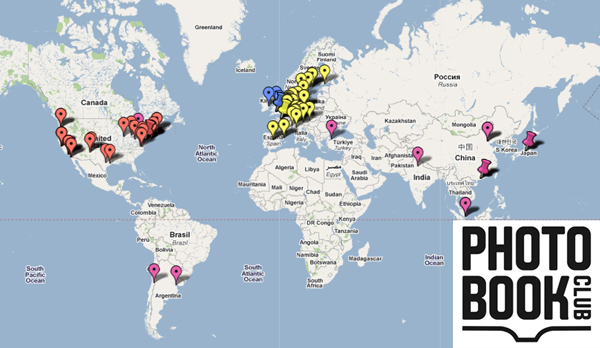
Since then we have received hundreds of suggestions creating a map that currently comprises over 110 of the best stores, galleries and museum bookshops to browse and by photobooks and zines.
The Photo Book Club World Map
A huge thank you to all who have emailed, tweeted and posted their suggestions to this crowd-sourced resource as well as the PDN, Conscientious, Hey Mammoth and FlakPhotowho mentioned the project to their own followers. It was also great being able to utilise Andy Adams’Flak Photo Network for the first time to get feedback from a 1700+ strong group of engaging photographers, educators and writers. To be able to tap into such a valuable community resulted in a much more complete picture of photobook stores around the world.
As mentioned above, the map currently stands at over 110 stores, but i’m sure there are many more: so please keep sending suggestions via email, twitter or in the comments section and they shall be added with a credit.
I have color coded stores in different parts of the world as well as using pins to represent highly concentrated areas, if you have any ideas on how we can improve usability – just let me know.
Now all that is left is for someone generous to send me on a world tour – stopping off at each store and buying a different photobook! I’ll even buy the books myself.
‘Observations’ doesn’t have the lineage of Frank’s ‘The Americans’, but we had some very positive feedback on including other books by Robert Frank and so have compiled the following resource for Richard Avedon:
Were still looking Richard Avedon’s ‘Observations’ throughout April but a heads up:
Next month for the first user suggested month, we will be looking at Eugene Richards ‘Cocaine True, Cocaine Blue’ put forward by Jags Parbha.
Do you have a copy?
More to follow at the beginning of May
Eugene Richards
Cocaine True, Cocaine Blue
Text from publisher Aperture books
This is a compelling portrait of three communities blighted by drugs and isolation: East New York, North Philadelphia, and the Red Hook housing projects in Brooklyn, New York. With a chilling and informative afterword by Dr. Stephen W. Nicholas, a pediatric AIDS physician in Harlem, Cocaine True, Cocaine Blue reveals how first steps toward solutions to overcome the drug trade have actually contributed to public denial and further isolation of the trapped communities. Cocaine True, Cocaine Blue is a history of our times, a terrifying document that will educate us and promote dialogue.
“Eugene Richards’s wrenching photographic study of the culture of cocaine in three inner-city neighborhoods gives faces to some of the victims of addiction. It provides a shocking and heartrending picture of the damage inflicted by the drug.”
–Charles Hagen, The New York Times
“Eugene Richards’s seventh book, Cocaine True, Cocaine Blue, reaffirms his position as the premier chronicler of the dark side of American life ˜ he is the true heir to the mantle of the legendary W. Eugene Smith.”