‘The Valley’ is not that easily accessible, hence our low-fi cover to cover video of the book. But another option for those looking for an introduction to Sultan’s work could consider the recent Steidl publication ‘Katherine Avenue’. The post below come from Wayne Ford’s fantastic Posterous blog.

Above Mom in Doorway, 1992, from Pictures from Home. (Courtesy of Steidl).
‘The San Fernando Valley is both the place where Larry Sultan (1946-2009) spent his childhood and the notional central point of reference of his artistic work,’ says Martin German in his introduction to Katherine Avenue, ‘In the three groups of works he produced between 1984 and 2009, namely Pictures from Home, The Valley and Homeland, he interweaves visible and invisible aspects of life there with the landscapes of his personal memories.’
Sultan, one of the most influential American photographers of his generation, studied political sciences before enrolling in a photography course at the San Francisco Art Institute under Robert Heinecken (1932-2006) in the late 1960s, reflecting upon this period German says, ‘This was the time when photography formed a bond with conceptual art, to whose marriage Sultan would soon render significant contributions.’
In 1972, Sultan met Mike Mandel with whom he would collaborate on a series of billboard collages that would continue well into the 1990s, through which the pair explored the ‘documentary value of images.’ In 1975, and over the next two years, Sultan and Mandel began working on Evidence (1977), a now seminal artists book that bought together 59 photographs selected from various governmental, research and scientific archives that were then arranged in a non-narrative sequence, removed from the original context and with no captions, Evidence is a complex and demanding work, ‘Thus Evidence not only alludes to the bureaucratic and scientific rituals that legitimated the daily business of the federal authorities in the period shortly after the Vietnam War, but more importantly also refers to the assumptions we make regarding truth and imagery,’ says German.

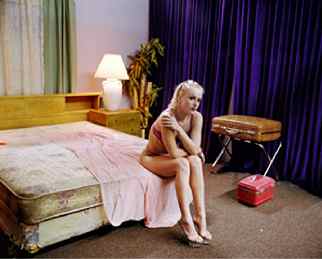
Above Sharon Wild, 2001, from The Valley. (Courtesy of Steidl).
The questions raised by Evidence would inform and influence much of Sultan’s subsequent work, in 1984 he began Pictures from Home (1992), here alongside the photographs of his parents and their daily middle-class routines and rituals, Sultan presents recordings, notes on conversations and stills from family movies along with other memorabilia to investigate the consequences of neo-liberal economic policies.
Reflecting upon his series, Sultan said, ‘I realize that beyond the rolls of film and the few good pictures, the demands of my project and my confusion about its meaning, is the wish to take photography literally. To stop time. I want my parents to live forever.’
In 1999, Sultan was commissioned to document a day in the life of a porn director, whilst known as the home of the American movie industry, the San Fernando valley is also home to the porn industry, were production companies hire private homes for their film shoots, which typically take a few days. This commission turned into The Valley, a series that Sultan worked on until 2003, looking out into the valley, with its upper-middle class tracht homes, Sultan focuses on the periphery of the films sets, presenting the sets and actors as ‘meta-theatre’ says German.
‘While the film crew and “talent” are hard at work in the living room I wander through the rest of the house peering into the lives of the people who suddenly left home. I feel like a forensic photographer searching out evidence in a crime scene. But what is the crime?’

Above Mulholland Drive #2, 2000, from The Valley. (Courtesy of Steidl).
With his final series Homeland, Sultan departs from the domestic exteriors and interiors of the San Fernando Valley, and uses the landscape around San Francisco, where he had lived since the 1970s. In these images Sultan employs day laborers — gardeners, builders and domestic workers — from Central America as actors, photographing them in what he calls ‘marginal spaces and transitional zones invisible to most of us.’ In these images Sultan, directs the ‘men’s actions and gestures while drawing from multiple sources,’ and amalgam of his ‘own childhood wanderings in this landscape as well as interpretations of their experiences as exiles.’

Above Batting Cage, 2007, from Homeland. (Courtesy of Steidl).
Katherine Avenue is published by Steidl.
Follow me on Twitter for frequent updates on the photographic books and exhibitions I am looking at.
– Wayne Ford