Categories
COMMENTS GUEST POST

Personal Reflection: Kate Osba on ‘Cocaine True, Cocaine Blue’

Richards’ ‘Cocaine True, Cocaine Blue’ had a big effect on photo editor Kate Osba, her personal reflection is below.
You can find Richards’ images on his site under Galleries – Cocaine True, Cocaine Blue

Everyone remembers their first love; their first kiss, first rock song that sounded like its lyrics were written just for them. My first love of a photo book happened by chance (or as I have always assumed, fate) in my college library on a late weekend night. It was my second year and I was trying to get through a paper I had no interest in. Avoiding my noisy neighbors I walked around the library floor and found a corner desk with a lone book with a navy protective cover and no title. I brushed the book aside and focused on my blank screen. While inspiration refused to strike, I picked up the sticky book and opened it, thinking nothing of it. I couldn’t believe what I saw. It hit me within seconds – I was looking at something incredible. I couldn’t stop looking, carrying it around in my bag for weeks, pausing randomly throughout the day to focus on one intense page. To this day, as I sit here looking at the images that haunted me for years, I still wonder why it was this book that found me.
©EUGENE RICHARDS

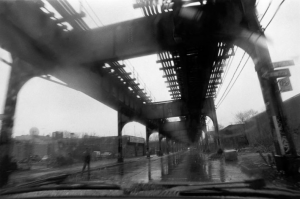
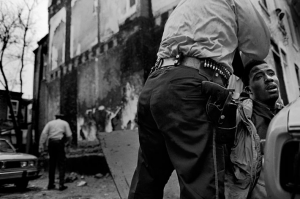
Something about Cocaine True, Cocaine Blue fired me up like nothing else. This man, Eugene Richards, had gone into one of the worst neighborhoods in New York at that time, alone, and documented a world that I had never been able to see. Growing up as a middle-class white girl in Manhattan, I knew there were parts of my city I would never know. This took me somewhere I never wanted to go to, but couldn’t stop looking at. Every shot was so rough, gritty, intense. At the time I thought to be a photojournalist, one needed to travel to a far off country to document war and suffering, I had no idea it could be a subway ride away.  It’s cliche to say, but those pictures are burnt in my mind. If you asked me to name the situation in each frame today, I could do it.

©EUGENE RICHARDS

To say a plastic coated book in a 70’s style library changed my life sounds silly, but it did. The following summer I interned at Magnum, just to be a few steps closer to the eyes that saw these things. On my first day I mentioned to my boss that Eugene Richards was my favorite photographer, and never to let me see him in person because I might literally have a heart-attack. He handed me a yellow envelope and told me I needed to bring this to Gene Richard, with an address, HIS address in my sweaty hand. To say my encounter was awkward is a generous understatement. While Mr. Richards wife told me to wait a few minutes so that I could meet her husband, I immediately told her that I needed to pee and she offered her bathroom. My response was that I couldn’t handle peeing in Eugene Richards bathroom. This might be the first time his wife was ever scared of an intern. Anyway, I met him and it was fine and I managed to not pee on myself, I met him again a few months later and was less awkward – thank you, red wine.
©EUGENE RICHARDS

I still get that feeling when I see someones work that is great, that weight in my heart, unconscious smile – though nothing will ever feel like it did in that library, but that’s okay, that’s what first loves for.

Reluctantly, I threw the address away.

– Kate Osba
– iamthewhat@gmail.com

Categories
BOOKS HISTORY

Controversy: ‘Cocaine True, Cocaine Blue’

It is fair to say that upon it’s release, Eugene Richards’ ‘Cocaine True, Cocaine Blue’ had a mixed reception from both the public and critics. Richards’ depiction of a predominantly black, poor, deprived community was seen by some to ignore the bigger issue of drug use in 90’s America, which was not exclusive to any class, or race.

Those who argued that Richards’ portrayal was biased, and that he was using sensationalism to sell photojournalism cited Richards’ use of cocaine as well as the fact that he had reportedly provided one subject with clean syringes as reason to doubt the validity of the images.

The arguments of bias, drug use and sensationalism in ‘Cocaine True, Cocaine Blue’ are best represented in two NY Times articles, along with both a letter from Richards to the article author, and one in reply to Richards.

Links to these articles and letters can be seen below, along with select quotes from each piece of text

– Matt Johnston

Coke Wars
The original article from the New York Times, By Brent Staples
Published: February 06, 1994

‘Like most of his kind, Mr. Richards is a voyeur, obsessed with the grisly. He is a master of the brutal image, though his is a cold, distant brutality that whispers instead of shouting.’

‘Take note of the needle; it could well be one of those that Mr. Richards says he bought Mariella because the ones she owned were too dull for proper use. Note also that Mr. Richards smoked his share of crack to get a feel for the subject.’

‘Reading and looking, I couldn’t help wonder: why are nearly all of the people in these photographs black? The vast majority of drug addicts in America are white. This could be said of any phenomenon in the United States, of course, but why is the white aspect of drug addiction so consistently invisible?’

©EUGENE RICHARDS

Richards to Staples – Letter to editor
Eugene Richards responds to Staples original article, addressing his use of cocaine, the clean syringes and his choice of subjects to document


‘Brent Staples’s review of “Cocaine True Cocaine Blue” (Feb. 6), my book on hard-core drug addiction, is a continuation of the ancient tradition of trying to kill the bearer of bad news. Mr. Staples’s weapon of choice here is the charge of bias.’

‘when I had completed my photographs, I delivered disposable syringes from a diabetic friend to Mariella. I did so after witnessing her jamming a bent needle first into her arm, then her neck. I knew that this woman I cared for would soon be using the syringes of others in that AIDS-plagued neighborhood.’

‘I did indeed reveal to Richard B. Woodward, the author of that article, that I had tried crack back in 1986, long before working on “Cocaine True Cocaine Blue,” but never again.’

‘Look, “Cocaine True Cocaine Blue” is quite obviously not a treatise on all drugs and drug users in America. It is not about a monthly snort of coke or casual marijuana use. From cover picture and title to the final paragraph, it is concerned with family- and neighborhood-destroying, racism-engendering, hard-core cocaine addiction.’

©EUGENE RICHARDS

Staples to Richards
At the end of Eugene Richards letter to Staples, you can find Staples’ response

‘I share Mr. Richards’ horror at the drug-related carnage in our streets. But he misstates the case when he says I accused him of “bias.” My review contained no such accusation; I worked especially hard to avoid that.’

‘I regret causing Eugene Richards the anguish and ill feeling represented in his letter. I respect his photographic eye and his considerable skills as a journalist. As my review said: “His works cannot be called picture books. He arranges his images to make what amount to visual novels, which he augments with pungent stretches of reflection, dialogue or description.”’

©EUGENE RICHARDS

Review/Photography; ‘Cocaine True’: Art or Sensationalism? By Charles Hagen
Published: March 11, 1994

‘Mr. Richards presents his powerful study with the impassioned anger of a biblical prophet. Many of his pictures seem intended to shock his audience out of any complacency it may feel about the scope or severity of the drug plague.’

‘But the real problem with Mr. Richards’s project is not the story it tells, but the ones it doesn’t tell. The pictures fit within the traditional functions of photojournalism, in which photographers, as surrogates for a middle-class audience, look at the problems of the poor.’

‘That may be too much to ask from any group of photographs. And despite the project’s limited scope, Mr. Richards’s pictures throw a harsh light on a world that is usually hidden from public view and give voices and faces to some people trapped there.’

©EUGENE RICHARDS

The arguments raised by these articles is just as prevalent with the role photojournalism plays in today’s fast paced, seen-it-all-before media audience. If you have anything to add to this discussion of Richards work, or the modern equivalents, drop us an email or leave a comment below.


– Matt Johnston