The following is a personal reflection from Wayne Ford on his first viewing of Cafe Lehmitz, if you have a reflection you would like to add, then do so in the comments below or email mail@photobookclub.org
I first came across Café Lehmitz in the mid-1980s, browsing the secondhand bookshelves of a local bookstore, there amongst the how to books, and pretty landscapes of the photography section, I came across this book full of raw and gritty black-and-white images that bought to mind the work of Japanese photographer Daido Moriyama, an artist I had only just discovered and whose work I had fallen in love with.
At that point I had never heard of Anders Petersen, was he an immensely important artist or a complete unknown, these where questions I would ask later, searching out the answers. But what I did know then, as I held the book in my hands, was that he was important to me famous or not, in his work I found an energy that I had rarely encountered before, and energy that I immediately found a connection with.
To me, There is something out of sorts about the scenes in Larry Sultan’s ‘The Valley’. And it is not the naked house guests or their crew members that are lighting, filming, resting, and sweating around the porn scenes.
Instead it is the homes and artifacts within them that seem out of place. The choice of art hanging on the wall and furnishings dressing the home all come under a new scrutiny when juxtaposed with the writhing bodies of many fantasies now occupying ‘family spaces’. I wonder, like Sultan, whether the real fantasy taking place here is that of the perfect American home. Each one we enter has a similar, slightly sterile feel. We see the pools, gazebos, patios, large sofas and TV’s that appear on the quintessential ‘dream home checklist’ but not much else.
The addition of fictitious backdrops in gardens and living rooms creates a feeling that the each house is just part of an elaborate set for the filming of real-life.
The personality Sultan does show us of these homes seems tired, the girls bedroom with neglected dolls now sitting on a shelf, a drum kit gathering dust and a bed with no sheets that has certainly seen better days. It is these rooms, kept out of view of the directors camera but picked up by Sultan’s that offer a melancholy feel to the viewing experience of the book. It reminds us of all the dreams and items once cherished as well as that which would be deemed unpleasant to others that are now gathering dust, or else pushed aside from the gaze of any possible visitors in so many homes.
These are not the locations chosen by the director, and neither are they chosen to be displayed by the home owner. Both the director and home owner want to show the same thing, a representation of success, and of a fantasy, but without any personal effects or clutter that would tarnish the ‘scene’.
Chris Timothy is a photographer and teacher from England, he runs the 21 Rue De La Hachette blog which is well worth a follow. He got in touch to add thoughts on Larry Sultan’s ‘The Valley’ with reference to key images. If you do not have access to the book make sure you check out our video from cover to cover.
Chris Timothy on Larry Sultan’s ‘The Valley’
Larry Sultans work entitled “The Valley” documents the filming of pornographic movies in his hometown of San Fernando Valley in Southern California. The Valley is an average middle class area, where homes cater for the needs of dentists, lawyers and strangely enough porn stars. These wonderful homes are rented out to the porn industry for live scenes to be captured in an aspirational setting. The strategy that ensures the body of works identity is different to that in which it is documenting is its main angle of concentration on location rather than the actors or actresses being sexualised or objectified. Sultan’s images explore the issues surrounding the questions; why would the owners of these middle class homes rent them to the industry, why does the industry want them? And maybe most importantly what are the consequences?
Why would the owners of these middle class homes rent them to the industry? Is it a sense of self-indulgence on the owner’s part or is it simply a method of further financial gain, which helps with the continuity of the middle class lifestyle? I believe it is the later. To rent out your home to the porn industry is a big moral decision and to do so is a clear indication of where you stand on the issue. However Sultan’s work discretely highlights maybe this moral decision is simply ignored and the homes are being rented out without too much thought to what the consequences may actually be. Sultan’s images show family portraits and personal photographs of the homeowners, their friends and their families, left on shelves and cabinet tops. These photographs are being captured in the background of sexual scenes and taken into the industry. While the viewers are consuming sexual media texts the home owners family and friends are on full view. Is this conscious choice of Sultan to show this demonstrating the loss of morality and care for others when a high amount of money is involved.
So why does the industry want these homes? The choice of location has been made by the production companies to satisfy the needs of the consumers of the films. Remember, the sole aim of these films are to excite the viewer, so the combination of sexual gratification and aspirational images and locations will help the audiences purpose of consumption be met. To set scenes in houses, which most are not able to afford adds to the fantasy aspect for consumers and maybe most importantly adds to the escapism. Sultan’s choice of mis en scene within some of his images demonstrates this.
There is a definite juxtaposition between the property owners and the porn stars. One of Sultan’s images will focus on the pleasure and excitement of being a porn star and the next, the banality of sitting, sleeping and generally waiting around on set. This drastic change of emotion could be compared to that stereotypical view of a superficial consumer lifestyle held by the middle class. One minute you are filled with excited with a purchase that most would not be able to afford, the next this excitement has worn off. You find yourself sitting in your museum of expensive purchases with the realisation that boredom has set in due to a lack of motivation and purpose of a lifestyle where there is no need to work towards anything, success has already been achieved.
Tasha's Third Film, 1998
Although Sultan states this work is not focused on the stars of the porn industry, after the audience views the images, most cant help but question why the actors and actresses take part in the industry. Do they perform due to a sense of aspiration and a desire to gain financial clout from a profession that is relatively high paid? Are the actors motivated by and aspire to be the very people who are renting their homes to the industry in which they work? So what are the consequences of the middle class renting out their home to the porn industry? Well, that is a matter of opinion dictated to you by your own moral standing. But what “The Valley” does clearly demonstrate is the porn industry and the films it creates are becoming more and more integrated in every day life and society in the western world.
The Valley is my favourite photobook. It’s the one I wish I had made. As a European, San Fernando Valley is pretty much my idea of the American dream. Equal opportunities in jizzneyland. I think the first image I ever saw from the book was the one with the lady in the killer heels, and the dogs following here. I was hooked. Then I read the essay and was blown away. It was so vivid, I could feel the Cali sun (and the dried cum too). The pictures themselves are so subtle and quiet, businesslike even. At the same time, they’re more cinematic than any porno I’ve ever seen. Porn is all about putting the viewer in the film, but Sultan manages to both be really present, and seemingly invisible at the same time. I still don’t understand how he made some of his shots. Sultan was there, and from first page to last. No book has thinner pages. There have been many books about porn and the performers, but The Valley will always be my American dream.
Everyone remembers their first love; their first kiss, first rock song that sounded like its lyrics were written just for them. My first love of a photo book happened by chance (or as I have always assumed, fate) in my college library on a late weekend night. It was my second year and I was trying to get through a paper I had no interest in. Avoiding my noisy neighbors I walked around the library floor and found a corner desk with a lone book with a navy protective cover and no title. I brushed the book aside and focused on my blank screen. While inspiration refused to strike, I picked up the sticky book and opened it, thinking nothing of it. I couldn’t believe what I saw. It hit me within seconds – I was looking at something incredible. I couldn’t stop looking, carrying it around in my bag for weeks, pausing randomly throughout the day to focus on one intense page. To this day, as I sit here looking at the images that haunted me for years, I still wonder why it was this book that found me.
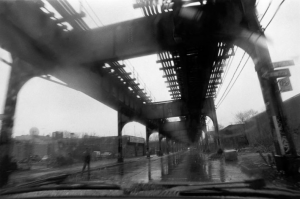
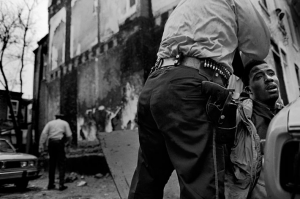
Something about Cocaine True, Cocaine Blue fired me up like nothing else. This man, Eugene Richards, had gone into one of the worst neighborhoods in New York at that time, alone, and documented a world that I had never been able to see. Growing up as a middle-class white girl in Manhattan, I knew there were parts of my city I would never know. This took me somewhere I never wanted to go to, but couldn’t stop looking at. Every shot was so rough, gritty, intense. At the time I thought to be a photojournalist, one needed to travel to a far off country to document war and suffering, I had no idea it could be a subway ride away. It’s cliche to say, but those pictures are burnt in my mind. If you asked me to name the situation in each frame today, I could do it.
To say a plastic coated book in a 70’s style library changed my life sounds silly, but it did. The following summer I interned at Magnum, just to be a few steps closer to the eyes that saw these things. On my first day I mentioned to my boss that Eugene Richards was my favorite photographer, and never to let me see him in person because I might literally have a heart-attack. He handed me a yellow envelope and told me I needed to bring this to Gene Richard, with an address, HIS address in my sweaty hand. To say my encounter was awkward is a generous understatement. While Mr. Richards wife told me to wait a few minutes so that I could meet her husband, I immediately told her that I needed to pee and she offered her bathroom. My response was that I couldn’t handle peeing in Eugene Richards bathroom. This might be the first time his wife was ever scared of an intern. Anyway, I met him and it was fine and I managed to not pee on myself, I met him again a few months later and was less awkward – thank you, red wine.
I still get that feeling when I see someones work that is great, that weight in my heart, unconscious smile – though nothing will ever feel like it did in that library, but that’s okay, that’s what first loves for.
When published in 1994, Cocaine True, Cocaine Blue was perhaps the last great photographic shock documentary, and brought with it considerable controversy for depicting a certain segment of society in such a negative, nihilistic manner. My younger self very much believed in the power of those raw, stark, in your face images- believed they were exactly what was needed to expose the crack and heroin scourge that was consuming inner cities across the country, and ultimately help reform a national drug policy long bereft of any possible rehabilitative or positive consequence.
In the interim, photojournalism has struggled to redefine and reestablish itself in a declining market, and reinvent itself in a new medium, via new technology. And yet the problem remains- critics clamoring for a new visual paradigm in photographic story telling, particularly, a new vision of depicting tragedy, hardship and conflict in a way that can command and engage our attention with those we may not encounter in our everyday lives. No short order in these austere and somber economic times when so many of us are simply striving to survive- or escape.
Eugene Richards never struck me as the kind of man, or photographer, who was strictly out to shock. The images in Cocaine True, Cocaine Blue have an almost apocalyptic sense of urgency in their madness and desperation, and as only a master photographer can envision and present, many of those same images are also maddeningly beautiful, not unlike the “darker” masterpieces of the Renaissance. His photographs seemed hell bent on rattling you to the very core, so that even if you turned away, they would still unnerve you, haunt you, have at you until you finally removed yourself from your comfort zone and entered their twisted netherworld of existence- the very madness addiction demands.
Obviously, I can’t speak for him, but I don’t think it would be the kind of book Mr. Richards would do today. If anything, his current work is more reflective, more contemplative. The Blue Room meticulously examines the domestic remains of those forced to abandon their points of origin, and his recent work with disabled vets, while containing many an unsettling and disturbing image, portrays subjects who could well be family members, neighbors, friends. We get to feel the main players out, get to know their stories, their lives- before, and after.
Although the characters get to speak out in Cocaine True, Cocaine Blue, their voices are lost within the insanity that overwhelms their lives and the numerous black and white enlargements that predominate the book itself. Powerful and significant as it was, perhaps that was the one key and vital ingredient that Cocaine True, Cocaine Blue so woefully lacked- we never connected with the individuals depicted, in fact, it was hard to even think of them as individuals! They were ghosts of former selves not even they would fully recognize, beings seemingly beyond redemption, beyond human connection, and well beyond our empathy…
I’m generally sympathetic to Brent Staple’s critique of “Cocaine True, Cocaine Blue” (now, as I was in 1994). He’s right to insist that the book can’t be properly evaluated without situating it within a society and culture that has been shaped, consciously and unconsciously, by racist ideologies and practices. It does seem to me, however, that the general thrust of his argument misses the most essential point.
Yes, it’s a problem that the faces in the book are overwhelmingly black and brown, although the cocaine problem — contra Richard’s self-defense — wasn’t confined to African-American and Latino communities. Drug use by whites may have been hidden — harder to see and to photograph because of the defenses that social class and racial privilege can erect — but it was a major element in the crisis of the mid-90s. Richards (and the writer Edward Barnes, with whom he worked) certainly should have foregrounded this fact. Not to do so was to reinforce ever-prevalent racist stereotypes about who uses illegal drugs and who doesn’t.
Staples alludes to, but does not develop, a much more important critique when he says that “Photographs can shock and dismay, but are useless to explain such complicated matters as economic decline [which underpinned the demand for drugs].” This is the heart of the matter.
Photographs, as every theorist and most photographers will tell you, are very good at showing us how things look, but very bad at explaining why they look that way. Documentary work, however, must be as much about the “why” as the “how.” Pretty pictures, scorching pictures, gut-wrenching pictures aren’t enough. Context and analysis are just as important. And this is where Richards fails utterly. Or, perhaps, “fails” is the wrong word. He doesn’t even try.
I’m tempted to say that it was rashly irresponsible for Richards to have published the book without attempting to explain the crisis he captured in his images. This was not, after all, an exercise in fine art photography. It’s documentary, and its purpose is to help us to understand the world in which we live.
Instead, I fear, many readers came (and come) away knowing less about the drug crisis, rather than more. In the absence of analysis and explanation from Richards, many people would have fallen back on ideas already circulating in the culture. A great many — not all — of those notions would have been deeply racist.
It’s not so much that Richards’ images are decontextualized, it’s that their context would too often have been America’s reflexively racist culture, rather than its history and political-economy. As a result, the photos reinforce, rather than undermine, stereotypes of black and Latino depravity and criminality.
As the end of the month draws near, I think it is also worth reflecting further on the creative and personal connections between Avedon and Robert Frank. As Wayne mentions, and as best narrated in Jane Livingstone’s book on the New York School, Avedon and Frank both worked for and studied with Brodovitch in the 1940s and 50s, although Avedon certainly had a closer relationship with the mentor.
As I was working on my dissertation, I spent a lot of time paging through old bound issues of Harper’s Bazaar in my university library, and I found a lot of product still lifes and other commercially motivated images bylined to Frank.
But I think it is most interesting to consider the relationship between The Americans and Avedon’s In The American West. Although the approach to photography of the two books could hardly be more visually distinct, I believe that Avedon set out to put his own mark on the kind of photographic grand tour that Frank originally perfected.
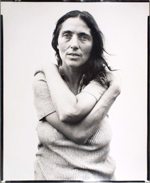
Both explored the west and sought to tell its story. And both told a controversial story of the failure of American ideals. Both were criticized for the perceived ugliness of their vision. Avedon photographed Frank and his wife (June Leaf, in what I think is a hidden gem among Avedon’s white background portraits) in the late 70s, and I suspect that their encounter was fresh on Avedon’s mind when he set out on his Western project.
Erik Palmer, creative director of Vico Collective and teacher of communication theory at Portland State, offered this great comment to Wayne Ford’s synopsis yesterday that we thought was deserving of it’s own post.
I own a battered copy of Observations, but had not looked at it in a couple of years. So, coming to it with fresh eyes, I think the first thing about the book, which we mostly take for granted, with our contemporary sensibility, is its very magazine-like architecture.
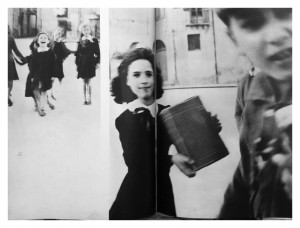
Viewing Observations from 2011, it’s hard to see how provocative it must have been to try to synthesize pop culture and high culture in a formal publication like a book, and in the way that Avedon and Alexey Brodovitch attempted here. Unlike a whole, unified, complete book, we have the joining of a number of not obviously related chapters, like magazine features: The Actors, The Singers, The Swans, The Couples, and so on. And then we have an even greater stylistic and thematic jump to Italy popped into the middle of this book.
I don’t find the approach completely satisfying or successful. By comparison, I much prefer later Avedon books where he pursued a consistent formal approach, including the American West and Richard Avedon Portraits. These are the books where Avedon most clearly and successfully gives us what I want from him: the sense of confrontation that defined his white background portraiture.
Another important formal element that we see in Observations is the development of Avedon’s strategies of montage: his use of two images on facing pages to make implied claims of similarity or difference between the people pictured. Again, it seems obvious to our 21st-century media-saturated eyes that we should do this as photographic designers, but look for comparison at the techniques of sequencing and montage in The Americans.
Avedon’s pictures speak to each other and create higher orders of metaphorical meaning in a way distinct from Frank’s sequencing. Consider, for example, page 146, where Avedon joins photographs of Robert Oppenheimer and Martin Darcy in a similar stance, and that helps to inspire Capote’s analysis of appearance and virtue.
Erik Palmer
If you would like to write a guest post on the Photo Book Club, please contact mail@photobookclub.org