Categories
COMMENTS GUEST POST

Personal Reflection: Kate Osba on ‘Cocaine True, Cocaine Blue’

Richards’ ‘Cocaine True, Cocaine Blue’ had a big effect on photo editor Kate Osba, her personal reflection is below.
You can find Richards’ images on his site under Galleries – Cocaine True, Cocaine Blue

Everyone remembers their first love; their first kiss, first rock song that sounded like its lyrics were written just for them. My first love of a photo book happened by chance (or as I have always assumed, fate) in my college library on a late weekend night. It was my second year and I was trying to get through a paper I had no interest in. Avoiding my noisy neighbors I walked around the library floor and found a corner desk with a lone book with a navy protective cover and no title. I brushed the book aside and focused on my blank screen. While inspiration refused to strike, I picked up the sticky book and opened it, thinking nothing of it. I couldn’t believe what I saw. It hit me within seconds – I was looking at something incredible. I couldn’t stop looking, carrying it around in my bag for weeks, pausing randomly throughout the day to focus on one intense page. To this day, as I sit here looking at the images that haunted me for years, I still wonder why it was this book that found me.
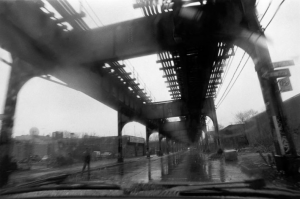
©EUGENE RICHARDS

Something about Cocaine True, Cocaine Blue fired me up like nothing else. This man, Eugene Richards, had gone into one of the worst neighborhoods in New York at that time, alone, and documented a world that I had never been able to see. Growing up as a middle-class white girl in Manhattan, I knew there were parts of my city I would never know. This took me somewhere I never wanted to go to, but couldn’t stop looking at. Every shot was so rough, gritty, intense. At the time I thought to be a photojournalist, one needed to travel to a far off country to document war and suffering, I had no idea it could be a subway ride away.  It’s cliche to say, but those pictures are burnt in my mind. If you asked me to name the situation in each frame today, I could do it.

©EUGENE RICHARDS

To say a plastic coated book in a 70’s style library changed my life sounds silly, but it did. The following summer I interned at Magnum, just to be a few steps closer to the eyes that saw these things. On my first day I mentioned to my boss that Eugene Richards was my favorite photographer, and never to let me see him in person because I might literally have a heart-attack. He handed me a yellow envelope and told me I needed to bring this to Gene Richard, with an address, HIS address in my sweaty hand. To say my encounter was awkward is a generous understatement. While Mr. Richards wife told me to wait a few minutes so that I could meet her husband, I immediately told her that I needed to pee and she offered her bathroom. My response was that I couldn’t handle peeing in Eugene Richards bathroom. This might be the first time his wife was ever scared of an intern. Anyway, I met him and it was fine and I managed to not pee on myself, I met him again a few months later and was less awkward – thank you, red wine.
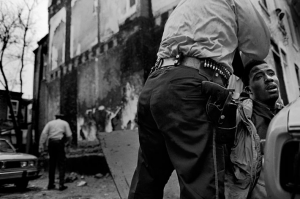
©EUGENE RICHARDS

I still get that feeling when I see someones work that is great, that weight in my heart, unconscious smile – though nothing will ever feel like it did in that library, but that’s okay, that’s what first loves for.

Reluctantly, I threw the address away.

– Kate Osba
– iamthewhat@gmail.com

Categories
COMMENTS GUEST POST

Stan Banos on ‘Cocaine True, Cocaine Blue’

Stan Banos of the fantastic Reciprocity Failure blog submitted the following piece on Richard’s ‘Cocaine True, Cocaine Blue’.

When published in 1994, Cocaine True, Cocaine Blue was perhaps the last great photographic shock documentary, and brought with it considerable controversy for depicting a certain segment of society in such a negative, nihilistic manner. My younger self very much believed in the power of those raw, stark, in your face images- believed they were exactly what was needed to expose the crack and heroin scourge that was consuming inner cities across the country, and ultimately help reform a national drug policy long bereft of any possible rehabilitative or positive consequence.

And, of course… nothing happened.

©EUGENE RICHARDS

In the interim, photojournalism has struggled to redefine and reestablish itself in a declining market, and reinvent itself in a new medium, via new technology. And yet the problem remains- critics clamoring for a new visual paradigm in photographic story telling, particularly, a new vision of depicting tragedy, hardship and conflict in a way that can command and engage our attention with those we may not encounter in our everyday lives. No short order in these austere and somber economic times when so many of us are simply striving to survive- or escape.

©EUGENE RICHARDS

Eugene Richards never struck me as the kind of man, or photographer, who was strictly out to shock. The images in Cocaine True, Cocaine Blue have an almost apocalyptic sense of urgency in their madness and desperation, and as only a master photographer can envision and present, many of those same images are also maddeningly beautiful, not unlike the “darker” masterpieces of the Renaissance. His photographs seemed hell bent on rattling you to the very core, so that even if you turned away, they would still unnerve you, haunt you, have at you until you finally removed yourself from your comfort zone and entered their twisted netherworld of existence- the very madness addiction demands.

Obviously, I can’t speak for him, but I don’t think it would be the kind of book Mr. Richards would do today. If anything, his current work is more reflective, more contemplative. The Blue Room  meticulously examines the domestic remains of those forced to abandon their points of origin, and his recent work with disabled vets, while containing many an unsettling and disturbing image, portrays subjects who could well be family members, neighbors, friends. We get to feel the main players out, get to know their stories, their lives- before, and after.

©EUGENE RICHARDS

Although the characters get to speak out in Cocaine True, Cocaine Blue, their voices are lost within the insanity that overwhelms their lives and the numerous black and white enlargements that predominate the book itself. Powerful and significant as it was, perhaps that was the one key and vital ingredient that Cocaine True, Cocaine Blue so woefully lacked- we never connected with the individuals depicted, in fact, it was hard to even think of them as individuals! They were ghosts of former selves not even they would fully recognize, beings seemingly beyond redemption, beyond human connection, and well beyond our empathy…

– Stan Banos

Categories
BOOKS COMMENTS HISTORY

John Edwin Mason on ‘Coke and Controversy’

The following is John Edwin Mason’s response to the post ‘Controversy: Cocaine True, Cocaine Blue’

I’m generally sympathetic to Brent Staple’s critique of “Cocaine True, Cocaine Blue” (now, as I was in 1994). He’s right to insist that the book can’t be properly evaluated without situating it within a society and culture that has been shaped, consciously and unconsciously, by racist ideologies and practices. It does seem to me, however, that the general thrust of his argument misses the most essential point.

Yes, it’s a problem that the faces in the book are overwhelmingly black and brown, although the cocaine problem — contra Richard’s self-defense — wasn’t confined to African-American and Latino communities. Drug use by whites may have been hidden — harder to see and to photograph because of the defenses that social class and racial privilege can erect — but it was a major element in the crisis of the mid-90s. Richards (and the writer Edward Barnes, with whom he worked) certainly should have foregrounded this fact. Not to do so was to reinforce ever-prevalent racist stereotypes about who uses illegal drugs and who doesn’t.

©EUGENE RICHARDS

Staples alludes to, but does not develop, a much more important critique when he says that “Photographs can shock and dismay, but are useless to explain such complicated matters as economic decline [which underpinned the demand for drugs].” This is the heart of the matter.

Photographs, as every theorist and most photographers will tell you, are very good at showing us how things look, but very bad at explaining why they look that way. Documentary work, however, must be as much about the “why” as the “how.” Pretty pictures, scorching pictures, gut-wrenching pictures aren’t enough. Context and analysis are just as important. And this is where Richards fails utterly. Or, perhaps, “fails” is the wrong word. He doesn’t even try.

I’m tempted to say that it was rashly irresponsible for Richards to have published the book without attempting to explain the crisis he captured in his images. This was not, after all, an exercise in fine art photography. It’s documentary, and its purpose is to help us to understand the world in which we live.

©EUGENE RICHARDS

Instead, I fear, many readers came (and come) away knowing less about the drug crisis, rather than more. In the absence of analysis and explanation from Richards, many people would have fallen back on ideas already circulating in the culture. A great many — not all — of those notions would have been deeply racist.

It’s not so much that Richards’ images are decontextualized, it’s that their context would too often have been America’s reflexively racist culture, rather than its history and political-economy. As a result, the photos reinforce, rather than undermine, stereotypes of black and Latino depravity and criminality.

– John Edwin Mason

Categories
SYNOPSIS

Synopsis: Eugene Richards – Cocaine True, Cocaine Blue

Title
Cocaine True, Cocaine Blue

Author
Eugene Richards

Publisher
Aperture, 1994 (Hardback)
Aperture, 1994 (Paperback)


Overview

Writing in the afterword to ʻCocaine True, Cocaine Blue,ʼ Dr. Stephen W. Nicholas writes,
ʻThe United States accounts for five percent of the worldʼs population and consumes 50
percent of the worldʼs cocaine,ʼ with approximately one million American teenagers and
young adults using cocaine for the first time each year, and the rate of cocaine-associated
physical, sociological, or family-related problems doubling nationwide since 1985.

In this powerful and raw book, Eugene Richards takes an in-depth and very intimate look
at the inhabitants of three troubled communities: East New York; North Philadelphia; and
the Red Hook Housing Project in Brooklyn, New York.

Alongside the bold and often graphic black-and-white images, are Richardsʼ own personal
observations and interviews, with additional comment by journalist Edward Barnes. These
interviews, with gang members, addicts, dealers, parents, children, the elderly, sex
workers, police, and the clergy. In one such observation Richards writes, ʻThere were 107
murders, 145 rapes, 3,285 robberies, and 547 felonious assaults in East New York in one
year, in a population of 160,000… This is how we first learn about Americaʼs troubled inner-
city neighborhoods, reading the most elemental and squalid statistics, the lists of atrocities
and casualties, the body counts that are no different from those posted during war.ʼ

In ʻCocaine True, Cocaine Blueʼ Richardsʼ offers a powerful insight, and alerts us to how
drugs can affect the very fabric of our society.

– Wayne Ford

Categories
Uncategorized

#fromthelibrary 3 – Paul Graham on the shelves at CU_Photography

Students from Coventry University will be visiting the Paul Graham exhibition at the Whitechapel Gallery, London next week. And so it seemed appropriate to add a bonus #fromthelibrary – highlighting the Paul Graham books on the shelf in the library.

It was great to find rare, original copies of Graham’s earlier books – ‘A1 The Great North Road’, ‘Beyond Caring’ and ‘Troubled Land’, along with ‘New Europe’, and the Phaidon ‘Contemporary Artists monograph’ offering a look at work between 1981 – 1996.

All books are now back on the library shelves for the students to discover before our visit.

– Matt Johnston

A1 The Great North Road, 1983
Paul Graham

Lorry Driver, Beacon Services, South Mimms, Hertfordshire, May 1982 ©PAUL GRAHAM

Images Online: http://www.paulgrahamarchive.com/a1.html
Here, in Graham’s first publication, he documents both the physical landscape and people that inhabit the roadside service stations, rest-stops and motels of the Great North Road in order to ‘weave a picture of England in the 1980’s’.

Beyond Caring, 1986
Paul Graham

Horse Poster, DHSS Office, Bristol, 1984 ©PAUL GRAHAM


Images online
: http://www.paulgrahamarchive.com/beyondcaring.html#a
‘Beyond Caring’ chronicles the state of employment in 80’s Britain through images made in the waiting rooms, corridors and cubicles of the department of social security and department of employment.

Trouble Land, The social landscape of Northern Ireland, 1987
Paul Graham

Graffiti, Ballysillan Estate, Belfast, 1986 ©PAUL GRAHAM

Images Online: http://www.paulgrahamarchive.com/troubledland.html
Troubled Land was Graham’s last book produced in the 80’s and followed the style of the two previous publications via ‘Grey Editions’. This time examining the subtle relationship between the landscape of Northern Ireland and the ‘troubles of its society’.

New Europe, 1993
Paul Graham

Page 1, New Europe ©PAUL GRAHAM

Images Online: http://www.paulgrahamarchive.com/neweurope.html
‘New Europe seeks to dig beneath the utopian dream of a united continent arising to face the 21st century. Paul Graham’s photographs reflect on the inescapable shadow of history that falls over each nation’s conscience, from the dictatorships of Franco and Hitler, to the Holocaust and the Irish conflict.’ (From back cover of ‘New Europe’)


Paul Graham Contemporary Artists monograph, Phaidon Press, 1996
Paul Graham, Phaidon

Phaidon - Paul Graham 1981-1996

This book features a collection of Graham’s images, along with essays and an interview to provide a solid overview of his work up to 1996. The extensive interview with Gillian Wearing, is alone worth the read and to find a conversation with the great Lewis Baltz at the end of the book is a great treat.

Categories
GUEST POST HISTORY

Robert Frank and Hugh Edwards correspondance

The following was added by William Allen, highlighting the correspondence between Robert Frank and Hugh Edwards following ‘The Americans’ (Curator of Prints, Drawing, and Photographs at the Art Institute of Chicago)

Robert Frank:

“It seems I made these photographs. I’m happy that they mean so much to you.”

“N.Y.C. May 1969 For Hugh Edwards  First with gratitude and respect to help + encourage when it mattered (1958) and now with regrets not to see in print your thoughts long before they became fashionable Your friend Robert.”

Those are inscriptions/dedications in The Americans, from Robert Frank to Hugh Edwards. Edwards was the Curator of Prints, Drawing, and Photographs at the Art Institute of Chicago. He gave quiet but effective support to emerging photographers, including Robert Frank. As Randy Kennedy put in the Times, Edwards was “a pioneering but still underappreciated curator.”

Frank had his first one-person show in a major venue at the Art Institute of Chicago in 1961. That was Robert Frank: Photographer and Hugh Edwards arranged the show. Here is the 1960 letter from Edwards inviting Frank to exhibit.

Hugh Edwards:

May 23, 1960
Mr. Robert Frank,
34 Third Avenue,
New York City, New York.

Dear Mr. Frank: It seems so long since I was in New York and talked with you on the telephone that I am afraid you have forgotten the conversations we had in regard to an exhibition. Since I came back to Chicago, I have been very busy and knew you had little time to be bothered with correspondence. However, I have not forgotten that you said you might be interested in a show and my experience with The Americans have been so many since my return that I am writing you at last, still with the hope that we may have an exhibition here.

In the last week I have completed an exhibition schedule so that I am able to give you, if you are still interested, some idea of when the show would take place. How would the period of April 28 through June 11 of next year suit you? I remember you said you would like to have some delay and although these dates-almost a year in the future-may seem distant, the time will pass much faster than we think.

I have had the museum store stock the American edition of your book. They have sold a number of copies and there is steady demand for it. We have both the French and American editions in the print room and they have been enthusiastically received by many young photographers who come here to look at the prints in our collection. This pleases me a great deal because no other book, except Walker Evans’ American Photographs, has given me so much stimulation and reassurance as to what I feel the camera was created for. I hope this does not have too pompous a sound for I feel your work is the most sincere and truthful attention paid to the American people for a long time. Although so different and not stemming from them, it may be kept in the company of Frank Norris, Sherwood Anderson, Hart Crane, Jon Dos Passos and Walker Evans and these are the best in American expression in the time I can remember. It is a real privilege to have known your pictures in their first freshness and newness. Someday they will spread to everyone and even the most sterile and analytical of intellectuals will except them at last.

I should greatly appreciate hearing from you as soon as possible in regard to what you think about the exhibition so that I may put it definitely in the schedule of exhibitions.

I hope to be in New York again, at least in the early fall, and talk with you again. As typewriters and telephones are instruments of inhibition for me, I regret I could not arrange a meeting during those days I was there this spring.

Yours sincerely,
Hugh Edwards, Curator of Photography.

The letter appears at http://bleakbeauty.com/edwards_letters.html . It is the second item, following an appreciation by Danny Lyon.

I want to thank David Travis, retired Head and Curator of the Department
of Photography at The Art Institute of Chicago, for sharing with me his
first-hand knowledge of the inscriptions of Robert Frank to Hugh
Edwards.
– William Allen

Categories
Uncategorized

#fromthelibrary – At Coventry University

The Photo Book Club’s Matt Johnston is currently residing in the Midlands, England, and so making use of the excellent photography section in the Coventry University library. Starting shortly, Matt will be posting some of the books found on the shelves of the library along with a brief synopsis under the headline and hashtag #fromthelibrary. As well as this online post, Matt will be meeting with students and holding informal discussions on these books, and the various books that students will bring to the sessions.

As with everything on the Photo Book Club we would love to get your thoughts and discussion on the books. You can use the hashtag #photobc on Twitter, or use the comments section below this post.

And if you want to see one of the #fromthelibrary books given a thorough look by the Photo Book Club and community, let us know!

Categories
COMMENTS

Erik Palmer on the Frank/Avedon Connection

Erik Palmer, creative director of Vico Collective and teacher of communication theory at Portland State added another great comment, this time to Wayne’s personal observation.

As the end of the month draws near, I think it is also worth reflecting further on the creative and personal connections between Avedon and Robert Frank. As Wayne mentions, and as best narrated in Jane Livingstone’s book on the New York School, Avedon and Frank both worked for and studied with Brodovitch in the 1940s and 50s, although Avedon certainly had a closer relationship with the mentor.

As I was working on my dissertation, I spent a lot of time paging through old bound issues of Harper’s Bazaar in my university library, and I found a lot of product still lifes and other commercially motivated images bylined to Frank.

But I think it is most interesting to consider the relationship between The Americans and Avedon’s In The American West. Although the approach to photography of the two books could hardly be more visually distinct, I believe that Avedon set out to put his own mark on the kind of photographic grand tour that Frank originally perfected.

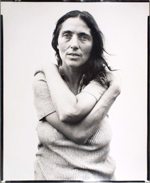
'June Leaf' ©RICHARD AVEDON

Both explored the west and sought to tell its story. And both told a controversial story of the failure of American ideals. Both were criticized for the perceived ugliness of their vision. Avedon photographed Frank and his wife (June Leaf, in what I think is a hidden gem among Avedon’s white background portraits) in the late 70s, and I suspect that their encounter was fresh on Avedon’s mind when he set out on his Western project.

Erik Palmer

Categories
CLOSER LOOK

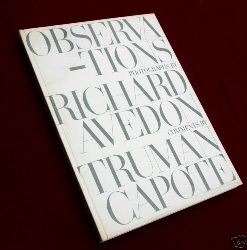
Observations – A Closer Look

At the age of 17, Richard Avedon (1923-2004) joined the merchant marineʼs photographic section in 1940, where he would spend much of his time producing personnel identification photographs, and occasionally document shipwrecks. Following his discharge from service in 1944, Avedon found a job as a photographer in a New York department store, before Alexey Brodovitch — who Avedon had studied under in his Design Laboratory at the New School of Social Research — hired the 22 year-old as a staff photographer at Harperʼs Bazaar in 1945, where he would be the youngest member of the Russian emigres team.

This appointment would mark the beginning of the creative collaboration between the
inspirational art director, who did much to introduce modern graphic design aesthetics, and modernist European photography to the United States, and the photographer, that
culminated in the publication of ʻObservationsʼ in 1959.


One of the characteristicʼs of Brodovitchʼs design style, was his use of white space on the
editorial pages of Harperʼs Bazaar and his other projects, including ʻPortfolio,ʼ and this
influence is seen in Avedonʼs photography when he adopted the seamless white background in his fashion photography, for which he first became known, and latterly his
portrait work to.

Throughout his career, Avedon was a restless chronicler of our time, that led John Lahr to
write in ʻThe Times,ʼ ʻNo one has given a nation a more wide-ranging, disciplined
photographic document of itself,ʼ which is well reflected in the 150 pages that make up
ʻObservationsʼ which includes portraits of Charlie Chaplin, John Huston, Alfred Hitchcock, The Duke and Duchess of Windsor, Arthur Miller, Picasso, Jacques Cousteau, Marilyn Monroe, Mae West, Judy Garland, Igor Stravinsky, Katherine Hepburn, Brigitte Bardot, Gloria Swanson, Louis Armstrong, Humphrey Bogart, Buster Keaton, Georgia OʼKeefe, Frank Lloyd Wright, and Truman Capote, amongst many other key people of the 20th century.

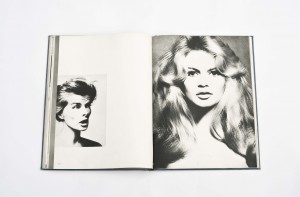
Katherine Hepburn, 1955 and Bridget Bardot, 1959 ©RICHARD AVEDON

A remark made by Avedon in the 1970s reflects this restless nature, ʻIf a day goes by
without my doing something related to photography, itʼs as though Iʼve neglected
something essential to my existence, as though I had forgotten to wake up.ʼ

For a photographer to produce during their career more than one exceptional book — a
volume that sets new standards — is a rarity, Avedon is one of those exceptions. In 1964,
he collaborated with the writer James Baldwin, to create ʻNothing Personalʼ (Atheneum),
which was designed by art director Marvin Israel (a good friend of Diane Arbus), and whilst ʻNothing Personalʼ isnʼt quite of the standard of ʻObservations,ʼ it signalled Avedonʼs commitment to the book format, and in 1985, he published his sixth book, ʻIn the American West 1979-1984,ʼ (Harry N. Abrams) designed by Elizabeth Avedon, who also produced ʻPortraitsʼ (Farrar, Straus, Giroux, 1976) and ʻPhotographs 1947-1977ʼ (Farrar, Straus, Giroux, 1978).

ʻObservationsʼ is unquestionably a beautifully conceived work of great importance, and as I mentioned earlier in the month, is included in Andrew Rothʼs superb reference ʻThe Book of 101 Books: Seminal Photographic Books of the 20th Century (PPP Editions, 2001), but ʻIn the American West 1979-1984,ʼ is Avedonʼs second great masterpiece.

Wayne Ford

Categories
BOOKS

The Photo Book Club World Map: An Update

We started the Photo Book Club World Map last Tuesday in an aim to create a comprehensive list of the best places to get your photobook fix – in physical stores.

Since then we have received hundreds of suggestions creating a map that currently comprises over 110 of the best stores, galleries and museum bookshops to browse and by photobooks and zines.

The Photo Book Club World Map

A huge thank you to all who have emailed, tweeted and posted their suggestions to this crowd-sourced resource as well as the PDN, Conscientious, Hey Mammoth and FlakPhoto who mentioned the project to their own followers. It was also great being able to utilise Andy Adams’ Flak Photo Network for the first time to get feedback from a 1700+ strong group of engaging photographers, educators and writers. To be able to tap into such a valuable community resulted in a much more complete picture of photobook stores around the world.

As mentioned above, the map currently stands at over 110 stores, but i’m sure there are many more: so please keep sending suggestions via email, twitter or in the comments section and they shall be added with a credit.
I have color coded stores in different parts of the world as well as using pins to represent highly concentrated areas, if you have any ideas on how we can improve usability – just let me know.

Now all that is left is for someone  generous  to send me on a world tour – stopping off at each store and buying a different photobook! I’ll even buy the books myself.

Matt Johnston