Categories
SYNOPSIS

Synopsis: Eugene Richards – Cocaine True, Cocaine Blue

Title
Cocaine True, Cocaine Blue

Author
Eugene Richards

Publisher
Aperture, 1994 (Hardback)
Aperture, 1994 (Paperback)


Overview

Writing in the afterword to ʻCocaine True, Cocaine Blue,ʼ Dr. Stephen W. Nicholas writes,
ʻThe United States accounts for five percent of the worldʼs population and consumes 50
percent of the worldʼs cocaine,ʼ with approximately one million American teenagers and
young adults using cocaine for the first time each year, and the rate of cocaine-associated
physical, sociological, or family-related problems doubling nationwide since 1985.

In this powerful and raw book, Eugene Richards takes an in-depth and very intimate look
at the inhabitants of three troubled communities: East New York; North Philadelphia; and
the Red Hook Housing Project in Brooklyn, New York.

Alongside the bold and often graphic black-and-white images, are Richardsʼ own personal
observations and interviews, with additional comment by journalist Edward Barnes. These
interviews, with gang members, addicts, dealers, parents, children, the elderly, sex
workers, police, and the clergy. In one such observation Richards writes, ʻThere were 107
murders, 145 rapes, 3,285 robberies, and 547 felonious assaults in East New York in one
year, in a population of 160,000… This is how we first learn about Americaʼs troubled inner-
city neighborhoods, reading the most elemental and squalid statistics, the lists of atrocities
and casualties, the body counts that are no different from those posted during war.ʼ

In ʻCocaine True, Cocaine Blueʼ Richardsʼ offers a powerful insight, and alerts us to how
drugs can affect the very fabric of our society.

– Wayne Ford
Categories
GUEST POST

Jags Parbha – Why I Chose ‘Cocaine True, Cocaine Blue’

Note: Jags, amongst others, have been suggesting books for us to look at. We aim to choose one at least every 3rd month. If you would like to suggest a book, please email mail@photobookclub.org

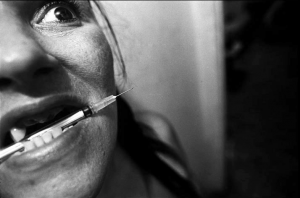
“I was introduced to Cocaine True, Cocaine Blue on my first photojournalism course. The cover captivated me – a woman staring into a distance with desperate eyes and a syringe held tightly between her teeth – as if it were the last moment of her life and the syringe was her only possession. I was disturbed and intrigued.

Cocaine True, Cocaine Blue ©EUGENE RICHARDS

Cocaine True, Cocaine Blue documents inner city America during the 1980s, lives consumed by drugs, poverty and gangs, rather like the crime drama The Wire. I’ve always been drawn to work which explores the ‘other side’ of society, requiring the photographer to get under the skin of their subject yet remain impartial, something only possible with patience, respect, tenacity and courage. I was fascinated by how Eugene Richards, being a white man, had gained such trust and done exactly that, allowing him to take such close and personal shots.

Was he wearing an invisibility cloak? How did he do it? How did he develop the relationships? The book redefined the meaning of photojournalism to me – it raised the bar. The term is often overused and the story badly told, but not this time.

Cocaine True, Cocaine Blue ©EUGENE RICHARDS

Picture after picture captivated me, telling me a story and leaving me haunted. I realised that a great photographer not only becomes invisible to their subject but presents their work with a respect and dignity.

If a great picture is a thousand words, this is a great novel.”

– Jags Parbha