Categories
COMMENTS GUEST POST

Aggie Morganti on Cafe Lehmitz

Our thanks to Aggie Morganti for getting in touch to share a love of Anders Petersen’s ‘Cafe Lehmitz’.

If anyone wants to continue the conversation with Aggie, you can do so on Twitter, here.

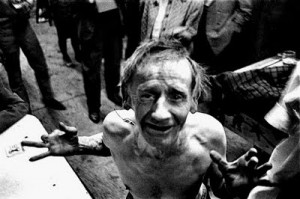
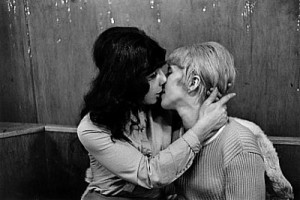
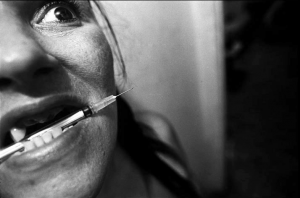
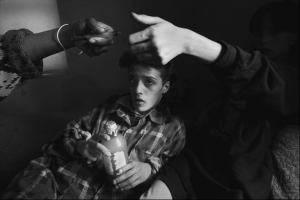
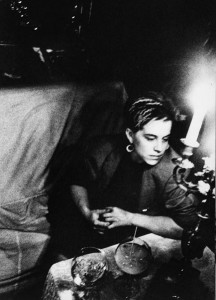
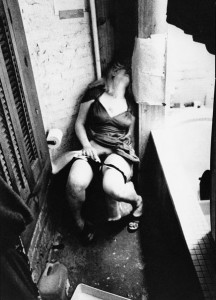
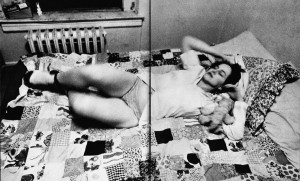
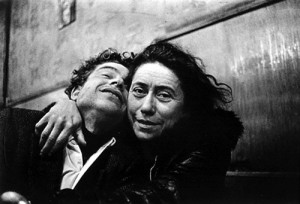
I’ve often wondered what makes Cafe Lehmitz so special to me. It’s not only about its exquisite photography, its visual intensity, its emotive tension running through the edit. That special something is, somehow, a step backwards, hiding in the making itself rather than in the final object.
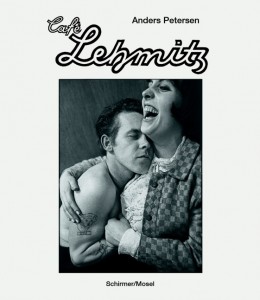
Anders Petersen - Cafe Lehmitz

I am amazed every time I flip through it by its unique way of being so rich and so poor at the same time. It is rich in all the above mentioned, and poor in pretentiousness. Straightforward, down to earth, honest-to-God report of what had to be reported – and nothing else. The book itself is stripped down to the bare essentials and it only makes me love the fancy title lettering even more, so much that I almost see it blinking on and off as a neon light from a bar would do in the dark of night.
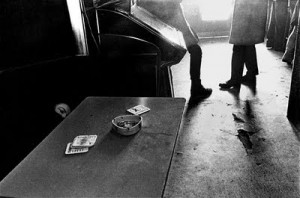
©ANDERS PETERSEN

It’s so transparent you can see through it – or feel you’re there. And the reason why I love it so much is that I have a very personal photographic memory related to Cafe Lehmitz (I’ll be brief – promise).

So, I was around 20 and I had just started to discovery what you could do with documentary photography in terms of storytelling and powerful narratives. It was a gloomy afternoon in December, in Lucca, and I was attending photojournalist Massimo Mastrorillo’s workshop on such matters.
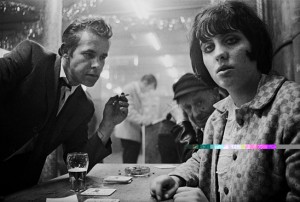
©ANDERS PETERSEN

To provide us with guidance and advice, he had brought some of his favourite photobooks with him (and many of them would also become a pick of my favourites later on, such as Billingham’s Ray’s a Laugh or Telex Iran by Gilles Peress). The table was literally flooded with wonderful things, and I remember this little, black and white white compact book striking me straight on. Cafe Lehmitz was special to him as well, for Massimo’s main advice to us was to follow what really means to us in our photography. To follow what literally grabs your heart and your stomach and does not let you go, to photograph what you love, in any possible way.

So, as I have tweeted before – this is what I’ve always found in Cafe Lehmitz from that moment on. Love, warmth of heart, being human, humble and true. That’s what I like about it and what I think of every time I start doing something photographic.

– Aggie Morganti
Categories
CLOSER LOOK COMMENTS INDEPTH

Cafe Lehmitz, InDepth by Wayne Ford

In 1968 Swedish photographer Anders Petersen walked into Café Lehmitz, a bar located on the Reeperbahn, the red light district of Hamburg. Sitting down at a table with a beer, the photographer was soon engaged in conversation with a young man, his camera sitting on the table top, when he got up fro the table to use the menʼs room, Petersen left his camera on the table, and when he returned from he found the barʼs clientele
photographing one another.

©ANDERS PETERSEN

Seizing the opportunity, Petersen asked if he too could photograph the bars clientele; a
mixture of sailors and dock workers, strippers, prostitutes and their pimps, along with poets and small time criminals; all of whom occupy the fringe of society, and signalling the beginning of a project that would occupy him on and off for the next two years.

©ANDERS PETERSEN

In the raw and gritty black-and-white images, that have now become a signature of
Petersenʼs oeuvre, we experience in Café Lehmitz, not a voyeuristic view of this
atmospheric, smoke filled world, but a collaborative visual dairy. Petersen has fully
integrated himself into the Café Lehmitz family, with it becoming a new home.

©ANDERS PETERSEN

Whilst this work is often graphic, even brutal at times, it is a very intimate and sensitive
work, with Kate Bush, curator of the Barbicanʼs ʻIn the Face of history: European
Photographers in the 20th Century,ʼ an exhibition which included the Petersenʼs series,
describing Café Lehmitz as a ʻZeigeist book,ʼ she continues, ‘It has a powerful identity and is totally of the moment. But Petersen is also important because he was very much a
participant in the social life he was documenting. His work has that integrity of engagement that great personal reportage requires.’

– Wayne Ford

Categories
COMMENTS REFLECTION

Cafe Lehmitz, a personal reflection by Matt Johnston

The following is a personal reflection from Matt Johnston on his first viewing of Cafe Lehmitz, if you have a reflection you would like to add, then do so in the comments below or email mail@photobookclub.org

I should have first seen Cafe Lehmitz back at university when my tutor suggest I see Petersen’s view of a single beer house in Hamburg for inspiration. I have to confess i didn’t see it then (sorry Jonathan!) as I was quickly distracted by the bright lights, ball parks and endless roads of American photography.

©ANDERS PETERSEN

And so my first viewing of ‘Lehmitz’ was only a month ago. The raw power of the striking, rich-black images grabbed me straight away, but it was the refreshingly honest and simple premise of the story that most appealed. I loved the idea I was seeing someone who first came as a visitor and soon became embraced by the seemingly dysfunctional family he depicted.

©ANDERS PETERSEN

I would never had made the images Petersen made here, and I don’t know many photographers who would have. The technical skill can be taught, but the way he went about gaining trust, meeting people and producing this ‘family album’ is something only Petersen knows.

– Matt Johnston


Categories
EVENTS NEWS

August’s book is……

Actually, there is no book for August! We were planning to look at Nan Goldin’s ‘Ballad of Sexual Dependency’ but have recently agreed to several events in September, and so are going to take a month out.

We will be looking at Goldin’s masterpiece in October now, and September itself will be a special month, with Ken Schles joining us to get involved with the discussion of his book ‘Invisible City’.

And so what are these events? Well, more details will follow shortly and be posted here, but for now we can say they involve the two following exciting projects.

– Matt Johnston


Categories
COMMENTS

Technical proficiency in Cafe Lehmitz – Stan Banos

Thanks to Stans Banos of ‘Reciprocity Failure‘ who commented this week on the technical proficiency Petersen demonstrates with the 35mm images in Cafe Lehmitz.

Banos pointed to several other artists who have captured moments under available light in a similar fashion, the comments, and a selection of images are shown below.

Stan Banos
Something that rarely, if ever, gets mentioned is that one of the reasons that Cafe Lehmitz remains so powerful and poignant to this very day is that the technical proficiency of the work alone is simply incredible. Early on, it really set the bar for what “availble light” work could aspire to be at its very pinnacle with a simple 35mm camera- and it was rarely duplicated in the years since…

Matt Johnston
Stan, you are absolutely right, the technical proficiency Petersen shows in Lehmitz is something i must say i overlooked on my first looks through the book. I would be keen to hear some of the projects you think have come close to the Lehmitz standard? I would suggest Invisible City by Ken Schles (which we look at in Sept) is another groundbreaking ‘available light’ piece of work.

Stan Banos
Good question. First off, it’s much easier to get top quality available light (ie- just enough existing light to record a worthwhile image) work today with full frame digital sensors. And although I can’t think of any (film) projects offhand of that particular (technical) quality that involve the sole use of available light photography, I’m sure they must exist. Admittedly, I’m not a great fan of available light work since 35mm by its very nature is pushing the limits of technical quality under the best of circumstances. That said, Henry Wessel’s 35mm prints (although not “available light”) are some of the most technically amazing and pristine wonders that can compete with any format for sheer technical (and aesthetic) beauty. And you need not go further than Cocaine True, Cocaine Blue to sample top notch work that features a considerable amount of available light work.

The work by Ken Schles has a different, more dreamy like aesthetic than Cafe Lehmitz that more closely resembles the work by another exemplary available light photographer, Michael Ackerman.


Anders Petersen

©ANDERS PETERSEN
©ANDERS PETERSEN
©ANDERS PETERSEN

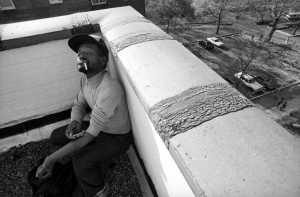
Eugene Richards

©EUGENE RICHARDS
©EUGENE RICHARDS
©EUGENE RICHARDS

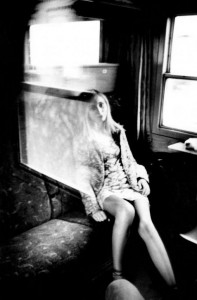
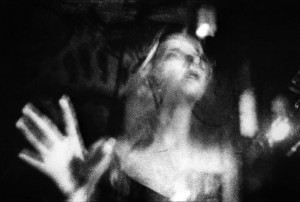
Michael Ackerman

©MICHAEL ACKERMAN
©MICHAEL ACKERMAN
©MICHAEL ACKERMAN

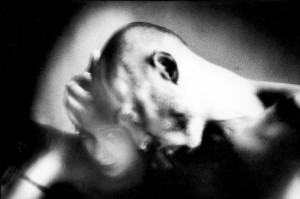
Ken Schles

©KEN SCHLES
©KEN SCHLES
©KEN SCHLES

We looked at Eugene Richards’ ‘Cocaine True, Cocaine Blue’ a couple of months back, the archive can be found here

And we will be looking at Ken Schles’s ‘Invisible City’ in September, so plenty of food for thought here!

– Matt Johnston


Categories
BOOKS COMMENTS REFLECTION

Cafe Lehmitz, a personal reflection by Wayne Ford

The following is a personal reflection from Wayne Ford on his first viewing of Cafe Lehmitz, if you have a reflection you would like to add, then do so in the comments below or email mail@photobookclub.org

I first came across Café Lehmitz in the mid-1980s, browsing the secondhand bookshelves
of a local bookstore, there amongst the how to books, and pretty landscapes of the
photography section, I came across this book full of raw and gritty black-and-white images that bought to mind the work of Japanese photographer Daido Moriyama, an artist I had only just discovered and whose work I had fallen in love with.

©ANDERS PETERSEN

At that point I had never heard of Anders Petersen, was he an immensely important artist or a complete unknown, these where questions I would ask later, searching out the answers. But what I did know then, as I held the book in my hands, was that he was important to me famous or not, in his work I found an energy that I had rarely encountered before, and energy that I immediately found a connection with.


– Wayne Ford

Categories
BOOKS HISTORY

Cafe Lehmitz – Key Editions and other publications by Anders Petersen

As we have pointed out before, and 5b4 books has commented on, there have been a variety of different editions that form a history of ‘Cafe Lehmitz’ from initial publication in 1979, to it’s latest incarnation from Schirmer/Mosel in 2009. It’s 32 year history marked by a total of 10 editions all listed below.

Key editions of Cafe Lehmitz:

Café Lehmitz; Prestel, 2009
Café Lehmitz; Schirmer/Mosel, 2009
Café Lehmitz; Rat Hole, 2007
Café Lehmitz; Schirmer/Mosel, 2004
Café Lehmitz; Fischer, 2003
Café Lehmitz; Schirmer/Mosel, 1985
Café Lehmitz; Fischer Taschenbuch, 1985
Café Lehmitz; Schirmer/Mosel, 1985 (French edition)
Café Lehmitz; ETC Förlags AB, 1982
Le bistrot dʼHamburg; Contrejour, 1979

As well as Cafe Lehmitz, Petersen has published numerous other successful books, listed below with, wherever possible current links to Amazon or other sources of information have been provided

Gröna Lund; Aman Iman, 2009
Dear Diary; Gun Gallery, 2009
Sète #8; Images En Manoeuvres, 2008
French Kiss; Dewi Lewis, 2008
Roma: A Diary; Zone Attive Edizioni, 2005
Ich Dich Iieben, Du mich auch?; Fotomuseum Winterhur, 2003
Du mich auch; Journal, 2002
Nära avstå/Close Distance, Journal Fölag, 2002
Indicier; Journal Fölag, 1996
Fotografier/Photographs 1966-1996; Journal Fölag, 1997
Ingen har sett alit; Legus Fölag, 1995
Karnevalen i Venedig; ETC Fölag, 1991
Rågång till Kärleken; Norstedts Fölag, 1991
I Mörkrummet; Fyra Förläggare, 1984
Brottsoffer; Pockettidningen R, 1977
En Dag På Cirkus; Bo Cavefors Bokförlang, 1976

Gröna Lund; Fyra Förläggare, 1973

Categories
BOOKS COMMENTS HISTORY

5b4 looks at the editions of ‘Cafe Lehmitz’

Several years ago, Jeff Ladd wrote a fantastic post on the editions of ‘Cafe Lehmitz’ over on the similarly fantastic 5b4 blog. This post, and accompanying comments are of course still relevant now and offer a great insight into changes made between different editions of our book for July.

Click the images below to go straight to the blog post

©JEFF LADD


©JEFF LADD


©JEFF LADD


Categories
SYNOPSIS

Synopsis: Anders Petersen – ‘Cafe Lehmitz’

Title
Cafe Lehmitz

Author
Anders Petersen

Publisher
Schirmer Mosel, 1978

Anders Petersen - Cafe Lehmitz

From the publisher:

Cafe Lehmitz, a beer joint at the Reeperbahn, was a meeting point for many who worked in Hamburg’s red-light district: prostitutes, pimps, transvestites, workers, and petty criminals.

Anders Petersen was 18 years old when he first visited Hamburg in 1962, chanced upon Cafe Lehmitz, and established friends that made an impact on his life.In 1968 he returned to Lehmitz, found new regulars , renewed contact and began to take pictures. His photographs, which we first published in book form in 1978, have become classics of their genre.

Tom Waits used the cover picture for his album Rain dogs. Their candidness and authenticity continue to move the viewer. The solidarity evident in them
prevents voyeurism or false pity arising vis-à-vis a milieu generally referred to as asocial. The other world of Cafe Lehmitz, which no longer exists in this form, becomes visible as a lively community with its own self-image and dignity.

Resources:

You can see many of the images on Petersen’s site here

The book is also available at a very reasonable price in it’s latest verion from Schirmer/Mosel:
– Amazon UK
– Amazon US


Categories
SUMMARY Uncategorized

The Valley: A Summary

Thanks to all who have contributed to the discussion on Larry Sultan’s ‘The Valley’. We have compiled an archive of the posts below for future reference and will also be listed under the reading list page.

Larry Sultan: Video Obituary
Synopsis: Larry Sultan, The Valley
Images from ‘The Valley’
VIDEO: Full book video
‘Nature is Strange in the Valley’ Essay by Larry Sultan
Erik Saeter Jorgenson – The Valley is my favourite photobook

Chris Timothy on Larry Sultan’s ‘The Valley’
Larry Sultan – Katherine Avenue
Larry Sultan interview with Terri Whitlock
Out of Sorts in ‘The Valley’ – Matt Johnston
The Valley – Exhibition Catalogue

July’s book is ‘Cafe Lehmitz’ by Anders Petersen. If you would like to contribute to the discussion, just let us know on mail@photobookclub.org