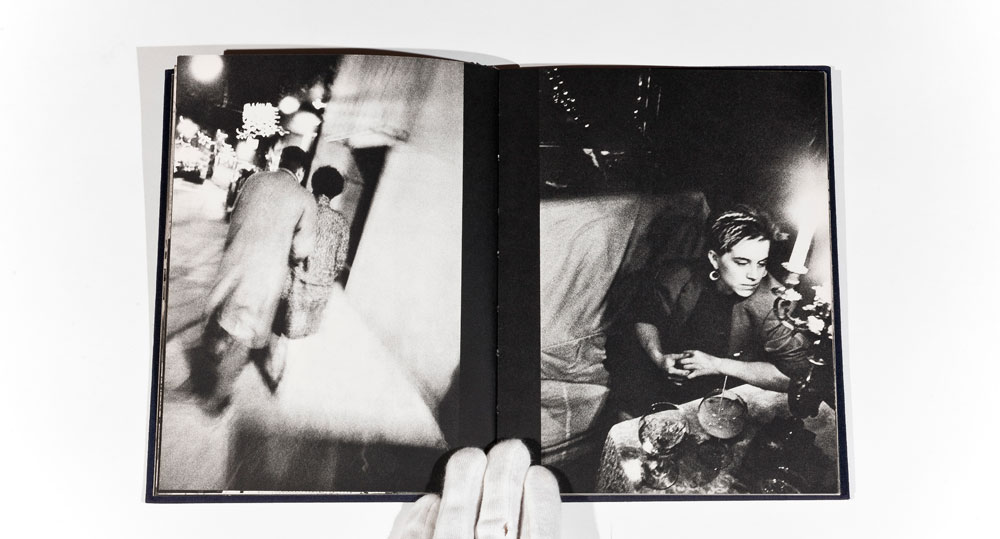
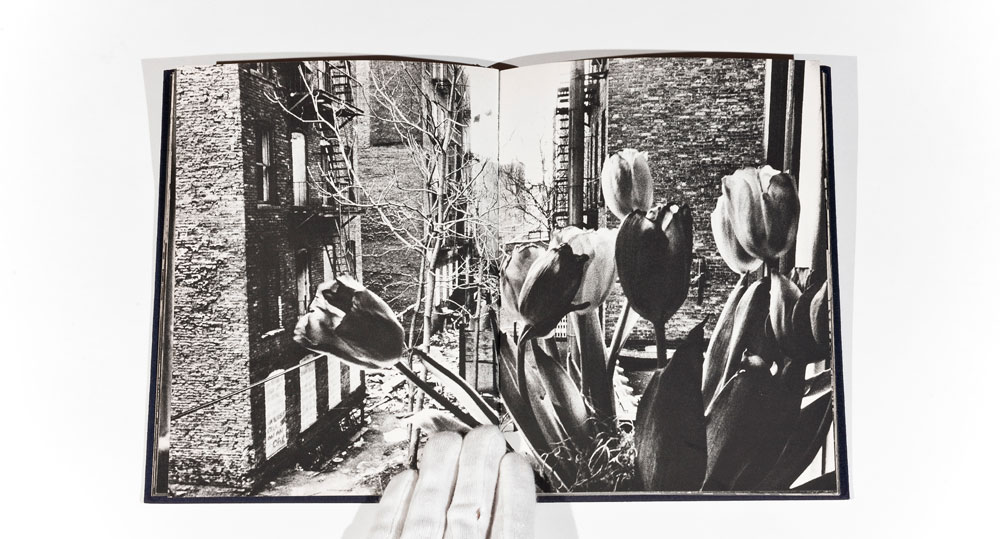
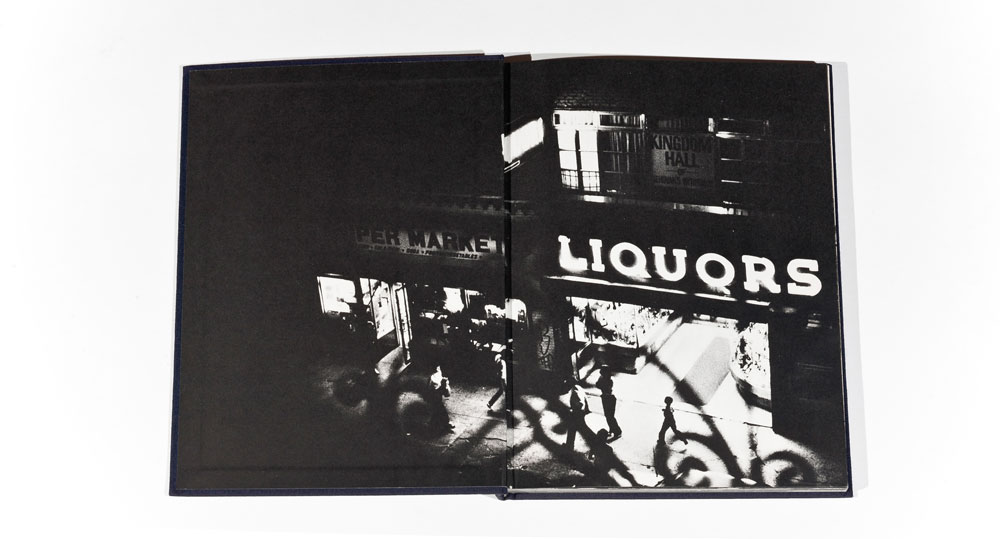
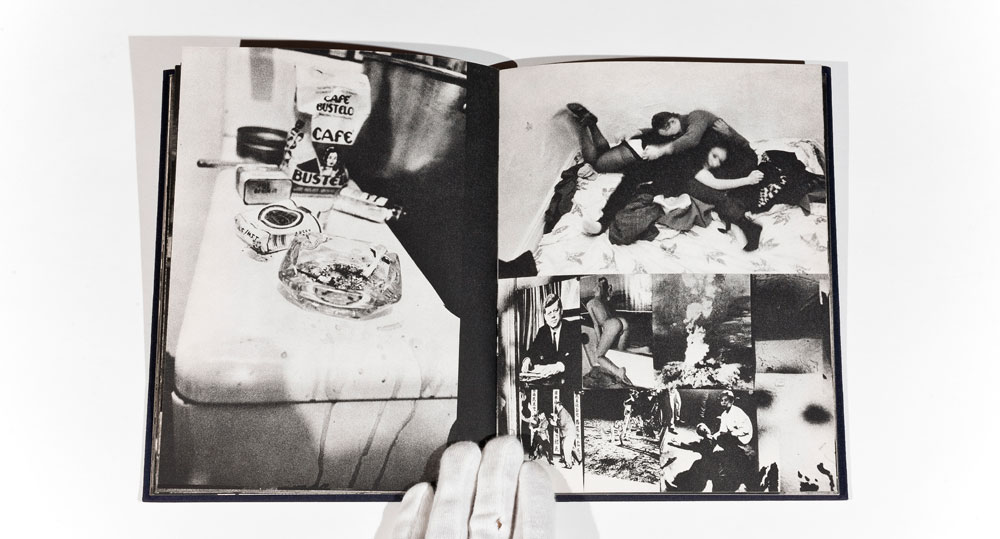
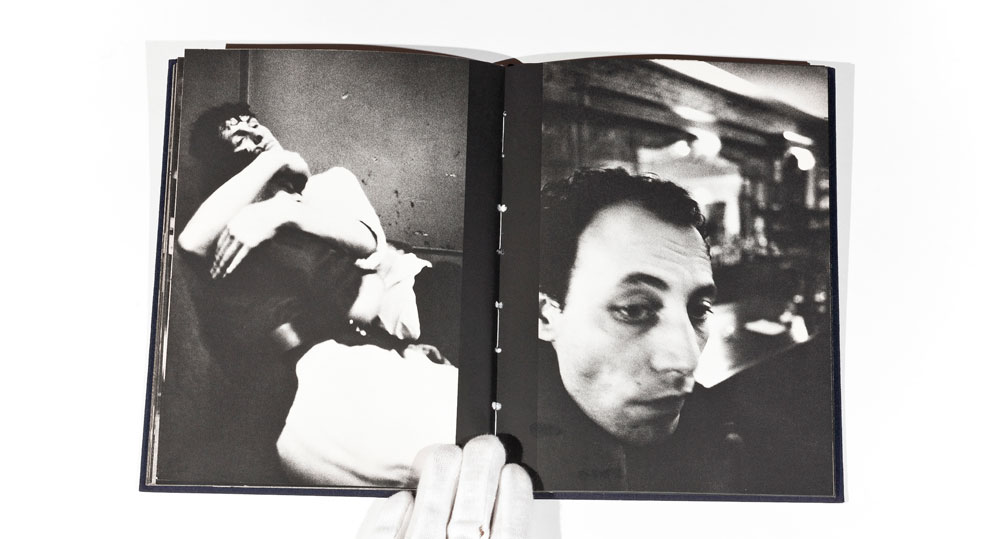
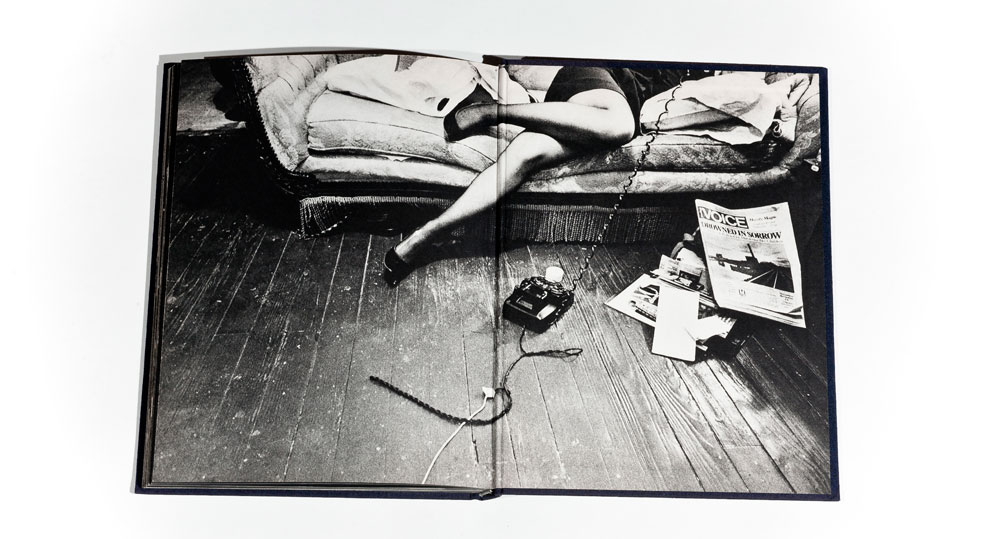
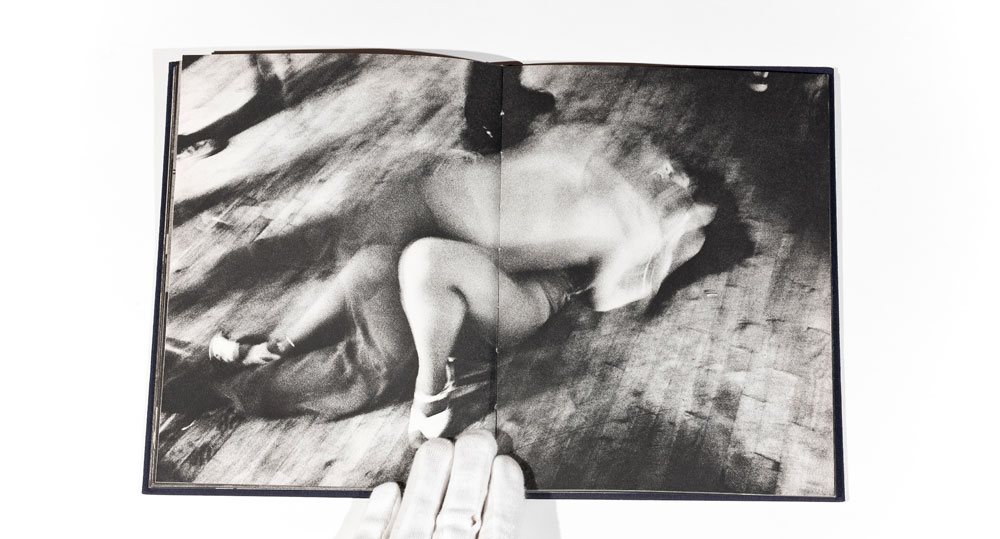
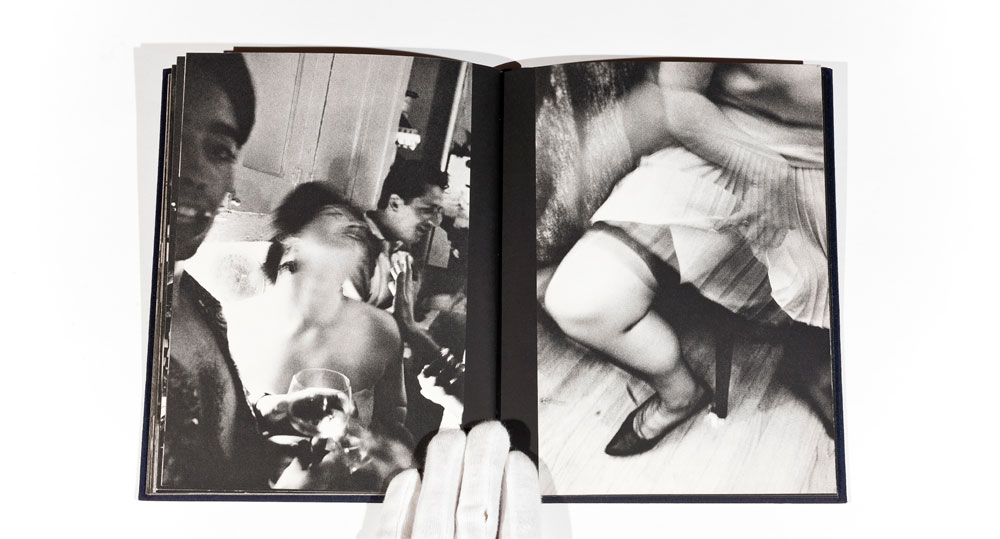
The first thing I said upon seeing the ‘Invisible City’ in it’s entirety was simply, “wow”, unfortunately at the time I was across the table from Ken Schles himself who had kindly agreed to lend the Photo Book Club a copy. It was a ‘Frasier-like’ moment when I really wished I had something more intelligent to say.
I also wished that I had a memory of this time and place depicted in such dark tones within Ken’s images, I wanted to layer my own history onto Ken’s page and relive a particular time through different eyes. But I have no memory of Ken’s subject and so Invisible City was new for me, allowing me to search without reference and without the worry of reality or history. It was like reading a book as a kid, each character would come to life and create a movie in my mind. There are books in which the authorial presence is constant and reassuring, in Invisible City I felt I was left alone to wander and explore Alphabet city, a fascinating, daunting, exciting and entirely unfamiliar place to be.
To me, Invisible City is not just a poem to the night (As Jeff Brouws commented) but a poem to the book, a reminder of how powerful the book as a medium can be. Single images are erased from my mind as I follow the darkest black tones from page to page, much like a shadow stretching across the entire spread of images. A photobook is a selection of images, and a good photobook is a fantastically sequenced and edited selection of images. Invisible City is just one, single, poetic image.
Ken Schles is a busy man! As well as contributing a great amount of his time to this special Photo Book Club month, Ken will be appearing and exhibiting at a number of great events over the next few months. Hopefully our discussions have inspired you to hear more of Ken’s thoughts on photobooks or to see ‘Invisible City’ and Ken’s new book ‘Oculus‘
A list of upcoming events is shown below:
30/09/2011 – 02/10/2011 NY Art Book Fair PS1 (advance copy of Oculus will be there, and so will I)
Preview of the limited edition at the Charles Lane Press booth Sat Oct.1 at 2pm. A very LIMITED number of copies of the trade edition will be at Dashwood books at the NY Art Book Fair —get there early for the trade edition.
01/10/2011 – 03/10/2011 Platform LA (advance copy of Oculus will be there, but not me)
A limited edition of Oculus can be seen at the Lapis Press booth #121 (I will not be in attendance due to the NYABF, see above)
15/10/2011 – 19/10/2011 (opening 14th) Bursa Photo Festival: at least two talks –one on my work and one more about the process of making photo books. There will be an exhibition of Invisible City. Probably the largest installation of the work to date. This is the first showing of Invisible City in 7 years and only the third time it’s had an exhibition print showing (the Museum of Modern Art showed the book as an object in its More Than One Photography exhibit in 1992). I will be giving a talk on my work and a separate hands on talk specifically about making my photo books.
3/11/2011 – 05/11/2011 Society for Photographic Education North East and Mid-Atlantic Conference
Keynote: Alec Soth, Honored Educator: Doug DuBois, Featured Speakers: John Gossage, Mary Virginia Swanson, and Andy Adams, General Speakers Include: Colette Copeland, W.M. Hunt, Paula McCartney, Ken Schles, Tate Shaw, Anne Whiston Spirn, and more…
3/11/2011 – 06/11/2011 The Edition Art Book Fair: (Lapis press will have the limited edition of Oculus –but I will be up at the SPE Conference)
10/11/2011 – 13/11/2011 Paris Photo —
3 very definite events in the main pavilion:
1. Harper Books will have the newly created, commissioned for the fair Invisible City inspired project: Invisible City: Nightwalk, Fragments and Alternates (book dummy);
2. there will be a book signing with Schaden.com on Saturday November 12 for Oculus (with the limited edition also available and on view)
3. Markus Schaden is doing this very interesting project, (for which I contributed a piece).
The full programme of signing sessions will be posted on-line at the end of September.There is a strong possibility that Noorderlicht will be at the Paris Photo off-print (to be confirmed), in which case, I will do a book signing there as well.
I came across Invisible City in April 1990 in the MoMA bookshop. It made an immediate impression on me. I was enthralled, and bought three copies for friends.
These photographs were of New York City at a time that I knew it, or thought I did. Ken Schles photographed the people and the streets of his neighborhood with such a deep love that he created a poem to those times we knew….if I close my eyes now 25 years on and pull on the memories of those long dark warm nights in the East Side, the images that come to me are Ken Schles’, not my own. This is how powerful Invisible City still is to me.
Like Cafe Lehmitz, I’m glad someone not only made the effort- but actually succeeded in successfully capturing this part of town, this part of time that existed in all its brief wonder and tragedy. Loisaida was in constant motion in the late 70′s, early 80′s, evolving (or devolving) from a culturally heterogeneous, junkie laden, cheap rent district of promise, hope and energy into that of a gentrified homogeneity of yuppies, condos and crack. In a half dozen brief years, the place was transformed from a place fueled by the spirit and fire of punk, new wave and the very beginnings of rap, to a veritable laughing stock where practically every other neighborhood storefront and bodega was transformed overnight into fledgling art galleries by trust fund, wannabe gallerists. Their “galleries” lasted about as long as your average punk set at CB’s, but the blight upon the neighborhood was permanent. The Ramones had somehow mutated into Madonna.
Ken, perhaps you could talk a little about Invisible City’s relationship with ‘Best Photobook lists’?
The lists… I’m assuming you mean the Parr/Badger book, the Roth book and Hasselblad’s The Open Book — I don’t really want to say too much about them directly since the stories I know about Invisible City being included in them or not are all hearsay. I’m happy Invisible City was seriously considered. I’m gratified that other people would argue publicly and privately disappointment that it wasn’t included: Here is a piece Bint photobooks blogged when the Parr book first came out, and here is Gerry Badger discussing it. This last thread contains good comments on the speculative prices of photography books.
I ran into Martin Parr the year before last at Arles. He gave me his Playas book and signed it: “to Ken — Invisible no longer.” Obviously I have a few things to say about history and being invisible and maybe my previous book A New History of Photography is a bit of a reaction to all these histories. No one person writes history and it’s problematic to second-guess these things when it is so very close to you.
I guess I can talk around it a bit, talk about the arbitrary turns that history plays upon us all. What seems important at the time and what becomes important in retrospect can be very separate things. I ran into Gail Buckland about a year ago after so many years—she was my history of photography prof in school and did the seminal research that established Fox Talbot as the inventor of photography (she came around over a hundred years later to sort that one out). She had some interesting things to say about how some work and some photographers arbitrarily have missed the boat of history or fell into it because of random decisions by curators or publishers or their own quirks. She told me about some photographers not wanting to have their work reproduced—that’s a buzz kill right there.
Reminds me a bit about photographers being paranoid about the Internet. Things that don’t get ported to new media can easily get lost. Certainly things that don’t get seen or become known do get lost. We are seeing it with film right now—old nitrite films are being lost forever as they decompose. Luckily books tend to kick around for a while and can be rediscovered. Yes, the work has to be good, but if it doesn’t get seen it can’t be remembered and might lay unopened on a shelf. What works for one generation may fall out of fashion and get picked up by the next, but if that next generation isn’t exposed to it in any form it can and will certainly die. What if Lisette Model didn’t show Diane Arbus the work of the little known German photographer August Sander? Torches need to be carried otherwise there will be no lights to guide those seeking things in dark corners.
Lists of the great photography books. Well, Invisible City did make it into one of those books. It is in Auer and Auer’s 802 Photo Books (#676). It lists the most important photography and photography related books of the last 250 years.
Thanks to Nina for offering this personal reflection on Invisible City. If you still havn’t seen it, you can view the book here, and images here.
I love this book so much. I co owned New Math gallery on 12th street between A and B from 1983 – 1986. Mario and I always said Ken was our resident photographer. He took so many beautiful photographs of the gallery and the neighborhood. he really captured both the up and downside of living somewhere where both art and creative energy and death and destruction shared a landscape. Thumbing through this book brings back so many memories.
It was a force of will. I think books are like that. I made Invisible City because I had to. I saw myself in a particular place at a particular time that wasn’t being looked at, simply wasn’t a part of the consciousness of the world ‘out there’ at the time. It was an intense period and depicts my life in that unforgiving place: NYC’s East Village/Alphabet City in the mid-1980’s. It was a hotbed of sociological and cultural phenomena that eventually became significant to the larger world: the downtown art scene, performance art, punk rock, hip-hop, the no-wave movement, squats, gay-rights, AIDS. It was the last pre-internet underground cultural scene in the United States. And I was coming of age.
In 1982 I graduated from art school. I found myself destitute in the heroin trade center for the planet—but felt lucky enough to find an apartment in what a few years later became an abandoned building—only it wasn’t really abandoned. There were many people living there—whole families, artists, couples, all sorts of people. It was the landlord who walked out on us. I remember that cold winter I was sequencing the images for Invisible City: there was a fire that destroyed the electrical controls for the boiler and we were having a kind of war with junkies who were using an apartment in the building as a shooting gallery. But that was later on.
When I was shooting Invisible City I was keenly aware of the rich history of photography in New York City: Jacob Riis, Lewis Hine, Weegee, Bernice Abbott, Louis Fauer, Helen Levitt, Roy DeCarava, William Klein, Robert Frank, Diane Arbus, Garry Winogrand, Lee Friedlander, Joel Meyerowitz’s early street work. And I recognized that legacy all around me. I saw it in the buildings and the sidewalks. These were the same hallways, the same streets, same tenements, sometimes seemingly the same faces in the crowds, the same freaks in the park that I saw in those photographs, but my view of it all was very different. Physically there were incredible similarities, but the physical content had a different significance to me. Having grown up in New York and being the son of someone who grew up in New York, I realized just how different the mythos surrounding New York City played to people of different generations.
You can only begin to know a place at a particular time and from a particular perspective. And you are, for the most part, isolated in that place and locked into that specific time. I recognized my invisible city. I saw the truth in it. The book is a love story about the place I found myself in. And it features many pictures of the person who eventually became my wife, so there is a romance in there as well. But the world and the images are not simple or one-dimensional. The depiction is complex, perhaps a little obscure and frankly, somewhat dark. I moved with some friends from high school to the East Village in 1978, a year after the black out and the riots. I was 17 and starting on my own—I just got into Cooper Union, an art school down in the Village. Those were the ‘Taxi Driver’ days. People were dying on the streets, victims of self-abuse and addiction, victims of violence. And then in the early 80’s friends started getting sick and dying of aids. And then there was this craziness to the abandon we were feeling and trying to make sense of. We were children and we had reign of the decay of the city. It was a world my friends and I embraced as our own.
I titled my book Invisible City after Italo Calvino’s amazing book Invisible Cities. His book is a fictional encounter between Marco Polo and Kubla Khan. Polo tells the Khan of cities within his vast empire—an empire so large that the Khan knows nothing about its composition. The descriptions turn to allegory or fantastic creations of the imagination. The emperor knows nothing of the reality outside the impenetrable walls of his palace and knows not whether to believe Polo’s tales or not. I was Marco Polo to the impenetrable world’s Kubla Khan.
I tried every publisher I could think of to publish the book. But it didn’t fit the mold at the time: it wasn’t a monograph devoted to a specific dead photographer tastefully done with large white borders in a coffee table format. It was dark and small and full bleed. I had no gallery to back it, no museum show to sell it through. No book tour. I was in my 20’s. I didn’t have a history that could be banked on: no gallery outside of the East Village would take me; no publisher would publish me: “Who do you think you are that you want to publish a book?” “Who wants to look at that?” And then Jack Woody picked it up after my anonymous drop. Late one sweltering summer night he called and spoke to me in his slow, deep and commanding voice: “Is this Ken Schles? I’m Jack Woody. I want to publish your book. It’s so depressing.” By then he was my last best hope really. By the time he called, I had nearly given up. And so, Jack Woody (publisher of Twelvetrees Press and later Twin Palms) just put it out there. No promotion, really. I guess he didn’t care if it sold or didn’t, he just wanted to make it happen. Strange that. But then, in those days, two thousand copies wasn’t such a great risk.
Ken Schles Invisible City was a lonely, cold toned poem to the urban night, capturing equally the alienation of those unsanctified city spaces while simultaneously calling forth the glee of anonymity and free flight found only on the street. The size of the book was perfect, the design perfect, and its printing perfect: matt, coal-black, sheet-fed gravure. Bleed upon bleed: images interrupting and overflowing onto, and into, one another.
This was a fragmented, elliptical narrative. With tenderness sprouting on one double spread, and bouts of cold-hard fucking amongst the decay on another. Blighted beauty. Naked nightscapes. Unkempt, dimly lit details of fast and forlorn self-pleasure make themselves known. Revelations pour down from our daily stage production, the audience a lone camera. Metonyms and metaphors for all that ail humanity.
This was a grainy, lens wide-open, manly photography: when a fellow had to know how to push film. Had to know the proper darkroom alchemy in which to conjure and coax delicate, thinly sliced images from cooked celluloid.
A bit of William Klein, Meatyard and Brassai. R. Frank roaming internal America instead of its hinterlands. A Tom Waits tune or Bukowskian turn-of-phrase made visual; the threat of the acrid, hot city beckoning, or blowing itself up, or perhaps imploding. Who knows in all that darkness?
Schles’ Invisible City photos hold all tension and dance with it. We catch our breath for the briefest of moments and then seek solace in movement again.
For those of you that may be just joining us, I thought it an idea to show you around so you can see what we have been up to lately.
This month, we are looking at Ken Schles’ ‘Invisible City’, with Ken himself contributing to the discussion, you can find all posts for Invisible City here. And you can see the other books on our past and future reading list here. If you don’t have a copy of the book, we have two videos, showing the book, and the images, embedded below.
If you have any comments, questions, or would like to use our website to share your thoughts on one of our books, leave a comment below, or email Matt Johnston here.
I received an email this morning from Ken with the following message regarding his lecture notes form 1990. The notes can be enlarged by clicking on the images. Thanks again to Ken for openly sharing this with the Photo Book Club.
Dear Matt,
Just wanted to send this. I found my original lecture notes for IC for a talk that I gave in April, 1990 at The International Center of Photography—over twenty years ago. I was 29 then. Now I am 51. Reading it, I feel it still rings true. I think other people might be curious to read and I am happy to share it.
Ken