Categories
GUEST POST

Jags Parbha – Why I Chose ‘Cocaine True, Cocaine Blue’

Note: Jags, amongst others, have been suggesting books for us to look at. We aim to choose one at least every 3rd month. If you would like to suggest a book, please email mail@photobookclub.org

“I was introduced to Cocaine True, Cocaine Blue on my first photojournalism course. The cover captivated me – a woman staring into a distance with desperate eyes and a syringe held tightly between her teeth – as if it were the last moment of her life and the syringe was her only possession. I was disturbed and intrigued.
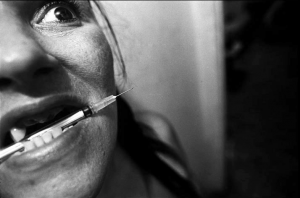
Cocaine True, Cocaine Blue ©EUGENE RICHARDS

Cocaine True, Cocaine Blue documents inner city America during the 1980s, lives consumed by drugs, poverty and gangs, rather like the crime drama The Wire. I’ve always been drawn to work which explores the ‘other side’ of society, requiring the photographer to get under the skin of their subject yet remain impartial, something only possible with patience, respect, tenacity and courage. I was fascinated by how Eugene Richards, being a white man, had gained such trust and done exactly that, allowing him to take such close and personal shots.

Was he wearing an invisibility cloak? How did he do it? How did he develop the relationships? The book redefined the meaning of photojournalism to me – it raised the bar. The term is often overused and the story badly told, but not this time.

Cocaine True, Cocaine Blue ©EUGENE RICHARDS

Picture after picture captivated me, telling me a story and leaving me haunted. I realised that a great photographer not only becomes invisible to their subject but presents their work with a respect and dignity.

If a great picture is a thousand words, this is a great novel.”

– Jags Parbha

Categories
Uncategorized

#fromthelibrary – At Coventry University

The Photo Book Club’s Matt Johnston is currently residing in the Midlands, England, and so making use of the excellent photography section in the Coventry University library. Starting shortly, Matt will be posting some of the books found on the shelves of the library along with a brief synopsis under the headline and hashtag #fromthelibrary. As well as this online post, Matt will be meeting with students and holding informal discussions on these books, and the various books that students will bring to the sessions.

As with everything on the Photo Book Club we would love to get your thoughts and discussion on the books. You can use the hashtag #photobc on Twitter, or use the comments section below this post.

And if you want to see one of the #fromthelibrary books given a thorough look by the Photo Book Club and community, let us know!

Categories
COMMENTS

Erik Palmer on the Frank/Avedon Connection

Erik Palmer, creative director of Vico Collective and teacher of communication theory at Portland State added another great comment, this time to Wayne’s personal observation.

As the end of the month draws near, I think it is also worth reflecting further on the creative and personal connections between Avedon and Robert Frank. As Wayne mentions, and as best narrated in Jane Livingstone’s book on the New York School, Avedon and Frank both worked for and studied with Brodovitch in the 1940s and 50s, although Avedon certainly had a closer relationship with the mentor.

As I was working on my dissertation, I spent a lot of time paging through old bound issues of Harper’s Bazaar in my university library, and I found a lot of product still lifes and other commercially motivated images bylined to Frank.

But I think it is most interesting to consider the relationship between The Americans and Avedon’s In The American West. Although the approach to photography of the two books could hardly be more visually distinct, I believe that Avedon set out to put his own mark on the kind of photographic grand tour that Frank originally perfected.

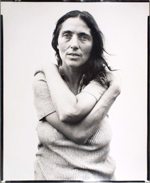
'June Leaf' ©RICHARD AVEDON

Both explored the west and sought to tell its story. And both told a controversial story of the failure of American ideals. Both were criticized for the perceived ugliness of their vision. Avedon photographed Frank and his wife (June Leaf, in what I think is a hidden gem among Avedon’s white background portraits) in the late 70s, and I suspect that their encounter was fresh on Avedon’s mind when he set out on his Western project.

Erik Palmer

Categories
REFLECTION

Observations – A Personal Reflection

This first personal reflection is from Wayne Ford, we would love to hear yours, especially if you have seen Observations for the first time from our video. Feel free to add it in the comment section for it to be posted here, or email mail@photobookclub.org

Wayne Ford

I first encountered the work of Richard Avedon through the art direction of Russian émigré Alexey Brodovitch (1898-1971), as a young graphic design student in the early 1980s. As my interest in editorial design grew, Brodovitch who was art director of ‘Harper’s Bazaar’ for almost a quarter of a century (1934-1958), became central to my studies.

Brodovitch was instrumental in introducing the ‘modern’ graphic design style that emerged through a number of art and design movements in Europe in the 1920s to the United States, in addition to which as Andy Grundberg writes, ‘Brodovitch is virtually the model for the modern magazine art director. he did not simply arrange photographs, illustrations and type on the page; he took an active role in conceiving and commissioning all forms of graphic art, and he specialised in discovering and showcasing young and unknown talent.’

Having arrived in New York in 1930, Brodovitch would regularly commission the likes of Bill Brandt, Brassai, Henri-Cartier-Bresson and Man Ray, his first design assistant was the young Irving Penn, and the list of photographers that he mentored in his long career, reads like a who’s who of twentieth century photography, Lillian Bassman, Robert Frank, Lisette Model, and of course Richard Avedon.

The copies of Brodovitch’s Harper’s Bazaar that I own are well thumbed, the mix of unmatched design and art direction, continually draws me back, as does my copy of ‘Observations’ for Avedon’s immensely powerful portraits, and also because the book itself was designed by Brodovitch.

Note: A small piece of trivia, it is well known that Fred Astaire’s role as a photographer in the film ‘Funny Face’ (1957), is styled upon Avedon, but the films art director is called ‘Dovitch’ reflecting the pairs influence on the world of popular culture during the period.

Categories
BOOKS

Richard Avedon: Books

‘Observations’ doesn’t have the lineage of Frank’s ‘The Americans’, but we had some very positive feedback on including other books by Robert Frank and so have compiled the following resource for Richard Avedon:

Other books by Richard Avedon

Where possible, Amazon links have been provided


Links
www.richardavedon.com

Categories
BOOKS

May’s book is… Eugene Richard’s ‘Cocaine True, Cocaine Blue’

Were still looking Richard Avedon’s ‘Observations’ throughout April but a heads up:
Next month for the first user suggested month, we will be looking at Eugene Richards ‘Cocaine True, Cocaine Blue’ put forward by Jags Parbha.
Do you have a copy?

More to follow at the beginning of May

Eugene Richards
Cocaine True, Cocaine Blue

Text from publisher Aperture books
This is a compelling portrait of three communities blighted by drugs and isolation: East New York, North Philadelphia, and the Red Hook housing projects in Brooklyn, New York. With a chilling and informative afterword by Dr. Stephen W. Nicholas, a pediatric AIDS physician in Harlem, Cocaine True, Cocaine Blue reveals how first steps toward solutions to overcome the drug trade have actually contributed to public denial and further isolation of the trapped communities. Cocaine True, Cocaine Blue is a history of our times, a terrifying document that will educate us and promote dialogue.

“Eugene Richards’s wrenching photographic study of the culture of cocaine in three inner-city neighborhoods gives faces to some of the victims of addiction. It provides a shocking and heartrending picture of the damage inflicted by the drug.”

–Charles Hagen, The New York Times

“Eugene Richards’s seventh book, Cocaine True, Cocaine Blue, reaffirms his position as the premier chronicler of the dark side of American life ˜ he is the true heir to the mantle of the legendary W. Eugene Smith.”

—American Photo

Copies of this book are still fairly easy to get hold of online and in some good shops (Abe Books link, Amazon link)

Categories
BOOKS LINKS

The Photo Book Club World Map

We would love to create a comprehensive map of all the best places to buy photobooks and zines around the world and so are asking for your help!

Let us know where the best place to buy photography books and zines are near you. We will add them to the map with your comments and a thanks.

email: mail@photobookclub.org
twitter: @photobookclub
hashtag: #photobc

(The map will always be available for reference from the Resources page of this site)

You can see the shops we have already placed by viewing the map below or click the link to open in google.


View The Photo Book Club World Map in a larger map

Categories
SYNOPSIS

Synopsis: Richard Avedon – Observations (With comments by Truman Capote)

A note…

This month’s book ‘Observations’ is not easily accessible in your local library, nor is it affordable to most. But we consider it to be more than worthy of a Photo Book Club discussion, and so next week we will post a video looking through the book, making sure this incredible book is available to view by as many fans as possible!

Title
Observations

Author
Richard Avedon, with comments by Truman Capote

Publisher
Simon & Schuster, 1959

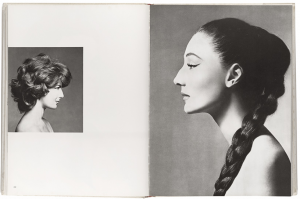
IMAGE ©RICHARDAVEDON.COM

Overview

Like Robert Frank’s ‘The Americans,’ which we discussed last month in the Photo Book Club, American photographer Richard Avedon’s first book, ‘Observations,’ was published in 1959. And, like ‘The Americans’ it was included in Andrew Roth’s ‘The Book of 101 Books: Seminal Photographic Books of the 20th Century (PPP Editions, 2001), now itself a seminal work on the history of the photographic book.

Having begun to take photographs during the Second World War, where he served in the Merchant Marine, Avedon became chief photographer of ‘Harper’s Bazaar’ in the late 1940s, where he helped redefine and elevate fashion photography to an art form, frequently taking his models out of the studio.

But Avedon’s first book did not focus on his fashion work, but on his iconic and penetrating portraits. In the 150 pages that form ‘Observations,’ with comments by the great American writer Truman Capote, we encounter the likes of Charlie Chaplin, John Huston, Alfred Hitchcock, The Duke and Duchess of Windsor, Arthur Miller, Pablo Picasso, Marilyn Monroe, Mae West, Judy Garland, Igor Stravinsky, Katherine Hepburn, Brigitte Bardot, Louis Armstrong, Humphrey Bogart, Buster Keaton, and many others.

Reflecting upon Avedon’s oeuvre, Maria Morris Hambourg recently wrote ‘By dint of progressive challenges to himself, Richard Avedon has not only distilled photographic portraiture to its irreducible core, but has also produced an extended meditation on life, death, art, and identity. Laureate of the invisible reflected in physiognomy, Avedon has become our poet of portraiture.’

Wayne Ford

Get involved

Let us know your thoughts by using the hashtag #photobc in Twitter or share links and blog posts in to comment section below.

Coming next…

Next week we will post a video, showing the book in all it’s glory to those who do not own, or have access to a copy (which is most of us!)

Categories
Uncategorized

April’s book is… Richard Avedon’s ‘Observations’

More to follow soon… but if you do or don’t know the book, let us know your thoughts by using the hashtag #photobc in Twitter or share links and blog posts in the comment section below.

Categories
LINKS

The Americans – by Andreas Schmidt

Thanks to ‘Here on the Web‘ for sharing the link to Andreas Schmidt’s book ‘The Americans’ in which Schmidt has sourced 83 images from Google to create a current version of Frank’s work. You can see a full preview of the book as well as purchase it, from blurb here.

Andreas Schmidt - The Americans

We would love to hear from anyone who has the book themselves – pop us an email mail@photobookclub.org

Schmidt’s Synopsis:

“Few books in the history of photography have had as powerful an impact as The Americans”, said The New York Times about Robert Frank’s photobook first published in 1958. More than 50 years later and made entirely without the help of a Guggenheim fellowship comes Andreas Schmidt’s take on a portrait of America. Selected from over 20 million photographs found on Google images, 83 photographs tell a story of contemporary America – pictures of normal people, everyday scenes, lunch counters, bus depots and cars, and the strangely familiar faces of people we don’t quite know but have seen somewhere. They are pictures showing the “American way of life” as we haven’t yet quite been able to see it ourselves, photographs that condense the entire life of a nation in classic images that speak to us today, and in another 50 years to come.