Categories
COMMENTS GUEST POST

Aya Takada on Cafe Lehmitz

Our thanks to Aya Takada fro producing this text on Anders Petersen’s Cafe Lehmitz which is featured here in both a Japanese and English translation. As well as checking out her website, you can follow Aya Takada on Twitter.

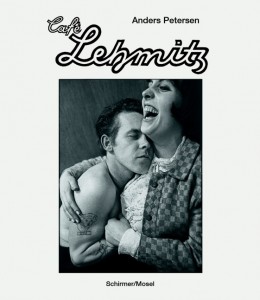
It is in the photo exhibition “Rat Hall Gallery” in Tokyo in 2007 that I first met Cafe Lehmitz. The first impression I saw reminded me of the book jacket from ‘Weegee’s people’, the production and typography were splendid. However it is the latest Cafe Lehmitz by Schirmer/Mosel that exists in my hands now.

If the book is opened, it is possible to put your own body to Cafe Lehmitz.

“It seems this is not work that a young person produced.”
There are times when you hear that kind of opinion, but on the other hand, it is through a young photographers eyes that this very pure and straight style could emerge. It seems like a conventional approach was chosen, simple and lacking in sensational images with a rustic feel.  The work is not dissimilar to that of Daido Moriyama in this respect.
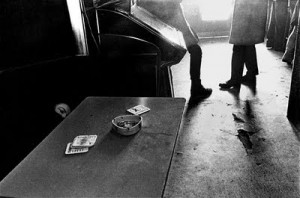
©ANDERS PETERSEN

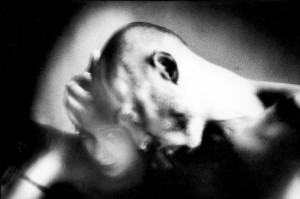
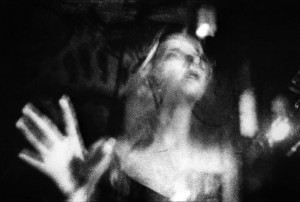
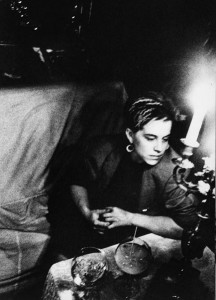
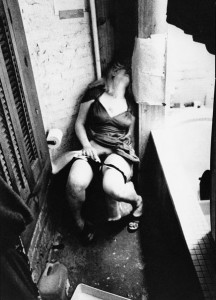
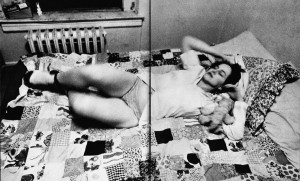
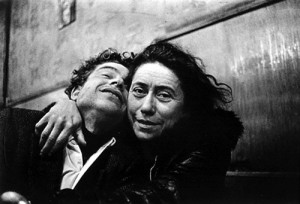
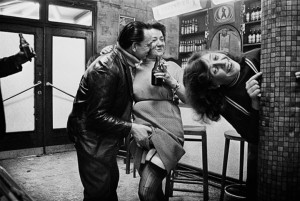
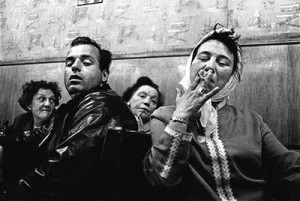
The characters are seen not as supportive as if the heart and mind, body and mutual support the body, sometimes they show a winsome look for the photographer, and
with each passing page, the subjects seems gradually to release themselves to Petersen. I feel a deep affection for the subject from the photographer.
I feel a line of vision near the sense that parents watch the child in a word to which family’s photo album is concluded. This will be able to be seen from the portrait of the photographer in the back book cover. The family is indispensable for Cafe Lehmitz.
©ANDERS PETERSEN

You might also understand the reason why this book keeps being resold as many as ten times, and being loved well.

Cafe Lehmitz is one book that a young photographer must see.

– Aya Takada


わたしが、Cafe Lehmitzに出会ったのは、

2007年東京のラットホールギャラリーで行われた写真展です。
ここから出版されたCafe Lehmitzの最初の印象はまさしく「日記帳」でした。
「Weegee’s People」のブックジャケットと似たタイポグラフィーを使った見事な演出。
しかし、現在、私の手の中にあるCafe Lehmitzは、「schimer/mosel」の最新版です。
中身を開けば、Cafe Lehmitzへ自分の身を置く事が可能です。
©ANDERS PETERSEN

「青年の撮影した写真ではないようだ。」
そのような意見を屢々聞くことがありますが、むしろ、まだ写真を始めて間もない若い写真家であるから完成できた作品群であると感じます。
とても純粋でありストレートな写真が多く見られます。
それは、写真の古典的なスタイルのようです。
センセーショナルな印象は少なく、とても素朴さを感じます。
森山大道に代表されるような(または筆者の後期の作品郡に近いような)、撮影時や暗室内での「マジック」をこの本で見ることはありません。

写っている人々は心と心を支え合うようかのように、肉体と肉体を支え合い、時折、写真家に対して愛嬌のある表情を見せることもあります。
ページを追うごとに、徐々に被写体は写真家に心を解放しているように見えます。
撮影者から被写体に対しての深い愛情を感じます.。
家族のフォトアルバムが完結されたような、つまり親が子を見守るような感覚というものに近い目線を感じます。
したがって、背表紙の著者のポートレートは、この本になくてはならない一枚であるように思えます。
©ANDERS PETERSEN

皆さんも、この本が10回も再販され、愛され続けている理由がよく分かるでしょう。
若い写真家にぜひ見て欲しい一冊です。

高田 彰

Categories
BOOKS EVENTS MEET-UPS

Photo Book Club Meet-up Map

A Photo Book Club suggests physical meetings, and it is something we have always wanted to be part of, and help facilitate. And so you can now find a map on the ‘Meet-ups’ page which we hope to get populated with people and meeting places.

Wayne and I will take part in potentially the first meeting this September as part of Photobook London although if anyone has a meeting before let us know!

The map can be seen below and can be edited by anyone


View The Photo Book Club ‘Meet-up Map’ in a larger map

Categories
BOOKS

Photo Book Swap

A great idea to check out – The Photo Book Swap has popped up online and will be organizing photo book swapping events so you can trade in your books that you bought on the spur of the moment and since decided you didn’t like – it could bring someone else hours of pleasure!

What’s more, it sounds like CAKE and BEER will be available at said meetings – see you there!


– Matt

Categories
COMMENTS GUEST POST

Aggie Morganti on Cafe Lehmitz

Our thanks to Aggie Morganti for getting in touch to share a love of Anders Petersen’s ‘Cafe Lehmitz’.

If anyone wants to continue the conversation with Aggie, you can do so on Twitter, here.

I’ve often wondered what makes Cafe Lehmitz so special to me. It’s not only about its exquisite photography, its visual intensity, its emotive tension running through the edit. That special something is, somehow, a step backwards, hiding in the making itself rather than in the final object.

Anders Petersen - Cafe Lehmitz

I am amazed every time I flip through it by its unique way of being so rich and so poor at the same time. It is rich in all the above mentioned, and poor in pretentiousness. Straightforward, down to earth, honest-to-God report of what had to be reported – and nothing else. The book itself is stripped down to the bare essentials and it only makes me love the fancy title lettering even more, so much that I almost see it blinking on and off as a neon light from a bar would do in the dark of night.

©ANDERS PETERSEN

It’s so transparent you can see through it – or feel you’re there. And the reason why I love it so much is that I have a very personal photographic memory related to Cafe Lehmitz (I’ll be brief – promise).

So, I was around 20 and I had just started to discovery what you could do with documentary photography in terms of storytelling and powerful narratives. It was a gloomy afternoon in December, in Lucca, and I was attending photojournalist Massimo Mastrorillo’s workshop on such matters.

©ANDERS PETERSEN

To provide us with guidance and advice, he had brought some of his favourite photobooks with him (and many of them would also become a pick of my favourites later on, such as Billingham’s Ray’s a Laugh or Telex Iran by Gilles Peress). The table was literally flooded with wonderful things, and I remember this little, black and white white compact book striking me straight on. Cafe Lehmitz was special to him as well, for Massimo’s main advice to us was to follow what really means to us in our photography. To follow what literally grabs your heart and your stomach and does not let you go, to photograph what you love, in any possible way.

So, as I have tweeted before – this is what I’ve always found in Cafe Lehmitz from that moment on. Love, warmth of heart, being human, humble and true. That’s what I like about it and what I think of every time I start doing something photographic.

– Aggie Morganti

Categories
CLOSER LOOK COMMENTS INDEPTH

Cafe Lehmitz, InDepth by Wayne Ford

In 1968 Swedish photographer Anders Petersen walked into Café Lehmitz, a bar located on the Reeperbahn, the red light district of Hamburg. Sitting down at a table with a beer, the photographer was soon engaged in conversation with a young man, his camera sitting on the table top, when he got up fro the table to use the menʼs room, Petersen left his camera on the table, and when he returned from he found the barʼs clientele
photographing one another.

©ANDERS PETERSEN

Seizing the opportunity, Petersen asked if he too could photograph the bars clientele; a
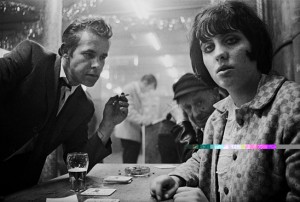
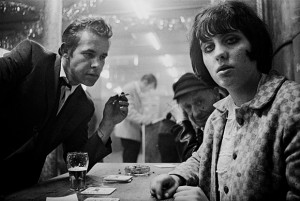
mixture of sailors and dock workers, strippers, prostitutes and their pimps, along with poets and small time criminals; all of whom occupy the fringe of society, and signalling the beginning of a project that would occupy him on and off for the next two years.

©ANDERS PETERSEN

In the raw and gritty black-and-white images, that have now become a signature of
Petersenʼs oeuvre, we experience in Café Lehmitz, not a voyeuristic view of this
atmospheric, smoke filled world, but a collaborative visual dairy. Petersen has fully
integrated himself into the Café Lehmitz family, with it becoming a new home.

©ANDERS PETERSEN

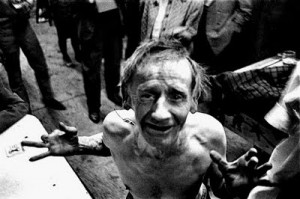
Whilst this work is often graphic, even brutal at times, it is a very intimate and sensitive
work, with Kate Bush, curator of the Barbicanʼs ʻIn the Face of history: European
Photographers in the 20th Century,ʼ an exhibition which included the Petersenʼs series,
describing Café Lehmitz as a ʻZeigeist book,ʼ she continues, ‘It has a powerful identity and is totally of the moment. But Petersen is also important because he was very much a
participant in the social life he was documenting. His work has that integrity of engagement that great personal reportage requires.’

– Wayne Ford

Categories
COMMENTS

Technical proficiency in Cafe Lehmitz – Stan Banos

Thanks to Stans Banos of ‘Reciprocity Failure‘ who commented this week on the technical proficiency Petersen demonstrates with the 35mm images in Cafe Lehmitz.

Banos pointed to several other artists who have captured moments under available light in a similar fashion, the comments, and a selection of images are shown below.

Stan Banos
Something that rarely, if ever, gets mentioned is that one of the reasons that Cafe Lehmitz remains so powerful and poignant to this very day is that the technical proficiency of the work alone is simply incredible. Early on, it really set the bar for what “availble light” work could aspire to be at its very pinnacle with a simple 35mm camera- and it was rarely duplicated in the years since…

Matt Johnston
Stan, you are absolutely right, the technical proficiency Petersen shows in Lehmitz is something i must say i overlooked on my first looks through the book. I would be keen to hear some of the projects you think have come close to the Lehmitz standard? I would suggest Invisible City by Ken Schles (which we look at in Sept) is another groundbreaking ‘available light’ piece of work.

Stan Banos
Good question. First off, it’s much easier to get top quality available light (ie- just enough existing light to record a worthwhile image) work today with full frame digital sensors. And although I can’t think of any (film) projects offhand of that particular (technical) quality that involve the sole use of available light photography, I’m sure they must exist. Admittedly, I’m not a great fan of available light work since 35mm by its very nature is pushing the limits of technical quality under the best of circumstances. That said, Henry Wessel’s 35mm prints (although not “available light”) are some of the most technically amazing and pristine wonders that can compete with any format for sheer technical (and aesthetic) beauty. And you need not go further than Cocaine True, Cocaine Blue to sample top notch work that features a considerable amount of available light work.

The work by Ken Schles has a different, more dreamy like aesthetic than Cafe Lehmitz that more closely resembles the work by another exemplary available light photographer, Michael Ackerman.


Anders Petersen

©ANDERS PETERSEN
©ANDERS PETERSEN
©ANDERS PETERSEN

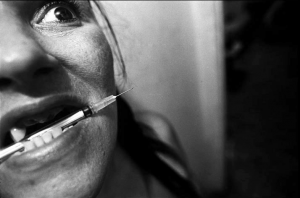
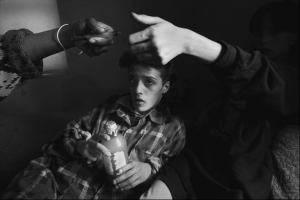
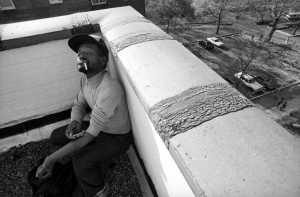
Eugene Richards

©EUGENE RICHARDS
©EUGENE RICHARDS
©EUGENE RICHARDS

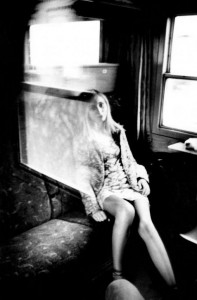
Michael Ackerman

©MICHAEL ACKERMAN
©MICHAEL ACKERMAN
©MICHAEL ACKERMAN

Ken Schles

©KEN SCHLES
©KEN SCHLES
©KEN SCHLES

We looked at Eugene Richards’ ‘Cocaine True, Cocaine Blue’ a couple of months back, the archive can be found here

And we will be looking at Ken Schles’s ‘Invisible City’ in September, so plenty of food for thought here!

– Matt Johnston


Categories
BOOKS COMMENTS REFLECTION

Cafe Lehmitz, a personal reflection by Wayne Ford

The following is a personal reflection from Wayne Ford on his first viewing of Cafe Lehmitz, if you have a reflection you would like to add, then do so in the comments below or email mail@photobookclub.org

I first came across Café Lehmitz in the mid-1980s, browsing the secondhand bookshelves
of a local bookstore, there amongst the how to books, and pretty landscapes of the
photography section, I came across this book full of raw and gritty black-and-white images that bought to mind the work of Japanese photographer Daido Moriyama, an artist I had only just discovered and whose work I had fallen in love with.

©ANDERS PETERSEN

At that point I had never heard of Anders Petersen, was he an immensely important artist or a complete unknown, these where questions I would ask later, searching out the answers. But what I did know then, as I held the book in my hands, was that he was important to me famous or not, in his work I found an energy that I had rarely encountered before, and energy that I immediately found a connection with.


– Wayne Ford

Categories
BOOKS COMMENTS HISTORY

5b4 looks at the editions of ‘Cafe Lehmitz’

Several years ago, Jeff Ladd wrote a fantastic post on the editions of ‘Cafe Lehmitz’ over on the similarly fantastic 5b4 blog. This post, and accompanying comments are of course still relevant now and offer a great insight into changes made between different editions of our book for July.

Click the images below to go straight to the blog post

©JEFF LADD


©JEFF LADD


©JEFF LADD


Categories
SYNOPSIS

Synopsis: Anders Petersen – ‘Cafe Lehmitz’

Title
Cafe Lehmitz

Author
Anders Petersen

Publisher
Schirmer Mosel, 1978

Anders Petersen - Cafe Lehmitz

From the publisher:

Cafe Lehmitz, a beer joint at the Reeperbahn, was a meeting point for many who worked in Hamburg’s red-light district: prostitutes, pimps, transvestites, workers, and petty criminals.

Anders Petersen was 18 years old when he first visited Hamburg in 1962, chanced upon Cafe Lehmitz, and established friends that made an impact on his life.In 1968 he returned to Lehmitz, found new regulars , renewed contact and began to take pictures. His photographs, which we first published in book form in 1978, have become classics of their genre.

Tom Waits used the cover picture for his album Rain dogs. Their candidness and authenticity continue to move the viewer. The solidarity evident in them
prevents voyeurism or false pity arising vis-à-vis a milieu generally referred to as asocial. The other world of Cafe Lehmitz, which no longer exists in this form, becomes visible as a lively community with its own self-image and dignity.

Resources:

You can see many of the images on Petersen’s site here

The book is also available at a very reasonable price in it’s latest verion from Schirmer/Mosel:
– Amazon UK
– Amazon US


Categories
SUMMARY Uncategorized

The Valley: A Summary

Thanks to all who have contributed to the discussion on Larry Sultan’s ‘The Valley’. We have compiled an archive of the posts below for future reference and will also be listed under the reading list page.

Larry Sultan: Video Obituary
Synopsis: Larry Sultan, The Valley
Images from ‘The Valley’
VIDEO: Full book video
‘Nature is Strange in the Valley’ Essay by Larry Sultan
Erik Saeter Jorgenson – The Valley is my favourite photobook

Chris Timothy on Larry Sultan’s ‘The Valley’
Larry Sultan – Katherine Avenue
Larry Sultan interview with Terri Whitlock
Out of Sorts in ‘The Valley’ – Matt Johnston
The Valley – Exhibition Catalogue

July’s book is ‘Cafe Lehmitz’ by Anders Petersen. If you would like to contribute to the discussion, just let us know on mail@photobookclub.org