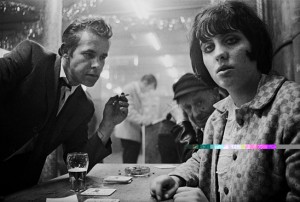
We will be holding our inaugural meet-up at Photobook London in the evening with an informal event of books, discussion and beer.
As well as the Photo Book Club bringing a selection of the books they have looked at over the past 6 months, those who wish to attend are asked to bring along a photobook to share and discuss. After the event, one of these books will be chosen to be January’s book on the Photo Book Club. This event has a limited number of spaces, please email info@photobookclub.org to reserve a space.
Date: Monday 5th September
Time: 18:00
Location: PhotoBook London 29-31 Saffron Hill London EC1N 8SW
Throughout September we will not only be looking at Invisible City, but we will be hearing from its author Ken Schles who will not only be giving us a unique insight on how the book came to be, but also answering questions from Photo Book Club readers on the book, his practice and anything else that you would love to ask one of the most important photographic minds working today.
The Photo Book Club Meet-up map has now had over 10,000 hits and a smattering of people adding themselves to the map in order to meet up with like minded ‘photobook-folk’. We also have the first few meetings shown on the map so make sure you check out if they are near you!
Some people have contacted me having trouble with adding themselves onto the map and so in order to make this smoother, I have created a form below and on the Meet-up page which when filled in, will be sent to myself in order to add you to the map.
If you are planning to host or organize a meeting, pop an email to matt@photobookclub.org and we shall add this to the map as well as publicize it on the website.
Note The map is still public and can be edited by anyone, this public nature also means that the information you provide can be seen by other users. If you would rather, you can provide a website instead of direct contact information, and a rough location rather than your house!
I will be looking closely at the photography book in particular and ways in which I see it developing, as well as the huge support we have had for the Photo Book Club, and for the physical books and stores that we all love.
If you would like to attend, you can get your tickets from this website. The talk takes place on September 17th at the Department of Anthropology, University College London from 10.30am – 3.00pm.
‘For a decade Ken Schles watched the passing of time from his Lower East Side Manhattan neighborhood. His camera has fixed the instances of his observations, and these moments become the foundation of his invisible city. Friends and architecture come under the scrutiny of his lens and, when sorted and viewed in the pages of this book, a remarkable achievement of personal vision emerges.’
As we have previously mentioned, come September we will be looking at Ken Schles’ ‘Invisible City’ with Ken himself agreeing to take part in the discussion and be available to answer any questions.
In order to do this we need to ensure as many people as possible can see this very rare and often expensive object. And so we have produced two videos which are shown below. The first displays all the images from ‘invisible City’ sequenced as they are in the book. The second video shows the book as an object in itself to give an idea of the layout, typography, size and feel of the book.
You can also flick through the book at your own pace with the slideshow at the bottom of the page (Click to advance)
We would love to hear first thoughts upon seeing the images and book as well as any questions which we can put to Ken when he joins us in September: email mail@photobookclub.org or find us on twitter – @photobookclub
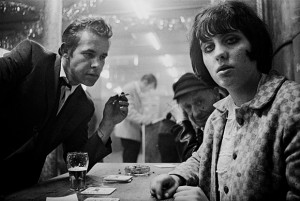
Thanks to all who have contributed to the discussion on Anders Petersen’s ‘Cafe Lehmitz’. It has been a really busy month! We have compiled an archive of the posts below for future reference and will also be listed under the reading list page.
Our thanks to Aya Takada fro producing this text on Anders Petersen’s Cafe Lehmitz which is featured here in both a Japanese and English translation. As well as checking out her website, you can follow Aya Takada on Twitter.
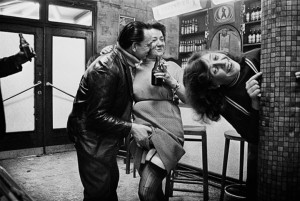
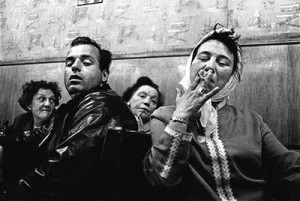
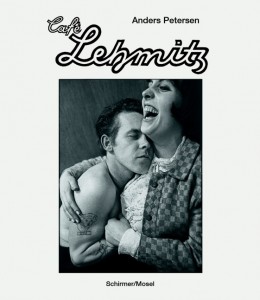
It is in the photo exhibition “Rat Hall Gallery” in Tokyo in 2007 that I first met Cafe Lehmitz. The first impression I saw reminded me of the book jacket from ‘Weegee’s people’, the production and typography were splendid. However it is the latest Cafe Lehmitz by Schirmer/Mosel that exists in my hands now.
If the book is opened, it is possible to put your own body to Cafe Lehmitz.
“It seems this is not work that a young person produced.” There are times when you hear that kind of opinion, but on the other hand, it is through a young photographers eyes that this very pure and straight style could emerge. It seems like a conventional approach was chosen, simple and lacking in sensational images with a rustic feel. The work is not dissimilar to that of Daido Moriyama in this respect.
The characters are seen not as supportive as if the heart and mind, body and mutual support the body, sometimes they show a winsome look for the photographer, and with each passing page, the subjects seems gradually to release themselves to Petersen. I feel a deep affection for the subject from the photographer. I feel a line of vision near the sense that parents watch the child in a word to which family’s photo album is concluded. This will be able to be seen from the portrait of the photographer in the back book cover. The family is indispensable for Cafe Lehmitz.
A Photo Book Club suggests physical meetings, and it is something we have always wanted to be part of, and help facilitate. And so you can now find a map on the ‘Meet-ups’ page which we hope to get populated with people and meeting places.
Wayne and I will take part in potentially the first meeting this September as part of Photobook London although if anyone has a meeting before let us know!
A great idea to check out – The Photo Book Swap has popped up online and will be organizing photo book swapping events so you can trade in your books that you bought on the spur of the moment and since decided you didn’t like – it could bring someone else hours of pleasure!
What’s more, it sounds like CAKE and BEER will be available at said meetings – see you there!
Our thanks to Aggie Morganti for getting in touch to share a love of Anders Petersen’s ‘Cafe Lehmitz’.
If anyone wants to continue the conversation with Aggie, you can do so on Twitter, here.
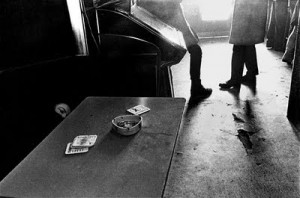
I’ve often wondered what makes Cafe Lehmitz so special to me. It’s not only about its exquisite photography, its visual intensity, its emotive tension running through the edit. That special something is, somehow, a step backwards, hiding in the making itself rather than in the final object.
Anders Petersen - Cafe Lehmitz
I am amazed every time I flip through it by its unique way of being so rich and so poor at the same time. It is rich in all the above mentioned, and poor in pretentiousness. Straightforward, down to earth, honest-to-God report of what had to be reported – and nothing else. The book itself is stripped down to the bare essentials and it only makes me love the fancy title lettering even more, so much that I almost see it blinking on and off as a neon light from a bar would do in the dark of night.
It’s so transparent you can see through it – or feel you’re there. And the reason why I love it so much is that I have a very personal photographic memory related to Cafe Lehmitz (I’ll be brief – promise).
So, I was around 20 and I had just started to discovery what you could do with documentary photography in terms of storytelling and powerful narratives. It was a gloomy afternoon in December, in Lucca, and I was attending photojournalist Massimo Mastrorillo’s workshop on such matters.
To provide us with guidance and advice, he had brought some of his favourite photobooks with him (and many of them would also become a pick of my favourites later on, such as Billingham’s Ray’s a Laugh or Telex Iran by Gilles Peress). The table was literally flooded with wonderful things, and I remember this little, black and white white compact book striking me straight on. Cafe Lehmitz was special to him as well, for Massimo’s main advice to us was to follow what really means to us in our photography. To follow what literally grabs your heart and your stomach and does not let you go, to photograph what you love, in any possible way.
So, as I have tweeted before – this is what I’ve always found in Cafe Lehmitz from that moment on. Love, warmth of heart, being human, humble and true. That’s what I like about it and what I think of every time I start doing something photographic.