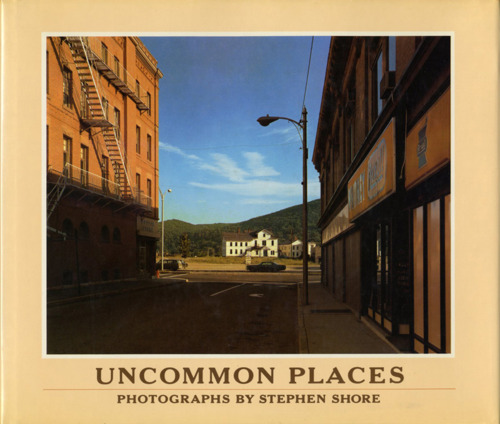
Stephen Shore. Uncommon Places, 50 Unpublished Photographs 1973-1978
From what I can tell via the publisher ‘Verlag der Galerie Conrads‘ the book ‘offers the first complete examination of Shore’s long and storied career, from his residency at Warhol’s Factory to his experiments in conceptual photography; from his landmark series AMERICAN SURFACES to his continued exploration of emerging techniques. Shore’s high-key portraits of America’s chromatic landscape can be found in the permanent collections of major museums all over the world.’
I would be keen to here more from anyone who has the book, is this a must for Shore fans or a bonus book for the die-hards only?
Karen said:
I’ve only realised after reading these articles on the Photo Book Club that my copy is “uncommon places 50 unpublished photographs 1973-78″ not the full book, none the less I still love it. There’s something about Shore’s work that excites me, something about the everyday, the normalcy, maybe it’s a nostalgia effect, maybe it’s the romanticism of Americana (for me), I can’t quite say.
Bonifacio Barrio Hijosa of ‘Gloves for Dummies’ got in touch today to let me know about the latest photobook meet-up starting in Madrid, Spain. The first even is planned for the 28th of February (19.00) and is to be held at the Real Sociedad Fotográfica. For more info, hit the link and see the ‘Tertulia de libros’ event.
Thanks to Simen Edvardsen who runs the blog ‘Enthusiasms’ here for this post comparing and relating Shore’s ‘Uncommon Places’ with the moods and thought’s of Jack Kerouac in ‘On the Road’. This is a fantastically rich article which I hope will be enjoyed in it’s entirety.
(And if you still have not seen Uncommon Places, the video is found at the bottom of this post)
– Matt
On the Road is the fictionalized account of a number of road trips Jack Kerouac took across America together with his friend Neal Cassady and an assorted menagerie of other characters in the late 1940s; Uncommon Places is the photographic account of a number of road trips Stephen Shore took, chiefly alone, through the 1970s, armed with an 8×10 camera and color film. I promised earlier that if I could get over myself, I would describe these two together, as I think they are in many ways similar and in some other ways dissimilar, but in almost every way illuminating in light of each other. Well, I got over myself and besides, I only finished reading On the Road recently, so here are some thoughts.
Beverly Boulevard and La Brea Avenue, Los Angeles, California, June 21, 1975
On the surface, the one thing that ties these together is the road, but I think there’s more to it than that. For one thing, they both take a particular interest in the unparticular, the mundane, the scenes that we pass through every day without consciously registering them. On the Road is written in a streaming way that is by turns impressionistic and quite frankly incoherent, with little to no meaning but with a certain poetic beauty, and an almost photographic depiction of the little things, which we can see as the literary analogue of the super-detailed scenes of everyday life in Anywhere, USA that Shore would later depict with his large format 8×10 camera. The characters, and especially Dean Moriarty/Neal Cassady, have an exaggerated but sincere fascination with everything, large and small, significant and insignificant. Kerouac was inspired by and tried to incorporate the free-flowing and vividly detailed letters Cassady wrote to him and to other of his friends — his wife described him as having a photographic memory — and this kind of raw curiosity and visual sponging-up of every detail is both analogous to the mega-negatives that Shore later exposed to the everyday world he passed through and captivating to read (for me, anyway). Here’s a wonderful little passage from Part Four of On the Road, which describes a trip from Denver to Mexico City — it’s an exalted overfascinated curious little monologue by Dean:
Oh! This is too great to be true. Gurls, gurls. And particularly right now in my stage and condition, Sal, I am digging the interiors of these homes as we pass them — these gone doorways and you look inside and see beds of straw and little brown kids sleeping and stirring to wake, their thoughts congealing from the empty mind of sleep, their selves rising, and the mothers cooking up breakfast in iron pots, and dig them shutters they have for windows and the old men, the old men are so cool and grand not bothered by anything. There’s no suspicion here, nothing like that. Everybody’s cool, everybody looks at you with such straight brown eyes and they don’t say anything, just look, and in that look all the human qualities are soft and subdued and still there. Dig all the foolish stories you read about Mexico and the sleeping gringo and all that crap — and crap about greasers and so on — and all it is, people here are straight and kind and don’t put down any bull. I’m so amazed by this.
All this from passing a few houses on the road. Stephen Shore, decades later, found that he didn’t need to focus on anything in particular, because his film was so huge and slow that it preserved approximately every detail you could ever desire and still had room for cramming in a piece of bacon should you so desire, so instead of putting one thing or another in center his images are for the most part in focus front to back and there are these little wonderful details that you don’t notice because no one forces you to stop and look at the everyday (dare I say, the daily meh), but Shore captures them and shows them to you, if you wish to look. On a second or third look, or even a fifth or fifteenth, you can still find details you didn’t notice on any of the previous viewings. I don’t know about you, but I can’t but admire the fascination and sincere interest in ordinary stuff — I’m too much of a sucker for the extraordinary and special which we can’t have every day anyway, and if I could only learn to enjoy the simple stuff and take in the world in the way one does when visiting a truly foreign country for the first time, life would be so much more interesting and exciting. Babies have this ability and I wish I had kept it, and admire those who do.
Presidio, Tex., Feb. 21, 1975
So, there’s all this detail, and Shore lets it sit there waiting to be discovered, instead of putting it left, front, center, in the rule-of-thirds-prescribed position, or anywhere else where you might expect it. Instead, he looks at lines and perspectives and puts on these displays of composition — not just a buzzword used as a placeholder for “I like your pic” on Flickr, see — that are nigh unparalelled in photography. I think if you took a bunch of transparencies, put them over Shore’s pictures and drew out the lines and stuff, you would have yourself a textbook in composition. Stephen Shore’s uncommon pictures of common places are real marvels of lines, really formal but nice. And there, my pairing of these two books starts straining and feeling forced.
I mean, both Shore and Kerouac are on the road, and both document it in their chosen medium, and both photobook and novel eventually became landmarks in their respective traditions, both capturing the zeitgeist and signaling, legitimizing a form of expression (art photography in color and the beat, “spontaneous prose” and then-vulgar lives of the Beats, respectively). Both are concerned in some way with the ordinary. But really. Sal Paradise and Dean Moriarty (especially the latter) are amoral adventurers who experiment with drugs, sex, breaking the law, peeking over the edge of life down to death, testing the limits of friendship, alternatively doing dirty jobs and living off momma’s grace to sustain themselves, digging the world, and generally being genuinely counterculture. They are obscure and searching. Stephen Shore, both the man and his photographic persona, seem quaint in comparison. He’s two decades too young to be a Beat, and according to interviews he once dressed up as a jungle explorer of the 1800s for the task of driving around the fucking country in a car, abiding the law, risking nothing, and taking pictures. His edginess consists of his choice of film (color) and something that would be called guerilla art today: distributing postcards he’d made of Amarillo, Texas (with nothing vulgar or interesting on them, in fact they looked like ordinary postcards) at store stands. His days as one of the cool kids are over when he turns to the road. Besides, he’s already famous, as famous as an art photographer gets, anyway.
Trail’s End Restaurant, Kanab, Utah, Aug. 10, 1973
That’s one of the important differences between Shore and Kerouac on the road, besides the obvious. Jack Kerouac was an obscure writer until he woke up the morning after he late at night had bought the freshly printed NY Times from an all-night newsstand and read its glowing review of On the Road — or so the legendarium that is the critical introduction to my copy of the book has it. Stephen Shore’s minibio up until his road trips, in contrast, looks like this: first photo kit at 6; calls up Edward Steichen, curator at MoMA, and sells three of his photos at 14; hangs around Andy Warhol’s Factory, taking pictures and getting to know Andy, from 17 and on; second living photographer to have a solo show at the Metropolitan Museum of Art at 24; experiences the greater America outside NY for the first time on a road trip around the same time. He was a successful artist and a naive youth when he set out while Kerouac was unknown, struggling, almost as naive but probably more world-weary when he hit the road. In common, they had a search for something, anything, whatever: meaning, or another of the eternals that we humans seek and seek and have sought since the dawn of time.
Of course, my slamming of Shore is only my youthful love of rebellion, otherness, edginess, which On the Road has in spades (though it’s no longer shocking, because, well, we’re used to that kind of stuff now) — even as I acknowledge that going the other way just for the sake of going the other way is stupid, that going the opposite way of the herd is no better than mindlessly going along with it. Shore’s project is by far the most mature, but also, I suppose, less fun. Both the view camera with its hyperdetailed images and the kaleidoscopic by turns hyper-aware and impressionistic, unconscious looking at the world that happens in On the Road are examples of what Shore calls “a heightened awareness of the world.” Shore is meticulous, both because he wants to be and because his large, slow camera forces him to be; Dean Moriarty is as fascinated by the world as Shore but he has the attention span of a goldfish and rather than slowly setting out to capture everything he almost accidentally inhales it. The characters in On the Road sound like they’re high (which they often are) even when they’re not. If Shore’s hyperawareness is achieved by the equivalent of meditating calmly in a cave for a decade, Dean and Sal’s is like ODing on life. No wonder Stephen Shore is still alive and will probably live to be both seventy and eighty (random unknowns notwithstanding) while both Kerouac and Cassady, the models of the characters in On the Road, died relatively young.
I’ve mentioned hyperawareness several times now, and it’s undeniable that the technical equipment has a large part in achieving this for Shore, while Kerouac’s and Cassady’s hardly can be attributed to their typewriters. View cameras are large, tripod-operated, slow, and they produce enormous negatives/slides (I was amazed when I realized the pictures in Uncommon Places the book are just a tad larger than the film that was exposed to produce them). The fact that a tool had something to do with it sort of destroys my neat as hell ten-years-of-meditation metaphor, but it’s true. Interestingly, Shore mentions in one interview — sorry, I didn’t keep notes while researching this post, so I don’t have a link — that he was actually more anonymous and drew less attention with his view camera than with his previous small 35mms. What was a spontaneous process in the precursor to Uncommon Places, the photographic diary Shore kept on one of his first road trips (in 1972) and which was exhibited to unglowing reviews as American Surfaces (guess what subject matter he chose), where he photographed everything casually with a small camera, became an involved process in Uncommon Places. He photographed his pancake breakfast early on, and where previously he would have reached for the camera, snapped a pic and then eaten, all while sitting, he now had to put his tripod-mounted camera on a chair, set it all up, focus via ground glass and everything, and when the picture was finished his pancakes were long cold.
On the other hand his newfound anonymity-by-hiding-in-plain-sight allowed him to photograph streets without having anyone complain or act up; the long-haired kid lurking around with a not always obvious camera that he was in American Surfaces wasn’t always welcomed. But then again Uncommon Places has few people in its pages, even in the Complete Works edition I have that contains some 100 pictures previously cut to keep the price down, including some more portraits and interiors. What is more important is that it forced him to or facilitated his looking at patterns, at lines, at corners and shapes, at the picture as a two-dimensional thing, and it resulted in his virtuoso performance as a photographic composer. Everything’s almost always placed so that there’s an underlying order. Poles and cables are everywhere, perspectives recede into the sharp background and your eyes are led into the picture as you switch between looking at the shapes and colors on the one hand and the 3D scene they represent on the other. All the while Shore doesn’t actually touch the scene. He can’t: his scenes are buildings, other people’s shops or homes, the urban landscape, stuff too heavy to move or choreograph other than by moving the frame, and he has only natural light to illuminate the stuff.
Merced River, Yosemite National Park, California, August 13, 1979
The details and the composition is illustrated well by the picture of Merced River, above. In recent years Shore has been making a series of small-run photobooks with iPhoto, and one of them consists solely of crops from Merced River. While this might have been a cheap gimmick from just about anyone, from Shore it works. At least the web-size pics I’ve seen of it. The technical quality is, of course, up to par, as you’d expect from the equipment. But there are so many details and patterns in this picture that, particularly when looked at up close, or as in Shore’s little book in crops, they stand up as individual pictures.
Uncommon Places is the only photobook I own. I love the photos in it. I can praise their subject matter, their exposure and composition and light and tonalities. But what appeals to me about both Uncommon Places and On the Road, as a young person and as someone who often feels like an outsider, not an interesting outsider with a backstory and a sidekick but simply one on the outside looking in on life, is the search and the guts. Out on the road, experience things, genuinely, without scarequotes around the experiences to protect from the criticism that inevitably comes from expressing a real, honest feeling about anything, and above all, live while you’re alive and worry about death while you’re dead (which is to say not at all) — that attitude is so full of life and so much of what many aspire to be, it’s pathetic, romanticizing and awesome. And here the pairing of these two books again falters, because when Shore talks about his project he talks about solving aesthetic problems, while Kerouac says things like:
… I shambled after as I’ve been doing all my life after people who interest me, because the only people for me are the mad ones, the ones who are mad to live, mad to talk, mad to be saved, desirous of everything at the same time, the ones who never yawn or say a commonplace thing, but burn, burn, burn like fabulous yellow roman candles exploding like spiders across the stars and in the middle you see the blue centerlight pop and everybody goes ‘Awww!’
While Stephen Shore also occasionally mentions that before the set out to do American Surfaces, he hadn’t seen much of the world outside New York and he wanted to rectify that, often he talks more about aesthetics and whatnot, maybe because his project has nothing to do with that search for meaning, purpose, a life that we find in On the Road, or maybe — and this is what I prefer, since I want him to be an actual adventurer and I want him to be someone I can identify with, even as I consider that this might be simply wishful thinking — or maybe he’s simply older and slightly embarrassed about the illusions of the road he had when he set out. In one interview he says he didn’t set out to copy Jack Kerouac or Robert Frank (another photographer who produced a seminal work documenting America, called The Americans, published around the same time as On the Road and with an introduction by Kerouac). He says that who he was really emulating was “a young painter who picks Jack up outside Cheyenne and takes him to Denver”, but “with a camera instead of a paintbrush.” That young painter did not make an impression, to say the least. I can’t even remember him, and I just read the book. So maybe his project isn’t that exciting in the meaning-of-life-searching way.
Cedar Springs Road, Dallas, Texas, June 5, 1976
One last thing. Both books have a sad undercurrent. There’s one picture of Shore in Uncommon Places, not counting one where only his feet are visible, and it’s a self portrait taken in his apartment in New York. In it, he’s staring emptily (if not angrily) into the camera (detail from that picture). The picture doesn’t fit in with the rest at all and yet strangely does, since it exemplifies the man behind the project, and maybe a little bit of his soul. Sal Paradise/Jack Kerouac, too, is a sad person. He is extremely extraverted compared to everyone I know, yet also sad and introspective (something I can more readily recognize in myself), and he has illusions of or hopes for the road that turn out to be nothing but disappointments. He is looking for something, for anything to make his life great, he’s having fun but also can’t shake the feeling that he’s been cheated out of whatever vague glob of happiness the dream promised him, and in the end, a lot is experienced (and isn’t the journey the point?) but nothing is accomplished. After his trips, Kerouac continued to seek meaning while he was struggling to write his road novel and get it published. When it finally was published, he couldn’t handle it, and his last years of life weren’t exactly characterized by the cheerful joy and hyperawareness of the best and most optimistic passages of On the Road.
In the end, we don’t know anything (except, per Socrates, the preceding fact) and especially so when we’re young. We seek but we don’t find. In fact I think the answer may be not to play the game: excessive introspection and meaning-seeking, while not exclusive to introverted and intellectual wannabes, always stands in the way of happiness. Happy people never look like the aforementioned intellectuals with big thoughts and huge doubts. Throwing yourself on the road and trying to live in the now is certainly one way to combat this, but whether or not it’s a success is a different question altogether.
As we look at Stephen Shore’s ‘Uncommon Places’ this month I have been overwhelmed by the amount of great resources online to get your Shore fix on. A few are linked below, these are by no means the only interviews/posts on Shore’s work, but offer a good starting point:
Interviews
Stephen Shore and Aaron Schuman ‘Uncommon Places’ 2004 (on Seesaw) Select Quote: (reffereing to the original Uncommon Places) “Well, I’m not turning my back on that work. It’s all included in the new edition. It’s just that, the original ought to have been twice the size to include other stuff. That aspect of the project was that aspect of the project. But, it just wasn’t the complete project.”
Stephen Shore and Rong Jiang ‘The Apparent is a Bridge to the Real’ 2007 (on ASX) Select Quote: “I wanted to see what our culture was really like. I knew New York. And in “American Surfaces”, there were a good number of pictures taken in New York City. But I wanted to see a wider spectrum of a culture. I wanted to see the ordinary things that were not the news.”
Videos
Stephen Shore ‘Uncommon Places’ 2011
– Shore talks about his compositional style, technique and his choice to present images from Uncommon Places as unusually small prints.
Photo LA – La Brea Matrix (Part 2)
– Shore joins a panel including Marcus Schaden to talk about the La Brea Matrix project of which he is both the inspiration for, and a part of.
Stephen Shore in Dublin
This short film follows Stephen Shore during a gallery setup in Dublin and it contains a conversation about one specific photo (New York City 2000/2002) between him and John Hutchinson, director of the gallery.
Stephen Shore in Paris 2010
– Phaidon produced this short video primarily concerning Shore’s journey into photography as well as Warhol’s influence on the photographer
Eggleston AND Shore
– William Eggleston and Stephen Shore share a stage in a brief interview
Uncommon Places, The Complete Book
– Of course our own video showing Uncommon Places (The Complete Works) in it’s entirety can be found here or at the end of this post
Posts
Blake Andrews on La Brea and Beverly
La Brea and Beverly (2011) by Blake Andrews
– Here Blake deftly melts together Shore’s original images made at the La Brea and Beverly intersection with a variety of quotes and other artworks made at the site from the likes of Banksy to Dalton Rooney who visited the site via Streetview.
“Shore’s new book finally reveals that this extensive body of work has always essentially been a photographic autobiography-an autobiography of seeing”
Those who have followed the Photo Book Club from it’s early days will remember Stan Banos’ valuable contribution to our discussion of Eugene Richard’s ‘Cacaine True, Cocaine Blue’. Now, I thank Stan again for his comment on the effect Shore’s large format images had on the print galleries and collectors market:
Eggleston’s Guide along with Shore’s Uncommon Places were THE two sources most often studied, cited and emulated back in those heady days of “New Wave Color”. They were the bibles; both were a sea change on how we perceive and appreciate the medium to this present day. And while Guide launched color to the forefront of photography, Shore’s work reinforced the move to large format as the legal tender of the fine art photo world- a move which not only had far reaching effects in how we see and relate to photography in terms of composition, and in terms of size, but also in economic terms.
Photo galleries could now display art work that could rival the size of painting, and thus gain more handsome, desirable profits (I often wonder how those ’80s C-prints have survived). It helped “legitimize” photo galleries from the relative cult status of the art world’s poorer siblings, to the Upper East Side venues of the mainstream. Fine art photographers could now wield the more formidable tools of large format loaded with the new art market weaponry of color film. It was a potent combination that drove a stake through the then still beating heart of small format, B&W “art” photography- as well as through the aspirations of those who could not afford the expenses that large format entailed.
For those who may not have access to either the original book, or ‘The Complete Works’ edition, I have made a video of my own copy (Complete Works) which can be seen below.
We would love to have as many people as possible to share their thoughts, whether this is your first viewing or you have owned and treasured a copy for decades! Please leave any comments in the section below and I shall post them towards the end of the week.
Before writing this synopsis and heading into the month long look at Shore’s book, I should point out that there are two books called ‘Uncommon Places’ by Shore, although to give the second it’s full title ‘Uncommon Places, The Complete Works’.
The original 1982 publication would set you back between £6-900 for a book in good nick and so there will be no book-bias here. Whichever copy you have, we would love to hear your thoughts. – Myself, I will be looking at a copy of ‘Uncommon Places, The Complete Works’ and occasionally the original from my local library
Title Uncommon Places/Uncommon Places, The Complete Works
Author Stephen Shore
Publisher Aperture 1982/Aperture 2004
From the publisher:
Published by Aperture in 1982 and long unavailable, Stephen Shore’s legendary Uncommon Places has influenced a generation of photographers. Among the first artists to take color beyond advertising and fashion photography, Shore’s large-format color work on the American vernacular landscape stands at the root of what has become a vital photographic tradition. Uncommon Places: The Complete Works presents a definitive collection of the original series, much of it never before published or exhibited.
Like Robert Frank and Walker Evans before him, Shore discovered a hitherto unarticulated version of America via highway and camera. Approaching his subjects with cool objectivity, Shore’s images retain precise internal systems of gestures in composition and light through which the objects before his lens assume both an archetypal aura and an ambiguously personal importance. In contrast to Shore’s signature landscapes with which “Uncommon Places” is often associated, this expanded survey reveals equally remarkable collections of interiors and portraits.
As a new generation of artists expands on the projects of the New Topographic and New Color photographers of the seventies—Thomas Struth (whose first book was titled Unconscious Places), Andreas Gursky, and Catherine Opie among them—Uncommon Places: The Complete Works provides a timely opportunity to reexamine the diverse implications of Shore’s project and offers a fundamental primer for the last thirty years of large-format color photography.
At age twelve, Stephen Shore’s work was purchased by Edward Steichen for the Museum of Modern Art. At twenty-four, he became the first living photographer to have a one-man show at the Metropolitan Museum of Art, New York. Other one-man show venues include the Museum of Modern Art, New York, the Art Institute of Chicago, and the Kunsthalle Düsseldorf. He has received two National Endowment for the Arts Grants and a Guggenheim Foundation Grant, and has been the Chair of Bard College’s photography department in upstate N.Y. since 1982.
The Photo Book Club Barcelona meets once again tomorrow night. Unfortunately (but in a great way) all the places have already been taken, and there is currently a waiting list for these meetings!
Those who are lucky enough to go to the event: I would love to hear a review of the evening, from a participants point of view ( matt@photobookclub.org )
A few months ago Ken Schles spoke at the SPE Northeast Conference in Syracuse, if ever there was a dream-team conference, this was it for me! Ken’s talk was posted online yesterday and I recommend anyone with even a passing interest in photobooks must take the time to view it.
Ken takes us through all four of his monographs, looking both at content and theme as well as the publication challenges and triumphs he experienced. What most interested me is just how much Ken’s books seem ultimately to form chapters in a much larger body of work, his interests and more importantly questions are never repeated, but we are reminded of them constantly.
Ken is proof that Tod Papageorge knew what he was talking about:
“If your pictures aren’t good enough, you aren’t reading enough” – Tod Papageorge
This talk is best enjoyed with a chilled beverage and note taking device
After a break over Christmas the Photo Book Club will be resuming normal service in February. There will also be a Meet-up in Coventry which I shall be running as part of the open photography class #picbod, and so if anyone is interested in attending and is in the West Midlands area, pop me an email.
And so to the first few books we will be looking at in 2012; we start with Stephen Shore’s ‘Uncommon Places’, followed by Sally Mann’s ‘Immediate Family’. Two classic American photobooks and two that I am sure will lead to some interesting discussion. – If you would like to write a personal reflection on either of these books, or suggest what we might look at in April, you can do so in the comments below, or via email.