Categories
CLOSER LOOK COMMENTS

Paul Graham’s British Road Trip

The A1 road for those who know it, or know the book, doesn’t exactly conjure up thoughts of a road trip or road trip aesthetic. There are no dessert vista’s here, no vast stretches of road ahead and behind. This is most certainly not the orange-tinted views of Wim Wenders or Stephen Shore as they pass through El Passo and Nevada, neither does it evoke thoughts of Kerouac or Pirsig’s prose.

©PAUL GRAHAM

This isn’t to say we do not recognize some of the conventions of the genre in the images, particularly in the diners, cafes and petrol stations, but Graham has also weaved a decidedly British streak into the book. Bright blue skies give way to overcast days and wet roads, neon is only seen once, and all in all, this is a much more subdued photographic approach. No fanfare will be found here, just a well paced, expertly edited series of images, and in this I find myself looking harder, and for longer.

©PAUL GRAHAM

What lies at the heart of this book (to myself at least) and does conform to the road genre is the human encounters Graham has documented along the A1. These are all characters we recognise, they are the hundred of people we see in the car alongside, or in the adjacent cubicle at a restaurant and if you are anything like me, you wonder about why they are here, now, or what it is they do and why they do it. Almost all of the subjects in ‘A1’ hold the camera’s gaze back, I like to think they are looking at Graham, or at me, wondering exactly the same things.

©PAUL GRAHAM

Interestingly, while we see life from the road, cafe’s and fields going by, even pulling up to a petrol station, we are never inside the car. It is at first an odd omission, especially compared to the more well known photography from the US dealing with the road, it’s landscape and it’s stories. But in doing so Graham remains very much a traditional documentarian, slightly removed from each situation he encounters unlike his Stateside contemporaries. The result is another reason this is such an important and unique piece in the ever expanding road photography genre.

– Matt

And if you haven’t seen the book yet…
Categories
SYNOPSIS

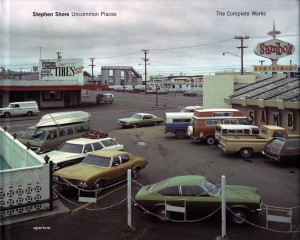
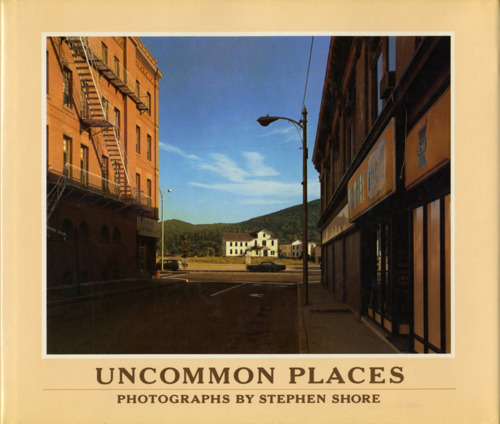
Synopsis: Stephen Shore’s ‘Uncommon Places’

Before writing this synopsis and heading into the month long look at Shore’s book, I should point out that there are two books called ‘Uncommon Places’ by Shore, although to give the second it’s full title ‘Uncommon Places, The Complete Works’.
The original 1982 publication would set you back between £6-900 for a book in good nick and so there will be no book-bias here. Whichever copy you have, we would love to hear your thoughts.
– Myself, I will be looking at a copy of ‘Uncommon Places, The Complete Works’ and occasionally the original from my local library

Title
Uncommon Places/Uncommon Places, The Complete Works

Author
Stephen Shore

Publisher
Aperture 1982/Aperture 2004

From the publisher:

Published by Aperture in 1982 and long unavailable, Stephen Shore’s legendary Uncommon Places has influenced a generation of photographers. Among the first artists to take color beyond advertising and fashion photography, Shore’s large-format color work on the American vernacular landscape stands at the root of what has become a vital photographic tradition. Uncommon Places: The Complete Works presents a definitive collection of the original series, much of it never before published or exhibited.

Like Robert Frank and Walker Evans before him, Shore discovered a hitherto unarticulated version of America via highway and camera. Approaching his subjects with cool objectivity, Shore’s images retain precise internal systems of gestures in composition and light through which the objects before his lens assume both an archetypal aura and an ambiguously personal importance. In contrast to Shore’s signature landscapes with which “Uncommon Places” is often associated, this expanded survey reveals equally remarkable collections of interiors and portraits.

As a new generation of artists expands on the projects of the New Topographic and New Color photographers of the seventies—Thomas Struth (whose first book was titled Unconscious Places), Andreas Gursky, and Catherine Opie among them—Uncommon Places: The Complete Works provides a timely opportunity to reexamine the diverse implications of Shore’s project and offers a fundamental primer for the last thirty years of large-format color photography.

At age twelve, Stephen Shore’s work was purchased by Edward Steichen for the Museum of Modern Art. At twenty-four, he became the first living photographer to have a one-man show at the Metropolitan Museum of Art, New York. Other one-man show venues include the Museum of Modern Art, New York, the Art Institute of Chicago, and the Kunsthalle Düsseldorf. He has received two National Endowment for the Arts Grants and a Guggenheim Foundation Grant, and has been the Chair of Bard College’s photography department in upstate N.Y. since 1982.