Categories
REFLECTION

Observations – A Personal Reflection

This first personal reflection is from Wayne Ford, we would love to hear yours, especially if you have seen Observations for the first time from our video. Feel free to add it in the comment section for it to be posted here, or email mail@photobookclub.org

Wayne Ford

I first encountered the work of Richard Avedon through the art direction of Russian émigré Alexey Brodovitch (1898-1971), as a young graphic design student in the early 1980s. As my interest in editorial design grew, Brodovitch who was art director of ‘Harper’s Bazaar’ for almost a quarter of a century (1934-1958), became central to my studies.

Brodovitch was instrumental in introducing the ‘modern’ graphic design style that emerged through a number of art and design movements in Europe in the 1920s to the United States, in addition to which as Andy Grundberg writes, ‘Brodovitch is virtually the model for the modern magazine art director. he did not simply arrange photographs, illustrations and type on the page; he took an active role in conceiving and commissioning all forms of graphic art, and he specialised in discovering and showcasing young and unknown talent.’

Having arrived in New York in 1930, Brodovitch would regularly commission the likes of Bill Brandt, Brassai, Henri-Cartier-Bresson and Man Ray, his first design assistant was the young Irving Penn, and the list of photographers that he mentored in his long career, reads like a who’s who of twentieth century photography, Lillian Bassman, Robert Frank, Lisette Model, and of course Richard Avedon.

The copies of Brodovitch’s Harper’s Bazaar that I own are well thumbed, the mix of unmatched design and art direction, continually draws me back, as does my copy of ‘Observations’ for Avedon’s immensely powerful portraits, and also because the book itself was designed by Brodovitch.

Note: A small piece of trivia, it is well known that Fred Astaire’s role as a photographer in the film ‘Funny Face’ (1957), is styled upon Avedon, but the films art director is called ‘Dovitch’ reflecting the pairs influence on the world of popular culture during the period.

Categories
BOOKS

Richard Avedon: Books

‘Observations’ doesn’t have the lineage of Frank’s ‘The Americans’, but we had some very positive feedback on including other books by Robert Frank and so have compiled the following resource for Richard Avedon:

Other books by Richard Avedon

Where possible, Amazon links have been provided


Links
www.richardavedon.com

Categories
BOOKS

May’s book is… Eugene Richard’s ‘Cocaine True, Cocaine Blue’

Were still looking Richard Avedon’s ‘Observations’ throughout April but a heads up:
Next month for the first user suggested month, we will be looking at Eugene Richards ‘Cocaine True, Cocaine Blue’ put forward by Jags Parbha.
Do you have a copy?

More to follow at the beginning of May

Eugene Richards
Cocaine True, Cocaine Blue

Text from publisher Aperture books
This is a compelling portrait of three communities blighted by drugs and isolation: East New York, North Philadelphia, and the Red Hook housing projects in Brooklyn, New York. With a chilling and informative afterword by Dr. Stephen W. Nicholas, a pediatric AIDS physician in Harlem, Cocaine True, Cocaine Blue reveals how first steps toward solutions to overcome the drug trade have actually contributed to public denial and further isolation of the trapped communities. Cocaine True, Cocaine Blue is a history of our times, a terrifying document that will educate us and promote dialogue.

“Eugene Richards’s wrenching photographic study of the culture of cocaine in three inner-city neighborhoods gives faces to some of the victims of addiction. It provides a shocking and heartrending picture of the damage inflicted by the drug.”

–Charles Hagen, The New York Times

“Eugene Richards’s seventh book, Cocaine True, Cocaine Blue, reaffirms his position as the premier chronicler of the dark side of American life ˜ he is the true heir to the mantle of the legendary W. Eugene Smith.”

—American Photo

Copies of this book are still fairly easy to get hold of online and in some good shops (Abe Books link, Amazon link)

Categories
VIDEO

Video: Richard Avedon’s ‘Observations’

When we started looking at Avedon’s ‘Observations’ we mentioned that we would produce a video for those who could not get hold of a copy themselves. A video to show Avedon’s images, their layout, sequencing and so on. You can see the video embedded below, and as always we look forward to hearing your thoughts and suggestions.

Richard Avedon – Observations from Photo Book Club on Vimeo.

Note: Due to a family emergency our video producer has been unable to create this video, and so for now a rather dogeared copy that is my own (including absence of p84-5) has been photographed this morning. Our apologies. Matt
Categories
COMMENTS GUEST POST

Erik Palmer on Avedon’s ‘Observations’

Erik Palmer, creative director of Vico Collective and teacher of communication theory at Portland State, offered this great comment to Wayne Ford’s synopsis yesterday that we thought was deserving of it’s own post.

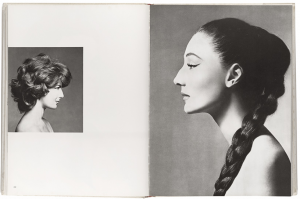
I own a battered copy of Observations, but had not looked at it in a couple of years. So, coming to it with fresh eyes, I think the first thing about the book, which we mostly take for granted, with our contemporary sensibility, is its very magazine-like architecture.

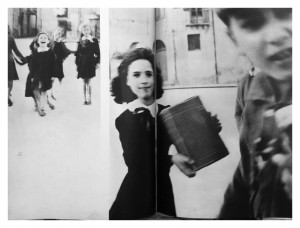
Viewing Observations from 2011, it’s hard to see how provocative it must have been to try to synthesize pop culture and high culture in a formal publication like a book, and in the way that Avedon and Alexey Brodovitch attempted here. Unlike a whole, unified, complete book, we have the joining of a number of not obviously related chapters, like magazine features: The Actors, The Singers, The Swans, The Couples, and so on. And then we have an even greater stylistic and thematic jump to Italy popped into the middle of this book.

Pages 74/75 The Italians ©RICHARD AVEDON 'Observations'

I don’t find the approach completely satisfying or successful. By comparison, I much prefer later Avedon books where he pursued a consistent formal approach, including the American West and Richard Avedon Portraits. These are the books where Avedon most clearly and successfully gives us what I want from him: the sense of confrontation that defined his white background portraiture.

Another important formal element that we see in Observations is the development of Avedon’s strategies of montage: his use of two images on facing pages to make implied claims of similarity or difference between the people pictured. Again, it seems obvious to our 21st-century media-saturated eyes that we should do this as photographic designers, but look for comparison at the techniques of sequencing and montage in The Americans.

Pages 146/147 ©RICHARD AVEDON, 'Observations'

Avedon’s pictures speak to each other and create higher orders of metaphorical meaning in a way distinct from Frank’s sequencing. Consider, for example, page 146, where Avedon joins photographs of Robert Oppenheimer and Martin Darcy in a similar stance, and that helps to inspire Capote’s analysis of appearance and virtue.

Erik Palmer

If you would like to write a guest post on the Photo Book Club, please contact mail@photobookclub.org

For those interested, Erik wrote a doctoral dissertation on Avedon’s work which can be accessed here (requires ProQuest subscription from your library)

Categories
SYNOPSIS

Synopsis: Richard Avedon – Observations (With comments by Truman Capote)

A note…

This month’s book ‘Observations’ is not easily accessible in your local library, nor is it affordable to most. But we consider it to be more than worthy of a Photo Book Club discussion, and so next week we will post a video looking through the book, making sure this incredible book is available to view by as many fans as possible!

Title
Observations

Author
Richard Avedon, with comments by Truman Capote

Publisher
Simon & Schuster, 1959

IMAGE ©RICHARDAVEDON.COM

Overview

Like Robert Frank’s ‘The Americans,’ which we discussed last month in the Photo Book Club, American photographer Richard Avedon’s first book, ‘Observations,’ was published in 1959. And, like ‘The Americans’ it was included in Andrew Roth’s ‘The Book of 101 Books: Seminal Photographic Books of the 20th Century (PPP Editions, 2001), now itself a seminal work on the history of the photographic book.

Having begun to take photographs during the Second World War, where he served in the Merchant Marine, Avedon became chief photographer of ‘Harper’s Bazaar’ in the late 1940s, where he helped redefine and elevate fashion photography to an art form, frequently taking his models out of the studio.

But Avedon’s first book did not focus on his fashion work, but on his iconic and penetrating portraits. In the 150 pages that form ‘Observations,’ with comments by the great American writer Truman Capote, we encounter the likes of Charlie Chaplin, John Huston, Alfred Hitchcock, The Duke and Duchess of Windsor, Arthur Miller, Pablo Picasso, Marilyn Monroe, Mae West, Judy Garland, Igor Stravinsky, Katherine Hepburn, Brigitte Bardot, Louis Armstrong, Humphrey Bogart, Buster Keaton, and many others.

Reflecting upon Avedon’s oeuvre, Maria Morris Hambourg recently wrote ‘By dint of progressive challenges to himself, Richard Avedon has not only distilled photographic portraiture to its irreducible core, but has also produced an extended meditation on life, death, art, and identity. Laureate of the invisible reflected in physiognomy, Avedon has become our poet of portraiture.’

Wayne Ford

Get involved

Let us know your thoughts by using the hashtag #photobc in Twitter or share links and blog posts in to comment section below.

Coming next…

Next week we will post a video, showing the book in all it’s glory to those who do not own, or have access to a copy (which is most of us!)

Categories
HISTORY LINKS

The Americans – A Summary

A huge thank you to all who have dropped by and especially those who have contributed in the first month of the Photo Book Club, looking at Robert Frank’s ‘The Americans’. We have compiled an archive of the posts below for future reference and will also be listed under the reading list page.

Please continue to share any links and further chatter around Frank’s masterpiece as we will keep updating the blog to provide an even better archive of information for future reference.

Categories
Uncategorized

April’s book is… Richard Avedon’s ‘Observations’

More to follow soon… but if you do or don’t know the book, let us know your thoughts by using the hashtag #photobc in Twitter or share links and blog posts in the comment section below.

Categories
WELCOME

Welcome to The Photo Book Club

Announcing the launch of the Photo Book Club

The idea for the Photo Book Club which will launch on 28 February 2011, grew out of conversations between designer Wayne Ford and photographer Matt Johnston, with the encouragement of photographer and educator Jonathan Worth.

The premise for the Photo Book Club is a simple one, each month we will discuss one book that we consider to have made a significant contribution to the world of photography, this may be a well known volume, such as Robert Frank’s Les Américains/The Americans, (1958/1959), which will signal the launch of the Photo Book Club, or a lesser known, but no less important work.

At the beginning of each month we will post a brief introduction of our chosen book on the Photo Book Club website, followed by a more in-depth comment on the work, and through the comment section of the website we aim to create a platform through which we can discuss the impact of each body of work through, over the coming weeks.

Whilst Wayne and Matt, both have ideas for the books that we would like to feature, we want the Photo Book Club to be an open platform, for a community to evolve, so we actively encourage suggestions for books, and in other ways in which we can develop the conversation, we want to create a community where the photobook in its widest context can be discussed and appreciated.

Whilst we are initially launching the Photo Book Club as a blog, and as a Twitter feed, we are hoping that in the near future we can arrange the occasional physical meeting, and even some print content too.

The Photo Book Club