Thanks to Lloyd Spencer for this reflection on Goldin’s book. If you would like to share your thoughts, see here.
A fascinating, compelling book. “Diary” is correct as it is the rather seedy and dissolute life that provides the real interest. Writing compellingly about such a life requires more skill than taking photos. Finding the words for the chaotic collisions, the violence or traces of violence, deciding how much to quote or report, what perspective to adopt: photography doesn’t really pose any of these challenges.
Nan Goldin emerges as a competent photographer and someone who probably lived her life (or her life ‘then’) as a kind of unfolding photobook . . .
The result is a pretty unique work. But unique (unmatched) also in Goldin’s subsequent career…
There is an abundance of online resources for those looking to learn more about both ‘The Ballad of Sexual Dependency’ and Nan Goldin herself. I have compiled just a few of these together, firstly looking at interviews:
Nan Goldin interviewed by Adam Mazur and Paulina Skirgajllo-Krajewska
Quote: “I went to school and there was a teacher who showed me Larry Clark. It has entirely changed my work. I knew that there had been somebody else who had done [photographed] their own life.”
‘The Dark Room’: Nan Goldin interviewed by Sheryl Garratt
Quote: “The music we were brought up on, the TV, the movies, the images our parents gave us aren’t of what relationships are really like. They didn’t prepare me, at least, for the ambivalence that’s normal in any real relationship”
I’ll be your Mirror: Interview with Nan Goldin by Kathy High
Quote: “The most important thing about this film to me is that unlike slide shows, you can’t update them, and that everybody’s life has changed so much since that film. Greer is dead. David broke up with his boyfriend. Sharon and her girlfriend broke up. Both David and Sharon have lost about forty pounds. Bruce is back on drugs. There’s no way to update it, so it seems like historical fact, where it was only true for that year.”
Nan Goldin on the 80’s: Interview with Tom Holert
Quote: “The text I wrote for The Ballad of Sexual Dependency was about what family meant to us. Perhaps I was idealizing what had gone on, but there was a solid basis.”
And bonus: Nan Goldin interviews Nobuyoshi Araki “We met for the first time at Dug, his regular jazz bar in Shinjuku, where he presented me with a bottle of I.W. Harper Bourbon (his favorite drink) with my name on it. Now it’s stored there next to Robert Frank’s.”
Goldin’s ‘The Ballad of Sexual Dependency‘ is by no means an undiscovered work, and as we will highlight, has been discussed and talked about many times, in many formats before. But this book never fails to invoke response from those who have either seen it 100 times, or those who are viewing it for the first time.
And we would really love to here from as many members of the Photo Book Club community as possible, so feel free to share your views in Twitter, Facebook, or in the comments section below. We are also happy to post any personal reflections on this blog (these do not have to be in praise of the book!) just leave your reflection in the comments or in email to matt@photobookclub.org.
I was chuffed to bits when Sean Davey from PhotoAccess, Australia got in touch recently to let me know of a Photo Book Meet-up happening at the PhotoAccess Gallery, Canberra, Australia. And really pleased to here it was such a success.
It seems that amongst many books, John Gossage’s ‘The Pond’ stuck out as a memorable discussion point, something I shall keep in mind!
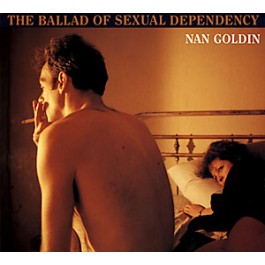
The Ballad of Sexual Dependency is a visual diary chronicling the struggle for intimacy and understanding between friends and lovers collectively described by Nan Goldin as her “tribe.” Her work describes a world that is visceral and seething with life. As Goldin writes: “Real memory, which these pictures trigger, is an invocation of the color, smell, sound, and physical presence, the density and flavor of life.”
“Goldin, at the age of 33, has created an artistic masterwork that tells us not only about the attitudes of her generation, but also about the times in which we live.”—Andy Grundberg, The New York Times
“Goldin’s prescient philosophy has, if anything been solidified by the intervening decade, and her Ballad resounds more poignantly than ever in its tenth-anniversary republication.”—Lawrence Schubert, Detour magazine
If you would like to receive 10% off this title, see here for a deal with the kind folks at Aperture
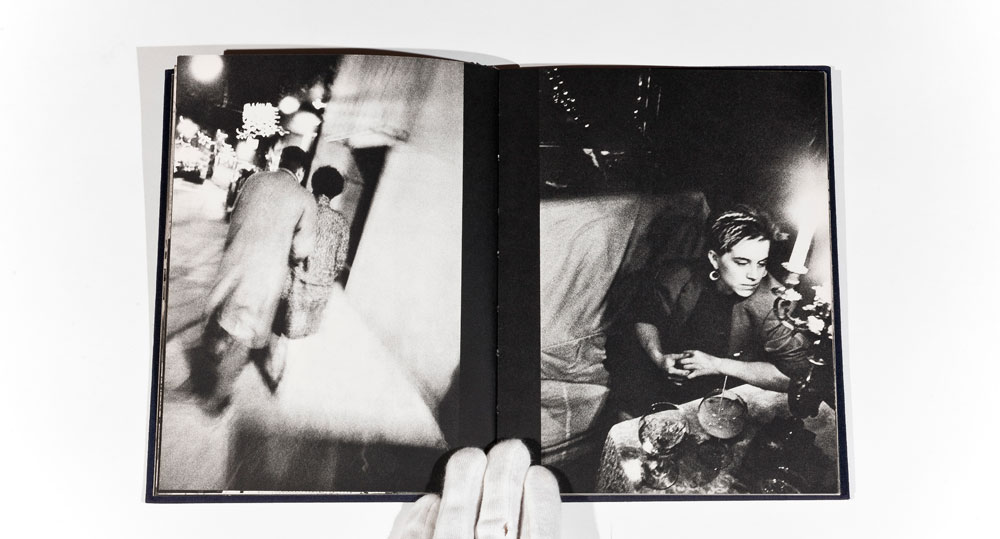
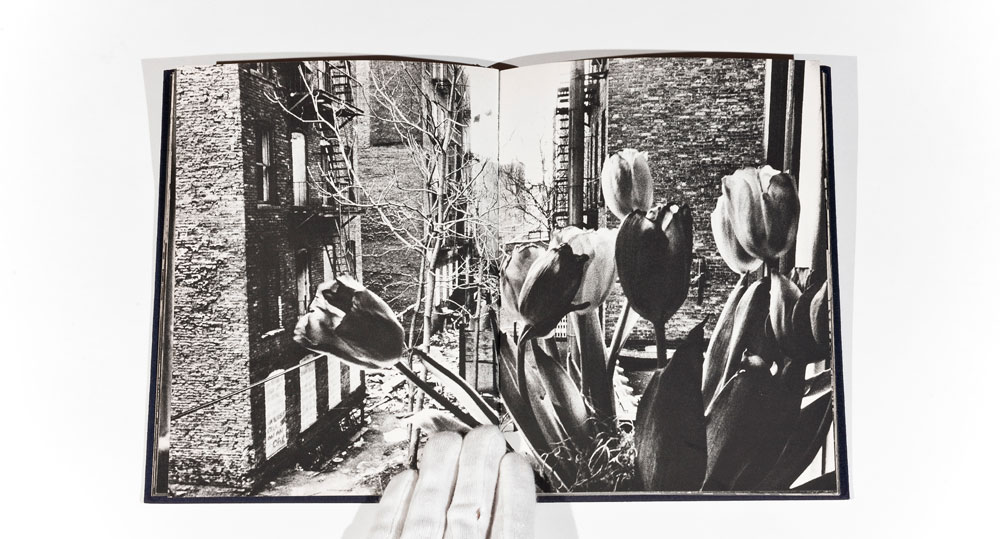
The first thing I said upon seeing the ‘Invisible City’ in it’s entirety was simply, “wow”, unfortunately at the time I was across the table from Ken Schles himself who had kindly agreed to lend the Photo Book Club a copy. It was a ‘Frasier-like’ moment when I really wished I had something more intelligent to say.
I also wished that I had a memory of this time and place depicted in such dark tones within Ken’s images, I wanted to layer my own history onto Ken’s page and relive a particular time through different eyes. But I have no memory of Ken’s subject and so Invisible City was new for me, allowing me to search without reference and without the worry of reality or history. It was like reading a book as a kid, each character would come to life and create a movie in my mind. There are books in which the authorial presence is constant and reassuring, in Invisible City I felt I was left alone to wander and explore Alphabet city, a fascinating, daunting, exciting and entirely unfamiliar place to be.
To me, Invisible City is not just a poem to the night (As Jeff Brouws commented) but a poem to the book, a reminder of how powerful the book as a medium can be. Single images are erased from my mind as I follow the darkest black tones from page to page, much like a shadow stretching across the entire spread of images. A photobook is a selection of images, and a good photobook is a fantastically sequenced and edited selection of images. Invisible City is just one, single, poetic image.
I came across Invisible City in April 1990 in the MoMA bookshop. It made an immediate impression on me. I was enthralled, and bought three copies for friends.
These photographs were of New York City at a time that I knew it, or thought I did. Ken Schles photographed the people and the streets of his neighborhood with such a deep love that he created a poem to those times we knew….if I close my eyes now 25 years on and pull on the memories of those long dark warm nights in the East Side, the images that come to me are Ken Schles’, not my own. This is how powerful Invisible City still is to me.
Like Cafe Lehmitz, I’m glad someone not only made the effort- but actually succeeded in successfully capturing this part of town, this part of time that existed in all its brief wonder and tragedy. Loisaida was in constant motion in the late 70′s, early 80′s, evolving (or devolving) from a culturally heterogeneous, junkie laden, cheap rent district of promise, hope and energy into that of a gentrified homogeneity of yuppies, condos and crack. In a half dozen brief years, the place was transformed from a place fueled by the spirit and fire of punk, new wave and the very beginnings of rap, to a veritable laughing stock where practically every other neighborhood storefront and bodega was transformed overnight into fledgling art galleries by trust fund, wannabe gallerists. Their “galleries” lasted about as long as your average punk set at CB’s, but the blight upon the neighborhood was permanent. The Ramones had somehow mutated into Madonna.
Ken, perhaps you could talk a little about Invisible City’s relationship with ‘Best Photobook lists’?
The lists… I’m assuming you mean the Parr/Badger book, the Roth book and Hasselblad’s The Open Book — I don’t really want to say too much about them directly since the stories I know about Invisible City being included in them or not are all hearsay. I’m happy Invisible City was seriously considered. I’m gratified that other people would argue publicly and privately disappointment that it wasn’t included: Here is a piece Bint photobooks blogged when the Parr book first came out, and here is Gerry Badger discussing it. This last thread contains good comments on the speculative prices of photography books.
I ran into Martin Parr the year before last at Arles. He gave me his Playas book and signed it: “to Ken — Invisible no longer.” Obviously I have a few things to say about history and being invisible and maybe my previous book A New History of Photography is a bit of a reaction to all these histories. No one person writes history and it’s problematic to second-guess these things when it is so very close to you.
I guess I can talk around it a bit, talk about the arbitrary turns that history plays upon us all. What seems important at the time and what becomes important in retrospect can be very separate things. I ran into Gail Buckland about a year ago after so many years—she was my history of photography prof in school and did the seminal research that established Fox Talbot as the inventor of photography (she came around over a hundred years later to sort that one out). She had some interesting things to say about how some work and some photographers arbitrarily have missed the boat of history or fell into it because of random decisions by curators or publishers or their own quirks. She told me about some photographers not wanting to have their work reproduced—that’s a buzz kill right there.
Reminds me a bit about photographers being paranoid about the Internet. Things that don’t get ported to new media can easily get lost. Certainly things that don’t get seen or become known do get lost. We are seeing it with film right now—old nitrite films are being lost forever as they decompose. Luckily books tend to kick around for a while and can be rediscovered. Yes, the work has to be good, but if it doesn’t get seen it can’t be remembered and might lay unopened on a shelf. What works for one generation may fall out of fashion and get picked up by the next, but if that next generation isn’t exposed to it in any form it can and will certainly die. What if Lisette Model didn’t show Diane Arbus the work of the little known German photographer August Sander? Torches need to be carried otherwise there will be no lights to guide those seeking things in dark corners.
Lists of the great photography books. Well, Invisible City did make it into one of those books. It is in Auer and Auer’s 802 Photo Books (#676). It lists the most important photography and photography related books of the last 250 years.
A huge thanks to the folks at Aperture publishing who have kindly offered the Photo Book Club community 10% off select titles, including Nan Goldin’s ‘Ballad of Sexual Dependency’ which we are looking at next month.
This special offer code will be sent to all members of our meet-up community at the beginning of next month. If you are not already part of this, you can add yourself below. And if you do not wish to be a meet-up member but would still like the code, please email Matt here.