Categories
CLOSER LOOK REFLECTION

Paul Graham’s ‘Free Pass’?

Shortly after I posted the first ‘Food for thought’ which gave an introduction to Paul Graham’s work, Stan Banos of Reciprocity Failure commented on the amount (or rather lack of) criticism his more recent projects have been subjected to. This doesn’t just apply to Paul Graham by any means and I think important points are raised here by Stan so have included his comments below: (Thanks Stan!)

– Matt

From the series 'Troubled Land' ©PAUL GRAHAM

Stan Banos:

FWIW, I think Troubled Land one of the greatest, most innovative documentary essays ever, and full well realize that Mr. Graham is close to a photographic demigod in many an art and documentary photo circle- and yes, who am I to say otherwise. Master photographer, innovator, educator- all well earned accolades. Nevertheless, all the above should not place anyone above criticism.

I’m not the greatest fan of his latter work, most of it searching for a new voice, a new vision he never quite achieves, but continues to deconstruct on his journey- and it most certainly is his prerogative not to repeat himself. But I continue to ask- who without his pedigree, without his name appeal would have been able to secure a publisher (other than Blurb) to publish a book of… grain? All without question or critique- no artist, politician, or god that should be given that much of a free pass.

From the series 'Films' ©PAUL GRAHAM

Matt Johnston:

Stan,
I would tend to agree with you here. Troubled Land is the rare photobook that really can keep you coming back and finding new layers and new questions each and every time, for me the same is true of ‘A1′ and in a very different way ‘Beyond Caring’. His latter, more conceptual work certainly doesn’t have the same gravity as these early projects but in ‘A Shimmer of Possibility’ I still find something special (can’t really out my finger on what that is though).

The free pass is a very good question, and I think it can apply to a few photographers lately; I know it is photo-suicide to say anything against Mr R Frank but I was immensely disappointed with ‘Pangnirtung’ and suspect this 5-day documentation would not have been published by Steidl had Frank been a young and unknown author.

I think in these cases the discussion and critique or review of the projects/books should be more transparent, otherwise these authors continue to have an aura of invisibility around them; everyone says they are fantastic but no one want to say why! On top of this, so many reviews now simply take the letter of the publisher as law, and in turn the publisher points people to this ‘great new review’ and the circle of photobook love-in continues. (There are of course some fantastic reviewers and photobook commentators who do not fall into the category above – Stockdale, Colberg, Claxton etc)

Do you think Graham’s standing as an ‘Art’ photographer helps with this ‘free pass’?

M

From the series 'American Night' ©PAUL GRAHAM

Stan Banos:

I can only speculate, Matt. Some artists build up toward greatness in slow and steady increments then maintain a persistent level of quality throughout, others have a rather meteoric rise, and then milk it- others still, try as they might, just can’t grab the golden ring again. I don’t believe Mr. Graham a slacker by any means, he has continued to create in earnest- I just don’t think anything he’s done since his initial three books has come anywhere near that level of artistic quality, confidence and authenticity. His latter work is characterized mostly by a series of hits and misses, perusing perpetually changing waters- not unsimilar to most student work. In this respect, he very much follows the Stephen Shore mode- an initial brush with photographic immortality, followed by more “personal” explorations.

Again, as to why the dearth of criticism (constructive or otherwise)- it’s hard to pinpoint exactly why certain artists and personalities become irreproachable darlings of the art world. Maybe, just maybe, because he was once called on how not to do documentary (B&W only, please) and having proved them wrong (big time) critics are now somewhat reticent to step up- particularly since he’s quite articulate and can sling the vernacular as good as any other art shark, and beyond. I still remember hearing him wax prolific on the benefits of “meditation pages” between images.

Hell if I know- what I do find curious though is that even the immortals of cinema get called out whenever they lay a turkey- and it’s usually fast and furious….

See the comments for more discussion:

Categories
FOOD FOR THOUGHT

Paul Graham: Some Food for Thought #2

Food for Thought #1 looked broadly at Graham and his extensive archive with some videos, interviews and reviews. This second version is more focused on the ‘A1: The Great North Road’ publication in particular.

Firstly, while it is no substitute for the real thing, you can see a selection of images from this book on the Paul Graham Archive website. Seeing as this book is upward of £350 I will be uploading a video of the book shortly (I have it on loan from the local Uni Library and as a warning, let’s just say it has been ‘well loved’).

You might also want to check out a few of the links below:

Simon Roberts references the book when he heads back down the A1 after his ‘We English’ project in 2008.
“The photographs are a mournful document of a grey nowhere land in a country moving too fast to stop for a cup of tea”

David Chandler wrote a nice little piece on the book found at the bottom of this page on ‘Self Publish be Happy’.
“And it represents what Paul acknowledges as the spirit of new wave, the punk ethos that enabled young people to create things for themselves, on their own terms…”

©PAUL GRAHAM

On the road itself there is a site dedicated to all things ‘A1’ run by Biff Vernon here. It’s quite niche and a little geeky – but I like that.

There are also a few quotes regarding the road on this page by Oliver Merrington.
“Now let me make a statement, in plain truth, of this road – betwixt Biggleswade and Buckden. As a road of fine gravel it is unequalled” (John Byng 1974)

Plenty more comment and inspiration coming, if you want to add your thoughts on the book, or any of the links and thoughts shared, do so in the comments section or via email (matt@photobookclub.org)

And if you haven’t seen the book yet…

– Matt


Categories
BOOKS VIDEO

Video – Paul Graham’s ‘A1: The Great North Road’

Seeing as this books isn’t easy to come by, I have made a quick video found here. My apologies for the book’s condition but thanks to CU Photography’s library as I don’t have a copy myself. Let’s just say it is good to see a book has been so loved!

(This video is intended to give a feel for the layout, design and sequencing of the book, for a selection of high quality images from this book, head over to Paul Graham’s website)

From the publisher:
Photographer Paul Graham spent two years completing this documentary on the life and landscape of the Great North Road. Throughout 1981 and 1982 he made numerous trips along the A1, crossing and recrossing the length of the nation to record every aspect of life at the verge of this great road. The photographs reproduced in this book build not only into a significant documentary of the A1, but also provide a thread along which we can travel the Great North Road, deep into the nation’s heart, and weave a picture of England in the 1980s.

Categories
COMMENTS REFLECTION

Elinor Carucci on ‘Immediate Family’, a Personal Reflection

My thanks to Elinor for offering these words on ‘Immediate Family’:

I saw ‘Immediate family’ when I was a student in Jerusalem and I was immediately drawn to this body of work. The images were so beautiful, magical, intense and complex…and even dark at times, as childhood can often be.
This landscape was like nothing I have seen before, being born and raised in Israel.

I love Sally Mann’s work, she is a brave and original artist.

– Elinor Carucci

Emmett’s Bloody Nose, 1985 ©SALLY MANN
Emmanuelle having her hair cut, 2007 ©ELINOR CARUCCI
Categories
FOOD FOR THOUGHT

Sally Mann: Some Food for Thought #2

As I mentioned in our first ‘food for thought’ post, this second version looks a little more at ‘Immediate Family’ than Mann’s other works and publications.

Firstly, as this book is easily available at a good price in a re-edition, I will be not be creating a video for the book in it’s entirety. And so you can either look to purchase the book here (or here for US), or look at what Mann features on her own website.
It is by no means a substitute for the book but it does give a taste for the work and as often as possible I will feature other images also.

1. There is a fantastic introductory article on the book over on American Suburb X authored by Valerie Osbourn. This article takes a look at Mann’s unflinching camera as well as some of the controversy that surrounded the book when it first came out.

2. Another fantastic piece here, this time about Mann’s provocation both in relation to the images of her children, and of more recent work with the dead.

3. The Smithsonian magazine writes about Mann’s images of her family here.

4. And… even though it was featured in the earlier posts, it is most certainly a must watch in relation to this specific book:
This video offers a great insight int Mann’s mind, and process as well as hearing from her children about their mothers image making and use of them as subjects.

Categories
FOOD FOR THOUGHT

Sally Mann: Some Food for Thought #1

As we look at Sally Mann’s ‘Immediate Family’ this month it is worth acknowledging the artist beyond this single publication. And so below are some useful links and resources to find out a little more about one of America’s most important female artists. You can also see the links below for other publications by Mann.

We will feature another ‘food for thought’ post shortly looking more closely at resources linked to ‘Immediate Family’.

1. Perhaps the best resource is the film ‘What Remains: The Life and Work of Sally Mann‘, directed by Steven Cantor.
Sections of the film can be found on Youtube or you can buy the complete film here.

2. In this interview from American Suburb X, Sally Mann speaks with Steven Cantor (director of ‘What Remains’) about the process of making the documentary, and in particular about the relationships between Mann and her children.

3. This next video is not nearly as in depth as ‘What Remains’ but it still offers a great insight int Mann’s mind, and process as well as hearing from her children about their mothers image making and use of them as subjects.

4. ‘From Lens to Photo: Sally Mann Captures her Love‘, in this video Mann speaks of her ‘Flesh and the Spirit’ body of work in which she photographs her husband Larry Mann.

5. And if you enjoyed that, NPR also feature an insider conversation between Sally and Larry Mann which is interesting, touching and sobering in equal measures.

6. In this text interview Mann talks about her ‘Deep South’ body of work

7. And, luckily for fans of Mann’s work, her website, unlike so many other big-gallery photographers is good!
You can see selections of images from most all of her series, hit the links below to get a taste for the different bodies of work:

Early Work
At Twelve
Family Pictures
Southern Landscapes
Battlefields
Body Farm
Faces
Proud Flesh
Ambrotypes

– Matt

Categories
SYNOPSIS

Synopsis: Sally Mann’s ‘Immediate Family’

We are looking at Sally Mann’s ‘Immediate Family’ through March on the Photo Book Club. Luckily this book is really easy to get hold of in libraries, photobooks or from the latest publisher of a paperback version, Aperture at a good price and so I shan’t be uploading a video this time.

If you fancy getting involved and sharing your thoughts on the book then you can do so in the comments section below or in email to matt@photobookclub.org.

– Matt

Title
Immediate Family

Author
Sally Mann

Publisher
Aperture 1992

IMMEDIATE FAMILY

“Mann’s subjects are her small children (a boy, a girl, and a new baby), often shot when they’re sick or hurt or just naked. Nosebleeds, cuts, hives, chicken pox, swollen eyes, vomiting—the usual trials of childhood—can be alarmingly beautiful, thrillingly sensual moments in Mann’s portrait album. Her ambivalence about motherhood—her delight and despair—pushes Mann to delve deeper into the steaming mess of family life than most of us are willing to go. What she comes up with is astonishing.”
—Vince Aletti, The Village Voice

“Immediate Family, which was published in 1990, must be counted as one of the great photograph books of our time. It is a singularly powerful evocation of childhood from within and without…”
—Luc Sante, The New Republic

Categories
BOOKS COMMENTS THOUGHTS ON BOOKS

Magnum’s ‘Postcards From America’

I should preface the below by saying that this is only my own view on Magnum’s ‘Postcards From America‘, as yet, I have only really heard positive things about the book.

I’m not interested in slating this publication, but, as there are more of these trips planned by Magnum and their all-star cast, I thought I would share my thoughts for anyone pondering a potential purchase, you can hear other points of view on this publication here, here and here.

If you do not know of the project, and product already, check out this video walkthrough from a true photo hero of mine, Mr Alec Soth:

Magnum’s ‘Postcards From America‘ is an interesting exploration into a section of the Southern States of America, the collaborations between photographers and with writer Ginger Strand lead to new and exciting perspectives. I particularly enjoyed Soth and Subotzky’s input. However, I am not producing a view of the content here, but of the product instead:

Instead of a traditional book, Magnum present us instead with a box, and within this box we find all manner of objects along with a sticker detailing our edition number and presenting the 5 signatures of contributing artists. The disparate elements of the box make sense in as much as they echo the fleeting and fluid idea of a roadtrip but fall short of contributing any sort of understanding about the project and it’s themes or ideas. Perhaps this is where the book comes in, as a sort of guide from which we can scoot of to explore the mini-stories contained within the zines?

Unfortunately this is not the case. I love to see progression in what the book can be, it’s exciting and is pushing forward a fantastic medium, but I have to question the ‘book’ included in the Magnum box. It is unbound for starters which I can accept were it not so big and unpractical to be so. And more annoyingly – the sheets are not printed as a book sequence, they are in fact a big stack of posters placed one on top of the other, and then folded in the middle. It requires space, and patience to attempt a ‘reading’ at all, and the (very) cheap-feeling paper combined with (very) average printing do not make this ‘reading’ a pleasant one. it could be my love for the physical object speaking but everything here seems to be very much a throw-away object, especially when you consider the asking price.

And perhaps this is where my relationship with this project and publication came unstuck  – ‘Postcards From America’ was $250 and it was the first time I have ever spent more than $100 on a photobook, so from the beginning I was going to scrutinize what I got for my money. As you can see Soth demonstrate in the video above, you get a lot for your money, at least it seems as though you do.

Actually, there is little substance here in terms of material objects. A smattering of zines, the above mentioned ‘book’, some stickers and a poster which makes up most of the box weight but which I imagine only a handful of people will have the room or interest in assembling. Let’s not forget the postcards received during the trip of course, although to my disappointment, even though I had ordered well before the start, all were sent at the conclusion of the trip (those who payed the $125 for the postcards alone must surely be even more frustrated?).

I understand that I cannot boil this argument down to material costs but there is such a mismatch between cost and price here it is hard to understand what I paid $250 for. I can only assume then, that a portion of my money is helping fund this trip, to make it possible. Great! Except that where many projects are open with those that fund them, Magnum’s seems to take all the credit. I would have been far happier had this been a kickstarter-style ‘reward’; knowing that while the material costs do not add up, the extra money had made it possible in the first place, maybe even a contributors/funders thanks in the book or online.

‘Postcards From America’ is a really interesting project, there is lots to explore here, but I think Magnum has completely missed the mark in relation to the product. If I were to be so bold as to offer pointers for next time, either:

  • Tell people where their money is going, credit those who fund the project, or
  • Make the product beautiful, something worthy of the pricetag, or
  • Make a non-limited, no-signature version available for the $60 it cost

I would love to hear from others who have this publication, unfortunately there are less than 500 and I fear many have bought it to put in a cool, dry place, unopened, waiting for the dust and price to rise. But, if you have opened it, and feel like sharing, do so in the comments section below.

– Matt


Categories
BOOKS CLOSER LOOK COMMENTS CONTEXT GUEST POST HISTORY INDEPTH

Kurt Easterwood on Stephen Shore’s ‘West Fifteenth’, A Conclusion

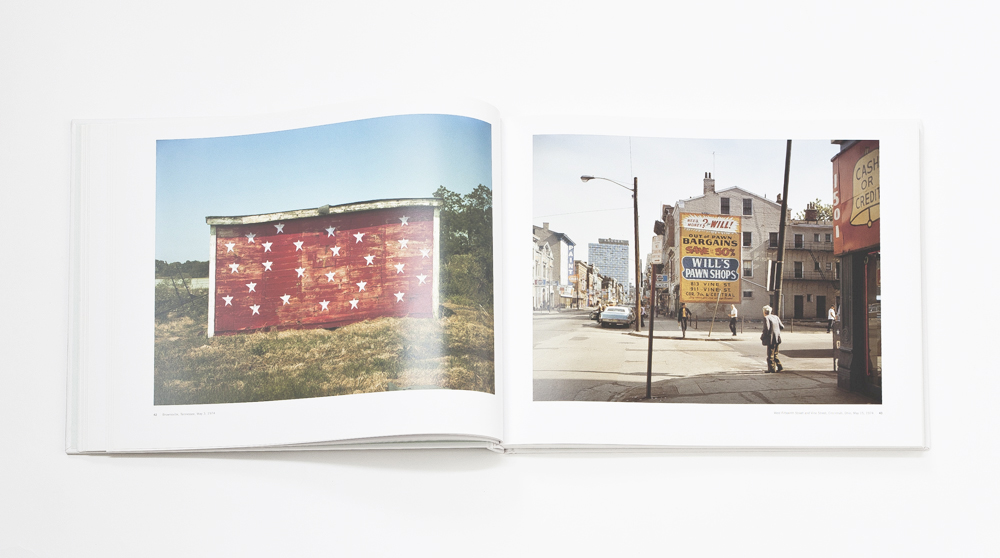
Here is the fourth and final extraction from an extended piece of writing by Kurt Easterwood of Japan Exposures. Kurt produced a fantasticaly rich deconstruction and analysis of Shore’s ‘West Fifteenth St. and Vine St., Cincinnati, Ohio, May 1, 1974’ featured in ‘Uncommon Places, The Complete Works’. The image in question can be seen on the right hand side of the image below and you can find the full PDF underneath the image or right here.

West Fifteenth St. and Vine St., Cincinnati, Ohio, May 1, 1974

PDF – Kurt Easterwood on ‘West Fifteenth’

A Conclusion

At most, Shore probably spent about 30 minutes standing at the corner of Fifteenth and Vine, framing the scene, adjusting the focus, measuring the light, preparing the film holder, and tripping the shutter. We can be fairly certain he did all these things blissfully unaware of Over-the-Rhine’s German immigrant antecedents, trends in outdoor advertising, or pawn shops as economic indicators. Nor is it likely that Shore took the inverted image he found on his camera’s ground glass and flipped it over in his mind, ruminating on what sociological discourse the graphical elements contained within his frame’s borders might conspire to conjure up for future travelers on his tour of uncommon places.

Thus there is a very real possibility that readers will bristle at my deconstruction of this photo, and the introduction of what may seem like incidental history and tangential politics in an attempt to locate the photo within a much broader context than Shore ever intended. Seeing as I’m likely guilty as charged on that count, in my defense let me stipulate that I see the tour I took of “West Fifteenth St. and Vine St., Cincinnati, Ohio, May 1, 1974” less as a deconstruction of an image and more a construction of a separate image, akin say to Mark Klett’s rephotography projects.  Like the spirit in which those are undertaken, the aim has not been to bring Shore’s original photo kicking and screaming into a context imposed from outside, or to re-align it to fight some rhetorical battle, but to merely have it in hand like a trusty map as I negotiate its spaces nearly 40 years later. It’s my hope that the new topography I have constructed as a result informs the old, much as Shore’s two-dimensional photographs in Uncommon Places built upon and informed their physical counterparts. READ MORE

– Kurt Easterwood

Categories
BOOKS CLOSER LOOK COMMENTS CONTEXT GUEST POST INDEPTH

Kurt Easterwood on Stephen Shore’s ‘West Fifteenth’, The Photographers Presence

Here is the third teaser from an extended piece of writing by Kurt Easterwood of Japan Exposures. Kurt has produced a fantastic deconstruction and analysis of Shore’s ‘West Fifteenth St. and Vine St., Cincinnati, Ohio, May 1, 1974’ featured in  ‘Uncommon Places, The Complete Works’. The image in question can be seen on the right hand side of the image below and you can find the full PDF underneath the image or right here.

In this installation Kurt looks at Shore’s presence in the scene itself….

West Fifteenth St. and Vine St., Cincinnati, Ohio, May 1, 1974

PDF – Kurt Easterwood on ‘West Fifteenth’

As our last stop on this exploratory journey, a final sightseeing viewpoint as it were, let’s ponder for a moment one more spot at the corner of Vine and Fifteenth, the spot Shore placed his tripod and set up his view camera to capture this scene. Shore’s presence, and the position of his tripod and camera, is referred to, if not exactly reflected in Lee Friedlander-like fashion, by the out of focus “Bus Stop: No Standing” sign that could be nowhere else but directly in front of where Shore was standing. We smile at the sign like we do at other occasional ironical signage in Uncommon Places — e.g. “MECCA” (p. 129) or “John F. Kennedy said: “ART IS TRUTH”” (P. 133) — as if Shore were thumbing his nose at the municipal establishment that would deign to tell him where he could or could not stand his tripod.

STEPHEN SHORE

PDF – Kurt Easterwood on ‘West Fifteenth’

The Photographer’s Presence

But telling people where they can or cannot stand in the form of municipal anti-loitering ordinances has long been a tactic used by city governments and police forces to exert undue control over citizens in lower-income areas. Three years before Shore took his photo, the U.S. Supreme Court had struck down Cincinnati’s own anti-loitering ordinance as unconstitutional. The ordinance had held that “It shall be unlawful for three or more persons to assemble, except at a public meeting of citizens, on any of the sidewalks, street corners, vacant lots, or mouths of alleys, and there conduct themselves in a manner annoying to persons passing by, or occupants of adjacent buildings.” In a footnote to his opinion, Supreme Court Justice Potter Stewart wrote that, “The alleged discriminatory enforcement of this ordinance figured prominently in the background of the serious civil disturbances that took place in Cincinnati in June 1967,” by which he was referring to race riots in the Cincinnati neighborhood of Avondale that spread over into Over-the-Rhine.

The sign can then be read not just as a joke of Shore’s own making, but as an ironic and not necessarily unintentional questioning of Shore’s right to be there, assembling these elements in a manner annoying to persons passing by, “an alien element impeding the activity on the street.”  READ MORE

– Kurt Easterwood