The Photobook Club Kuala Lumpur is to launch on the 1st of June before it enters into a series of events including the Obscura Photography Festival from 21st – 30th June in Penang before touring around Malaysia.
In part this is a genuine frustration but I should also say that I have spent my limited book budget for the year in just the first three months and so perhaps a good deal of my frustration is aimed at my own lack of self restraint.
Rinko Kawauchi teamed up with Ivan Vartanian/Goliga recently to realise her latest work ‘Approaching Whiteness‘. The result is a beautiful scroll with a set of images on it, there are 9 scrolls with different themes or images, each also has a silk-screened pattern in luminescent ink and calligraphy with sumi ink. Sounds great eh! Those amongst us who occasionally fetishize the photobook must be in heaven, but unfortunately this excessive beautifying may have gotten in the way of something much more valid for the photobook (at least for most of us) in the expansion of the reading experience.
From the Goliga site and video: “The sequence of frames flow from right to left and connote the passage of time as an uninterrupted sequence. This idea extends to a larger philosophy that all things are connected.”
Of course the scroll is not a new invention and so perhaps it is over the top to call it a triumph in communication, but here is a photographer and publisher thinking beyond the bound book to the most suitable means of communicating a horizon to the viewer. I only wish the damn thing wasn’t £200+ pound for each version; surely a sign that this is being produced solely for the collector. There’s nowt wrong with collectors editions and making work specifically for them, hell I imagine that without the collectors money many projects would never be realised, much less break even. But what’s the alternative for the vast majority of us? Can we not enjoy this work as it is intended to be read, minus the rare wood, gold butterfly wings and price tag?
John Baldessari once said that every artist should have a “cheap line”. I imagine in 6 months time I shall be proved wrong about Approcahing Whiteness and Vartanian might bring out a non boxed scroll set or something similar for the masses but in the meantime I wish Baldessari was taken into account for this is a mainstream artist asking questions of the book that few others have dared to.
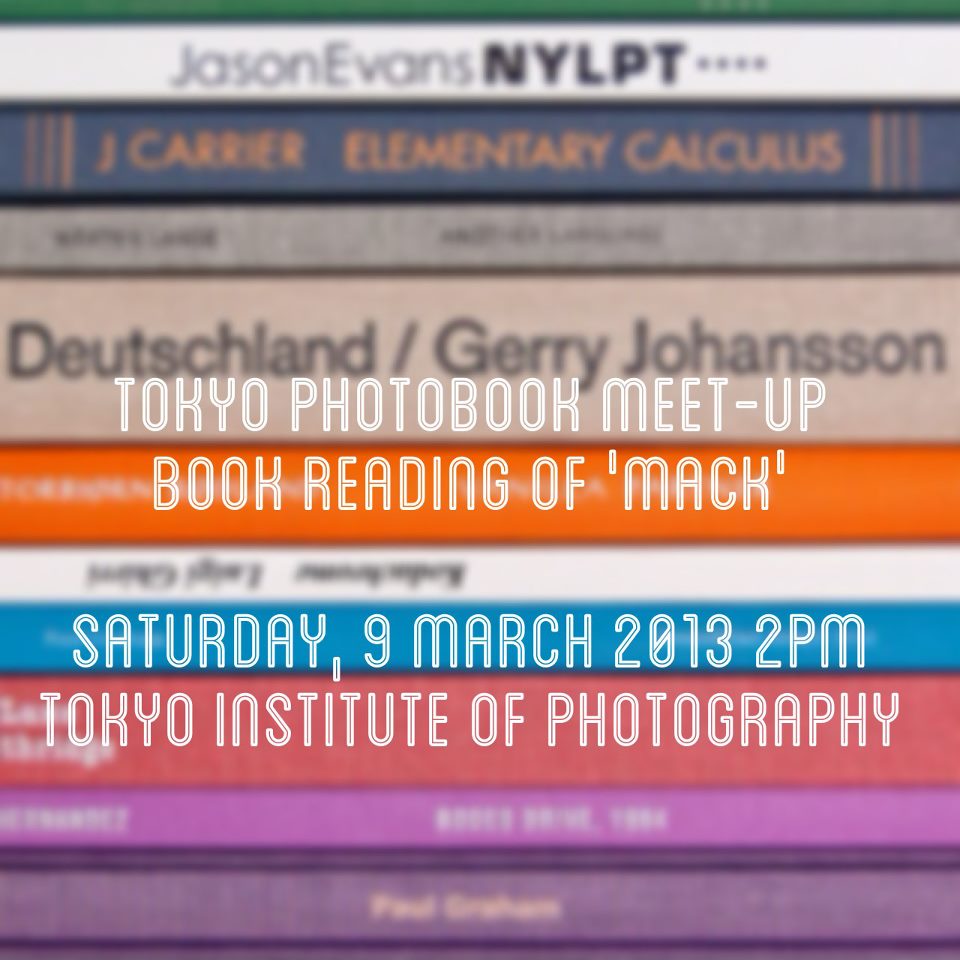
TIP is the center of photography in Japan and also publish the photo magazine “PHaT PHOTO“. They have assured us that they can help by lending a meeting place for future events.
As we are cooperating with each other on the meetup we will discuss the MACK books at TIP and We will invite a PHaT PHOTO’s chief editor to the meetup.
We are really pleased that we have meet with a lot of response to our movement and we should not only hold meetup in Tokyo, but also another city in the near future.
Here is more information on this event:
Photobook Meet-Up in Tokyo (♯3) collaborator: twelvebooks
Please join us Saturday, Mar. 9. 2013 from 2:00 to 5:00 pm.
TOKYO INSTITUTE OF PHOTOGRAPHY exart bild. 1F, 3-6-6 Kyobashi, Chuo-ku, Tokyo, Japan
Those of you who remember (and those of you who do not), last year I mentioned I would not enter into the ‘best of’ bonanza before proceeding to do just that by selecting 5 photobooks that had stood out to me in the ‘B*@t of 2011’ post.
This year I shan’t try to hide the fact that I have made a list but it’s not the regular ‘Best of 2012’ style. I simply haven’t spent time with enough new books this year to be able to give any sort of top ten or top twenty. Instead I will list those that I have enjoyed/been entertained/confused and educated by over the course of 2012 in a few different categories.
NB: It seems a contractual obligation now to trash ones own list or at least belittle/justify it before proceeding with the ‘main event’. I would like to think I started this last year but know that is not true. What I do no to be true – people like to make lists, it is a nice way to step back and perhaps try to learn something from our viewing habits and the themes that are drawing us in. People also like to read lists, it is always interesting to see whose taste is similar or differs wildly and then try to catch some of those books we have missed.
It is also great to see this year that a lot of the books from last years ‘Best’ lists have had very good second editions, most are available again at reasonable prices which offers some hope for this years ‘top books’. I dont think there is anything in my list that is particularly hard to get hold of at the moment but if there is drop me an email and I will loan out the book for free. – Matt
Back to back:
I started by looking back at the books I chose last year. It is always pleasing to find out that the book you were gushing about 12 months ago is one that has continued to entertain and educate/frustrate over this past year. In this category fall two books from last years list:
Redhead Peckerwood made a lot of lists last year and I am sure The Present will make many this year, they certainly both make mine, but it took some time.
Redhead Peckerwood took time only in as much as the curse of the photobook list made it almost impossible to get hold of for a good price until the second edition came out, and by this time I felt I could do without. Seeing it at Paris Photo made me change my mind and it was first in the suitcase. Following it was a book I never thought I would buy (especially after the ‘film‘ debacle) – Paul Graham’s ‘The Present‘ which really must be seen to be believed, the internet does not do justice to this book and this work; subtle and sweet but with a serious undercurrent. I would not be so bold as to say it is a must-own but a must-see for sure.
Two projects here that have had the guidance of Paradox in the Netherlands and are both much bigger than the books mentioned here. ‘Poppy‘ and ‘The Last Days of Shishmaref‘ are books, but they are also exhibitions, online galleries, blogs and educational resources; true transmedia projects that you can, and should get totally lost in. I expect ‘Poppy‘ will find it’s way onto many lists but ‘The Last Days of Shishmaref‘ (2008) has more heart and good intent than you can ignore.
These books don’t try to change the world, nor do they seek to challenge our interpretations of the fluidity and omnipresence of a 2D world (or other such nonsense), instead they tell a small story, one that is engaging from start to finish and one that for a moment at least makes us think a little differently.
Road and Rail Links Between Sheffield and Manchester
Bird Watching:
Used to be a bit of a bird nut as a kid so maybe that is where my interest comes from but it seems photographers have been turning their lenses on the winged of late too. Three books I have thoroughly enjoyed this year that focus on the bird; there are more, but I have not seen them. The three here are all a bit of fun, at least on one level, Paloma al Aire is just straight up fun from page to page – and it puts a smile on my face to see people take such enjoyment from this ‘hobby/lifestyle’. Bird Watching is a great book and depending on how much time you spend with the book it will give you different messages; personally I don’t like to think too much when I look through this one, I enjoy it as a bird watchers notebook, I just wish the description ‘tags’ were stuck in rather than printed on the page.
A craving for a less concrete life has continued to manifest itself in the books I have been drawn to this past year. You could consider the above category linked in here but the following sum it up a little neater I suppose. I was also drawn to the array of ‘hessian-like’ covers this year on books like Erik van der Weidje’s ‘Superquadra‘ and ‘Reading Ed Ruscha‘.
The book that garnered the most discussion at meetup that I ran this year was, without doubt John Gossage’s ‘The Pond‘. For those that had not seen the work before it tended to be a love or hate kinda relationship (with more siding for love) and produced much conversation on sequencing and pace of photobooks.
As I mentioned up top, this list doesn’t really constitute a best of, more a collection of books I found interesting for different reasons. The books below are on my desk and may have had a brief viewing but no more than that, they are included for the fact that they currently all excite me and i’m looking forward to exploring them more…
Very proud to see the Photobook Club’s digital publication ‘Ken Schles, Invisible City; A Digital Resource’ make it onto Martin Brinks ‘Top Digital Photobooks‘ list last week and now very happy to read a great little review of the publication in Taco Hidde Bakker’s ‘Photobook Listmania‘.
Alongside comment on lists and photobook consumption which is worth a read in itself, Taco dubs our publication as ‘the most surprising 2012 photobook publication’. You can read the section below but please do head over to the post to hear Taco’s other thoughts.
The most surprising 2012 photobook publication to me has been The Photobook Club‘s free-of-charge e-book: Ken Schles – Invisible City: A Digital Resource. A page-by-page digital representation of the beautifully printed original 1988 book (which is rare and expensive nowadays) embedded within notes around the production of the book, and recent discussions. An excellent example of how valuable older, sometimes overlooked and understudied, photobooks can be lifted out of the shadows and be studied in a public realm beyond the traditional library.
The Photobook Club Helsinki held their inaugural meetup on the 29th October organised by Johannes Romppanen. You can see images from the event as well as read a brief comment from Johannes below;
Image JOHANNES ROMPPANEN
We were a good sized group attending, I was positively surprised 🙂 Ida Pimenoff, who also brought her own book, had Alec Soth’s Broken Manual with her. It was nice to see, none of us had seen it live before. And Ida was really surprised when we told her the current market value of the book! 😉
We decided to meet the next time 28.11., place is yet to be confirmed and also plan to meet approx every 6th week or so in colaboration with PhotoDo.
This really should not have taken as long as it has, and for that my apologies. I often stress that accessibility is of paramount importance to me and The Photobook Club so was well aware that in publishing the Invisible City iBook I was both improving access to content for some but excluding a large audience also.
And so here I hope to rectify that by launching ‘Ken Schles: Invisible City, A Digital Resource’ as an enhanced PDF. Provided you have the latest Adobe Reader software (free and available on all platforms) you can download the resource for free below.
About:
This publication takes on a magazine-style format, inside of which you will find not only the images and text featured in Invisible City, but a variety of personal reflections, commentary on the process of creating Invisible City from Ken Schles and even original notes from a lecture given at New York’s International Center of Photography in 1990.
If you have an iPad, you can download the publication free from the link given below via the iBook store.
The complete forward featured in the publication alongside screenshots is featured below this introductory video.
Forward I set up the Photobook Club in 2010 as a response to both my own fascination and frustration with photobooks. My fascination was born and nurtured as a student spending thousands of hours in the University library choosing books at random by the colour of their spine, or based on recommendations from my peers and tutors. My frustration was a little harder to pinpoint but essentially stemmed from my wanting to learn more about the classic photobooks, those revered and often rare books that held a sense of mystery between their two covers; everyone agreed they were classics but there was little discussion of why.
At the time there was, and still is, a huge interest in photobooks, but predominantly in the new, the self published and the handmade, and so together with partner-in-crime Wayne Ford, I decided to open out my thoughts and learning to a wider community – just as a traditional book club. As well as promoting and facilitating this shared experience online, I was keen to encourage the generative experience the photobook offers us both in spending time with a beautifully crafted artifact, and in sharing thoughts (as well as books) in person.
I certainly hope that (depending on your knowledge of Invisible City), this publication will either introduce you to, or help create a greater understanding of a hugely influential modern photobook. Inside you will find not only the images and text featured in Invisible City, but a variety of personal reflections, commentary on the process of creating Invisible City from Ken Schles and even original notes from a lecture given at New York’s International Center of Photography in 1990.
Regardless of your previous experience with this book, or whether you are a lecturer, photographer, student, book lover or just curious, I would really appreciate your comments via the email address below.
Finally, thanks must of course go primarily to Ken Schles, not only for allowing all to see his wonderful images but also for kindly lending me a copy of the book to work with, and for his enthusiasm towards this project. My thanks also to the contributors listed on the following page who offered their own, personal reflections on the book.
This one is still available at a reasonable price and so this video is in no way a replacement for seeing the real thing, instead it is shown here to give a feel for the layout, design and sequencing of the book, for a selection of high quality images from this book, head over here.
From the publisher:
In this new Photoworks publication, British photographer Mark Power returns to the dialogue between real and imaginary space that characterised his most successful book to date, “The Shipping Forecast” (1996). Once again the premise for this work has been a map and a sense of those invisible boundaries that help to form a strong and durable idea of place. In this case that place is the great sprawl of London, whose outer limits are, for most of us, defined by the extent of the A to Z road atlas. It is these outer zones – where, as the map suggests, the city thins out and then falls away into nothingness – that are the subject of Power’s photographs.
Taking each page of the atlas as his guide Power has embarked on an epic quest into a kind of local unknown, a voyage into a form of melancholic emptiness where the energies of the city evaporate into a strange kind of inertia.Like “The Shipping Forecast” before it, “26 Different Endings” is a project still deeply concerned with the weather, with the everyday drabness of places resigned to their climate of indistinction, where a condition of greyness has become the condition of life.”26 Different Endings” is a report about what appears to be a deeply traumatised place. It is also about a state of mind that Power has become entranced by, one conditioned by flat white skies and a generous expanse of pebble dash, an overbuilt environment where all buildings, new and old, look something like ruins. David Chandler’s autobiographical short story, written in response to Power’s pictures, delves deeper into this state of mind, drawing on a vivid picture of both the emotional and physical landscape of his childhood. Mark Power is Professor of Photography at the University of Brighton, and joined Magnum Photos in 2002. This large-scale, landscape format book is published in a limited edition of 1000.
This ‘Food for Thought‘ post is for those unfamiliar with Mark Power’s work and will give a variety of links to his projects, interviews, videos and so on. For those who are more interested specifically in ’26 Different Endings’, the following ‘Food for Thought‘ post will focus on this photobook.
Power has an extensive archive of images from a variety of projects, all of which can be found on his excellent website. His work has documented all manner of subjects here in the UK, in Europe and further afield.
You can find most of the essays connected with Power’s projects, and featured in his photobooks on the Mark Power essay page.
If you are after an interview with the man himself then head over to ‘Photojournalism Love Story‘ to find a solid interview covering a variety of Power’s work and processes.
If you enjoyed looking at ‘The Shipping Forecast‘ then the video below gives a whole new dimension, especially for those who have never heard the foreign language that is the shipping forecast on radio…
Power has also embraced new ways of working and regularly shoots very short moving images, all with a static camera (and silent). They have the same aesthetic feel as his images with the addition of movement. You can check them all out on his Vimeo profile as well as see one below:
“Now that everyone in the developed world seems to own some form of camera, a different space has opened for documentary photographers. It’s a space free from specific events, where there are different expectations, where it is first and foremost about ideas. Now we can all take pictures, with varying degrees of consistency, more than ever before it’s about what we do with photography.”
From the publisher: In this new Photoworks publication, British photographer Mark Power returns to the dialogue between real and imaginary space that characterised his most successful book to date, “The Shipping Forecast” (1996). Once again the premise for this work has been a map and a sense of those invisible boundaries that help to form a strong and durable idea of place. In this case that place is the great sprawl of London, whose outer limits are, for most of us, defined by the extent of the A to Z road atlas. It is these outer zones – where, as the map suggests, the city thins out and then falls away into nothingness – that are the subject of Power’s photographs.
Taking each page of the atlas as his guide Power has embarked on an epic quest into a kind of local unknown, a voyage into a form of melancholic emptiness where the energies of the city evaporate into a strange kind of inertia.Like “The Shipping Forecast” before it, “26 Different Endings” is a project still deeply concerned with the weather, with the everyday drabness of places resigned to their climate of indistinction, where a condition of greyness has become the condition of life.”26 Different Endings” is a report about what appears to be a deeply traumatised place. It is also about a state of mind that Power has become entranced by, one conditioned by flat white skies and a generous expanse of pebble dash, an overbuilt environment where all buildings, new and old, look something like ruins. David Chandler’s autobiographical short story, written in response to Power’s pictures, delves deeper into this state of mind, drawing on a vivid picture of both the emotional and physical landscape of his childhood. Mark Power is Professor of Photography at the University of Brighton, and joined Magnum Photos in 2002. This large-scale, landscape format book is published in a limited edition of 1000.