The box of dummies is now working it’s way around the world after initial events at Coventry, Murcia and Valencia.
The Box of Dummies in Valencia
And the original Box of Books is about to start it’s journey back home from Canada – there are things planned for it’s arrival which I will be posting soon.
In other news, Nathan Pearce’s ‘Midwest Dirt‘ edited by myself and brought to book-life by Akina books has sold out – a few copies available in book shops only now! While I will continue to work with Nathan on new works I am also interested to hear from other photographers who might wish to collaborate on a body of work – email matt@photobookclub.org
Over the last ten weeks or so, some of my students from Coventry University have been connected with Tom Griggs’ students in Medellin, Colombia. The image exchange was designed to connect locations, perspective and ideas between students on two continents and is an open project viewable by the following blogs…
We exchange emails and talk frequently through Facebook and have bounced ideas off one another and have learned so much from just seeing the work that was being exchanged.
The Photographers Playbook, published by Aperture and edited by Jason Fulford and Gregory Halpern has just arrived on the doormat and I thought it worth a post.
306 assignments from well respected photographic educators, professionals and artists plus myself. The assignments vary from reflective exercises to shopping lists, technical amendments and more traditional photographic tasks. There is much in here and certainly not just for the student – I really hope this book and it’s assignments are used widely and shared often, perhaps there needs to be a space to share reflections and outcomes?
A report from Walter Costa from the PBC TRAMA in Brazil…
Here’s the post about our last session…. I’m sorry but it’s in Portuguese only!
It was like a series of short duels between two teams attacking or defending the books we previously drew among a selection of 2 titles per country… it was really interesting to see how the debate rose thanks to the duel scheme: people who normally are quite silent were “forced” to participate and added interesting considerations!
And notice of an event in Belfast next Tuesday at Belfast exposed can be found here….
Dragana Jurisic, who recently exhibited ‘Yu: The Lost Country’ at Belfast Exposed will present the next edition of Photobook Club Belfast on Tuesday 29 July. Jurisic will speak about the development of her publication of the same work, as well as exploring other publications that have inspired and influenced her practice. This event is free and all are welcome.
An open call for photobook dummies from our friends in Madrid…
We are very happy to organize once again a special session we call cosecha 2014 (harvest 2014) in which we would like participants to share the dummies of the photobooks in which they have been working this year. We would like to celebrate recent work, not old projects. It doesn’t matter if the book has been published or not, we are interested in the dummies. This year the session is organized with the Library and Documentation Centre of the Reina Sofía Museum in Madrid, Spain, and the La Central bookshop in the Reina Sofía Museum.
Save the date: July 15, 2014
There are two ways to participate. If you want to participate in person, please send an emailbefore July 13 with your name, contact information, and whether you will bring a book dummy or not. We have only 45 places so we will give priority to those with book dummies. Alternatively, if you can’t come to the meeting, you can send the book dummy by post. In that case, contact us for details.
In September, those who wish can participate in a dummy exhibition at the La Central bookshop in the Reina Sofía Museum.
Date: July 15
Registration: info@photobookclubmadrid.com before July 13
Location:
Library and Documentation Centre
Reina Sofía Museum
Nouvel Building
Ronda de Atocha, intersection with Plaza del Emperador Carlos V
Subway: L1: Atocha
Image: Paysanne hongroise récoltant du raisin, Agence de presse Mondial Photo-Presse, 1932
Source: Bibliothèque nationale de France, département Estampes et photographie, EI-13 (2970)
The following is an interview with Andrew Piper, associate professor in the department of Languages, Literatures, and Cultures at McGill University who has recently written ‘Book Was There’ – A presentation and discussion of current debates surrounding the book both past and present. It is at the same time a nod to University Presses – an often overlooked publishing platform by many outside academia but one that can add to both our photobook shelves (with the likes of Eugene Smith’s ‘The Big Book’ and Rachel Sussman’s recent publication ‘The Oldest living Things in the World’) and our understanding of the book as medium (‘Various Small Books’, ‘The Pivot of the World’ etc).
The Oldest Living Things in the World
We started by discussing whether ‘books’ is in the first instance too large an area to understand with any certainty or to pass comment on, whether it prohibits valuable discourse as the word covers so many genres and sub-genres. Andrew pointed out the different roles that books play in our lives – and that the children’s book, or the photobook together with their place in the 21st century, should be understood separately independently.
Discussion regarding the photobook as a prospering genre led to the qualities of the corporeal bookwork…
[AP] There is a lot of effort to pinpoint what is special about the physical book as apposed to the digital book and so a lot of publishers are experimenting with design and material. It is no longer enough to separate your book from the other books in the store but now also important to separate ‘the book’ from it’s digital counterpart. Publishers are putting a big amount of thought into artisanal qualities, they often draw from historical styles and tropes to emphasise the tactility, permanence of these things. [AP]
This is something we can quite easily see in current photobook trends. Just as books on birds, fauna and a Walden-esque life with subtle cloth covers and embossed spines now pop up on tables in Waterstones and Borders, so to the photobook store is decorated with wooden slipcases, exposed bindings and textured wraps.
So is this a hankering for the nostalgic? For the books we used to own or the books our parents used to own? We hear about the digital native, or at least of a generation growing up with screens in place of paper – what do they have to be nostalgic about – where is their reference? Is this a craving without full understanding?
[AP] Yes I think that’s exactly it, I have yet to meet a large cross section who is just completely spent with print, I know it must exist! For a while there was the myth of the digital native and at some point that might happen but for the most part the majority of my students have a clear idea of bifurcation. They know how to read online (and they do) but they also have really strong and often sentimental attachments to book reading. I just taught a ‘history and future of the book’ class and from 60 students I couldn’t find any who were completely done with the book, and in fact most of the class was more interested in the past of the book rather than the future. I think the harder sell is the future; computation and electronic texts.[AP]
Again here we can relate to the photobook – which is experiencing a surge in interest – interest in the physical, corporeal work rather than digital possibilities. There have been interesting experiments with digital works (Via PanAm is a reliable example) but for the most part it has been pushed to the side with few champions of the medium (a notable exception being Matin Brink’s blog which burned bright but short). We can also see that the community of photobook makers and consumers is a variably aged one – my students of 18-25 are as passionate about the codex as my academic peers, or perhaps more so!
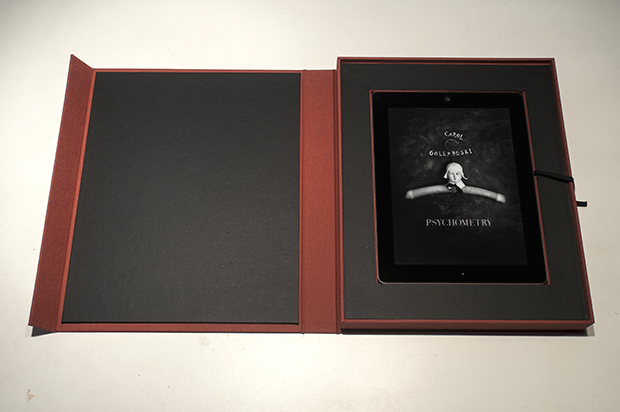
Carol Golemboski’s ‘Psychometry’: a hybrid book
We turn quickly towards a frustration with the narrow romantic or eulogistic discourses surrounding the book. Andrew comments on his dislike of this binary argument and his response…
[AP] … this is what led to me writing the Book was There, the debate was so ‘either or’, there were these really polarised camps and it didn’t reflect my own interests and experiences or that of my students. It also didn’t reflect well the world we inhabit which for the time being is hybrid. It seems silly to fetishise one thing at the expense of another or to worship the new at the expense of the old so I was trying to put the two in conversation with each other (which is hard as people do seem to fall into these two camps). I am a curious historian by nature, I am interested in where things come from and how they live on. For me you can’t understand computation and electronic texts without understanding books. [AP]
One of the key aspects of ‘Book was There’ was thinking of reading and the book as different things. We understand that the book does not translate well to the screen – but does reading? (I went off on a bit of a tangent here about how photography’s second paradigm shift has led us to think of the image and the photograph as different things – the image as communication [mms/instagram/snapchat] and the photograph as a more traditional medium of expression)
[AP] That’s a really interesting distinction. I wanted in ‘Book was There’ to disaggregate reading from books, the history of the book and the history of reading bleed into one another but they have separate histories and uses also. [AP]
Here I wonder whether the unbound electronic text is changing the way that physical bookworks are produced and read, whether we are seeing more experimentation?
[AP] Its a good question because there is a lot of experimenting but it always remains very experimental. If you think of commercial presses they are still working with a fairly coherent and unchanging notion of what a book is even though they are very happy to sell electronic books. I don’t know when or if that will change, I don’t see signs of publishers really experimenting (beyond the likes of the Kindle ‘single’). When people write books today they are still writing things that look like books of old. They may be sold in different formats but the concept hasn’t changed in the mainstream.
It may be that it is a really important anthropological constant, it’s been a very powerful media for a long time so it is naive to think it might disappear overnight. Yet on the other hand I feel like if people spent enough time in their lives clicking through the web to find things, you are going to have readers who feel less comfortable with the book in it’s traditional format. maybe all that clicking makes you want the book more! [AP]
Perhaps this is where the photobook comes into its own as it has often, if not always, been an experimental medium. Its status as a luxury/art-object/cult/underground means of presentation has given us the accordion of Ed Ruscha, the hidden secrets of Ben Krewinkel and the anti-linearity of Paul Graham.
Conversations with Gaulbert
I was keen to hear Andrew’s opinion on the lack of a digital incarnation of the book, whether we could even expect one…
[AP]I think that the timescales we are looking at are Darwinian, more than the human framework can really understand. We can’t see that evolution in action, in realtime. For me a lot of it is going to have to come from social pressures, the book has always responded to social needs – to address beliefs about how information and society works. A lot has to change before the book is not a good thing to serve social needs. Imagine education or entertainment – books are still very good at meeting broad audiences in broad ways. [AP]
And a last thought on University presses…
[AP] They are really where intellectual avant grade still happens, there is a lot of mundane stuff gets published with them but they are a test bed for new ideas that commercial presses wouldn’t publish. So they, like some of the smaller indie presses, are really key. [AP]
Next Saturday (14th), as part of the Straybooks festival organised by Akina books, I will be heading in to London to host a wee event with Emilie Hallard of the Photobook Club Paris. The event will start at 4pm and will be a relaxed affair in which we try to better understand the state of photobook culture by picking examples for discussion direct from the exhibition (though you can feel free to bring your own books too).
The Box of Dummies which was formed last year during the ‘Le Photobook Fest’ dummy award, is now ready to ship! The box features 12 awesome dummy photobooks which I hope will make their way to a whole bunch of different events around the world.
While I have already received some locations for stops, it would be great to have all interest expressed here so that the most efficient route for the books can be worked out. As before the only cost involved is in paying for the postage from the book’s previous destination. If you are interested – pop me an email matt@photobookclub.org.
I have been thinking a lot lately about the readership of photobooks which is, in most cases, limited. Limited in quantity, breadth and diversity*. This is little concern for self referential and egotistical works but what about the bookworks that contain questions, answers and thoughts that a wider readership could benefit from.
One such project is ‘Understanding Stanley, Looking Through Autism‘ by Rosie Barnes, a “beautiful new photo book that gives a unique and powerful visual insight into life on the autism spectrum.” In the Kickstarter video featured below, Rosie mentions that she ideally wants this book to be seen by the person standing next to Stanley at a bus shelter who through reading the book may better understand and be more inclined to find out more about autism – what a powerful idea. The book is affordable, a digital edition would make it more so, perhaps this is a photobook that will really break the photobook bubble, find it’s way into school’s curriculums even?
*Lately newspaper works have sought to fill this need but they are few and far between in relation to good photobooks and could be said to ignore people under 20/25 for whom the medium is un-relateable and cumbersome.


 The Photographers Playbook, published by Aperture and edited by Jason Fulford and Gregory Halpern has just arrived on the doormat and I thought it worth a post.