Categories
CLOSER LOOK REFLECTION

Paul Graham’s ‘Free Pass’?

Shortly after I posted the first ‘Food for thought’ which gave an introduction to Paul Graham’s work, Stan Banos of Reciprocity Failure commented on the amount (or rather lack of) criticism his more recent projects have been subjected to. This doesn’t just apply to Paul Graham by any means and I think important points are raised here by Stan so have included his comments below: (Thanks Stan!)

– Matt

From the series 'Troubled Land' ©PAUL GRAHAM

Stan Banos:

FWIW, I think Troubled Land one of the greatest, most innovative documentary essays ever, and full well realize that Mr. Graham is close to a photographic demigod in many an art and documentary photo circle- and yes, who am I to say otherwise. Master photographer, innovator, educator- all well earned accolades. Nevertheless, all the above should not place anyone above criticism.

I’m not the greatest fan of his latter work, most of it searching for a new voice, a new vision he never quite achieves, but continues to deconstruct on his journey- and it most certainly is his prerogative not to repeat himself. But I continue to ask- who without his pedigree, without his name appeal would have been able to secure a publisher (other than Blurb) to publish a book of… grain? All without question or critique- no artist, politician, or god that should be given that much of a free pass.

From the series 'Films' ©PAUL GRAHAM

Matt Johnston:

Stan,
I would tend to agree with you here. Troubled Land is the rare photobook that really can keep you coming back and finding new layers and new questions each and every time, for me the same is true of ‘A1′ and in a very different way ‘Beyond Caring’. His latter, more conceptual work certainly doesn’t have the same gravity as these early projects but in ‘A Shimmer of Possibility’ I still find something special (can’t really out my finger on what that is though).

The free pass is a very good question, and I think it can apply to a few photographers lately; I know it is photo-suicide to say anything against Mr R Frank but I was immensely disappointed with ‘Pangnirtung’ and suspect this 5-day documentation would not have been published by Steidl had Frank been a young and unknown author.

I think in these cases the discussion and critique or review of the projects/books should be more transparent, otherwise these authors continue to have an aura of invisibility around them; everyone says they are fantastic but no one want to say why! On top of this, so many reviews now simply take the letter of the publisher as law, and in turn the publisher points people to this ‘great new review’ and the circle of photobook love-in continues. (There are of course some fantastic reviewers and photobook commentators who do not fall into the category above – Stockdale, Colberg, Claxton etc)

Do you think Graham’s standing as an ‘Art’ photographer helps with this ‘free pass’?

M

From the series 'American Night' ©PAUL GRAHAM

Stan Banos:

I can only speculate, Matt. Some artists build up toward greatness in slow and steady increments then maintain a persistent level of quality throughout, others have a rather meteoric rise, and then milk it- others still, try as they might, just can’t grab the golden ring again. I don’t believe Mr. Graham a slacker by any means, he has continued to create in earnest- I just don’t think anything he’s done since his initial three books has come anywhere near that level of artistic quality, confidence and authenticity. His latter work is characterized mostly by a series of hits and misses, perusing perpetually changing waters- not unsimilar to most student work. In this respect, he very much follows the Stephen Shore mode- an initial brush with photographic immortality, followed by more “personal” explorations.

Again, as to why the dearth of criticism (constructive or otherwise)- it’s hard to pinpoint exactly why certain artists and personalities become irreproachable darlings of the art world. Maybe, just maybe, because he was once called on how not to do documentary (B&W only, please) and having proved them wrong (big time) critics are now somewhat reticent to step up- particularly since he’s quite articulate and can sling the vernacular as good as any other art shark, and beyond. I still remember hearing him wax prolific on the benefits of “meditation pages” between images.

Hell if I know- what I do find curious though is that even the immortals of cinema get called out whenever they lay a turkey- and it’s usually fast and furious….

See the comments for more discussion:

Categories
COMMENTS REFLECTION

Elinor Carucci on ‘Immediate Family’, a Personal Reflection

My thanks to Elinor for offering these words on ‘Immediate Family’:

I saw ‘Immediate family’ when I was a student in Jerusalem and I was immediately drawn to this body of work. The images were so beautiful, magical, intense and complex…and even dark at times, as childhood can often be.
This landscape was like nothing I have seen before, being born and raised in Israel.

I love Sally Mann’s work, she is a brave and original artist.

– Elinor Carucci

Emmett’s Bloody Nose, 1985 ©SALLY MANN
Emmanuelle having her hair cut, 2007 ©ELINOR CARUCCI
Categories
CLOSER LOOK REFLECTION

Sally Mann’s ‘Immediate Family’ and Death

Mann’s images in ‘Immediate Family’ show her subjects in a state of content, content with their surroundings and with the omni-presence of the camera. Her family seem to move slowly through life and through the book we hold in our hands, despite the titles incorporating ages and dates, there is a sense of timelessness and fantasy to the narrative.

'Virginia in the Sun' 1985 ©SALLY MANN

In some of the images this timeless quality transforms into more of a stillness, her children moving from subjects of a documentary to still life’s in a collection. It becomes apparent that just as Mann is aware of the joys and trivialities of life, she is equally intrigued and conscious of our fragile mortality. Since ‘Immediate Family’ she has gone on to document her husband Larry’s deteriorating physical health as a result of muscular dystrophy as well as the University of Kentucky’s ‘Body Farm‘, but even here in the serene Virginia landscape there is evidence of Mann’s curiosity. In an article from the Guardian in 2012, Blake Morrison commented that:

In truth, though, Mann’s lively obsession with death – her capacity to be unsqueamish about it while seeing its thumbprint everywhere – originated way back in early childhood. Her father was a country doctor who had seen his share of death and who liked to say there were only three subjects for art: sex, death and whimsy. He was himself an artist in his spare time, and his whimsical creations included a man with three penises (Portnoy’s Triple Complaint) carved from a tree trunk. It was an unconventional, rural childhood, middle class but bohemian: no church, no country club, no television. Mann describes herself as a “feral child”, running naked with dogs or riding her horse with only a string through its mouth.

'Jessie and the Deer', 1985 ©SALLY MANN

Mann presents us with the role of death in country life through images such as ’squirrel season’ and ’Jessie and the dear’, but these only solidify the nomadic theme we are presented with throughout the entirety of the book. What I found more interesting were the images that seemed to exude a feeling of death, or in some case more of a permanent stillness.

'Dirty Jessie', 1985 ©SALLY MANN

Here in ’Dirty Jessie’ we are presented with a clearly live Jessie but whose legs are positioned at such an uncomfortable angle that to make connections with a fall and broken limbs is one that many make on first seeing the scene. The grass spreading away from the body with a scattering of leaves contributes to the notion of impact.

In ’Flour Paste’ it is hard not to conjure up thoughts of death. The flour past on young, sleight legs gives the appearance of a much older subject, of frailty and ultimately when we consider the framing, pairing with ’Squirrel Season’ and an ankle bracelet that brings to mind a body tag, death.

'Flour Paste', 1987 ©SALLY MANN

Likewise in ’Jessie’s Cut’, the blood, stitches, closed eyes and lack of any other human presence create a sense of unease.

'Jessie's Cut', 1985 ©SALLY MANN

These images carry a real potency and add weight to the complete series of images Mann presents us with, and to me, it offers another strand to the book that I dont entirely understand – I love that.

– Matt


Categories
GUEST POST REFLECTION

Hilary Wardhaugh on ‘Sally Mann’, a Personal Reflection

A big thanks to Australian photographer Hilary Wardhaugh for offering her own personal reflection on Sally Mann’s intimate practice and her family relationships. You can see Hilary’s website here or follow her on twitter here.
(The video Hilary refers to in this reflection can be seen at the bottom of the post)


“I have always loved her art and more so since being a mum.

I’m not photographic art critic and my words here are from the heart, only.

©SALLY MANN

In a way I am torn about how I felt watching the film and Sally Mann’s unwavering vision, her dedication and the fact that she is seemingly consumed by photography. I would love the ability to be that focussed and am envious that she has a husband and family that are so supportive of her ‘work’ even though her work or art has always involved them.

I feel for the children, too. When I am consumed with my photography I would love to follow that train of thought or action to completion but I cannot because of family demands. Im not saying that Mann’s actions are selfish but I feel that she is fortunate to have the unerring support of her family. I’m guessing that her work supports them very well and so they appreciate that if she may be at times emotionally unavailable when working they appreciate that what she does pays the bills.

I don’t think that her being so consumed doesn’t mean that she doesn’t love her kids. She is an artist and to work efficiently she needs to be in the right head space to work, though at times it is a the expense of family time. I met Trente Parke in 2003 and he was at that time very similar, saying that almost his every thought was of photography and he is an amazingly talented and successful photographer, too. In think it goes with the territory.

I did note that her son spoke about ‘Sally Mann’ not ‘mum’, but what to make of that I cannot answer.

©SALLY MANN

Some people may see as what she has done as exploitative but I don’t. As a mum to a young boy I am fortunate of our close relationship that he allows me in and doesn’t mind being the object of my focus. To me their lives growing up being part of their mother’s vision was amazing. They were willing participants and I love the fact that many of the images they appear naked. Some of their portraits are so direct and raw, something only maybe possible if it’s your mother photographing you.

However, I feel it’s  always good to question any portrait and look deeper. Some of the childrens’ looks in their portraits could be deemed as  affected. Or was it that they had got to the point after numerous ‘takes’ that they were actually past that point where they were fully consenting. Who knows?

Mann’s images, art and consuming passion for photography make her an icon of our time and we need to thank her family for that, too.”

– Hilary Wardhaugh

Categories
REFLECTION

Sally Mann’s ‘Immediate Family’ and the Physical landscape

One of the things I love about photobooks is that they can stay on your shelf and change over time so much so, that two readings of the same book can cause completely different reactions.

Lately I have found myself drawn back to books that work with the physical, natural landscape, a few of my favourites at the moment being Paula McCartney’s ‘Bird Watching‘ and Bernard Fuchs’ ‘Roads and Paths‘.

©SALLY MANN 'Fallen Child, 1989'

And so perhaps it is no surprise that in picking up ‘Immediate Family’ again for this month, one of the themes that resonated unlike before was the physical landscape and serene beauty of this idyllic setting. As a town-dwelling citizen I see (naively) only the ideals of this rural setting, the simple pleasure of collecting yard eggs and resting by the water.

Mann’s images really bring home this idea of living alongside the landscape when we see Jessie’s wild hair tangled up and becoming part of the foliage she stands in front of. Or where Emmet stands tall in the black water, only creating the slightest of alteration to the flow. This Virgina idyll also puts me in mind of Henry David Thoreau’s ‘Walden’ from which I have lifted a few quotes alongside Mann’s images.

– Matt


“In my afternoon walk I would fain forget all my morning occupations and my obligations to society.“

©SALLY MANN 'Yard Egss, 1991'

“As I sit at my window this summer afternoon, hawks are circling about my clearing; the tantivy of wild pigeons, flying by twos and threes athwart my view, or perching restless on the white-pine boughs behind my house, gives a voice to the air…”

“Now that the cars are gone by and all the restless world with them, and the fishes in the pond no longer feel their rumbling, I am more alone than ever. For the rest of the afternoon, perhaps, my meditations are interrupted only by the faint rattle of a carriage or team along the distant highway.”

©SALLY MANN 'The Alligator's Approach, 1988'

“While I enjoy the friendship of the seasons I trust that nothing can make life a burden to me. The gentle rain which waters my beans and keeps me in the house today is not drear and melancholy, but good for me too.”

“On land only the grass and trees wave, but the water itself is rippled by the wind. I see where the breeze dashes accros it by the streaks or flakes of light. It is remarkable that we can look down on its surface. We shall, perhaps, look down thus on the surface of air at length, and mark where a still subtler spirit sweeps over it.”

©SALLY MANN 'The Last Time Emmett Modeled Nude, 1987'


Categories
GUEST POST REFLECTION

Daniel Milnor on ‘Immediate Family’, a Personal Reflection

Thanks to Daniel Milnor who runs the always-worth-a-bookmark blog ‘Smogranch’ over here for offering this personal reflection on Sally Mann’s ‘Immediate Family’. If you would like to add your own reflection, please do so in the comments below or by emailing matt@photobookclub.org

– Matt

I have very distinct feelings about this book because I discovered “Immediate Family” in the very early stages of my decision to become a photographer. I was NOT of the “art” mind at the time because the photography that gave me reason to pursue this endeavor was the photography of the Vietnam War. I found Larry Burroughs and felt a way I’d never felt before. I would go through old copies of News Photographer Magazine. I found “Deeds of War” by Nachtwey and again felt a way I’d never felt before. And then I found “Immediate Family,” and once again I felt something I’d never felt before but in a different way.

©DANIEL MILNOR from 'Vanishing Speed'

I’m not sure you can find two more different genres than war photography and what Sally Mann was doing, but I felt like they were both putting out similar emotion. Honestly, I wasn’t even sure what to think when I found Sally Mann’s work. It froze me in my tracks. Since that time, all those years ago, I think her work had more of an impact on me than the work of the photographers in the photojournalism world, and I am still doing documentary work today. Years ago i was asked to do a portrait of my neighbor’s kids and I said “no.” The neighbor brought her kids over anyway and for the following seven years I photographed kids full time.

©SALLY MANN 'Approach of the aligator'

I never tried to copy Sally Mann but I surely had her emotional impact in mind every time I put my camera to my eye. She also made me realize I have a responsibility when it comes to my own family. I’m the guy. I’m the photographer in the family. If I don’t document my family there will simply be no record of them. When you walk in my house, the first picture you see is not an image from my 20+ years of doing documentary work. The first image you see is a 40×40 black and white portrait of my 8-year-old nephew. And on a sidenote….years ago, when I worked for Kodak, my phone rang and the voice on the other side said, “Hi Dan, this is Sally Mann.” Having the kind of friends I do, ones that would try to trick me any chance they had, I ALMOST hung up on her. Turns out it was the “real” Sally Mann. I’ve lived in LA many years, have never been starstruck by anyone but in this case I was almost speechless. In my office I have a portrait of Sally Mann, made by my New Mexico photographer and friend Karen Kuehn. I keep it there as a reminder to never forgot what this pursuit of photography really means. So, in short, if you don’t have this book…..get it.

– Daniel Milnor

Categories
COMMENTS REFLECTION

Matt Johnston on ‘The Ballad of Sexual Dependency’, a personal reflection

I have never truly enjoyed Goldin’s ‘Ballad’ as much as I feel I should, but I have always had a copy on my shelf.

I have it because of the confirmation it provides that turning one’s camera onto your own ‘tribe’, onto what you know and live, can be as interesting as a trans-continental adventure with a plate camera and entourage of assistants. Goldin’s friends and ‘characters’ may be more universally interesting than many but if another photographer had parachuted into these situations, the result I am sure, would not be looked at with the same appreciation ‘Ballad’ is today.

I have a copy of ‘Ballad’ to challenge me, I have bought too many books based on their aesthetics and subject matter that have gone on to rarely be opened. I know what is in them, I understand it, I like it, I know it. ‘Ballad’ is a beautifully honest, yet awkward film to me, the kind that you will keep watching, and re-watch, and discuss, but never truly understand, and never fully enjoy.

I am also frustrated by the book. I am aware that a book may rarely give a complete view of a subject, but ‘Ballad’ seems to be missing so much, the work lives far beyond the pages, in slide shows, and music and talks, in bars and rooms once occupied by Goldin and her tribe. I feel the book only scratches the very surface of a much larger being.

I am glad to hear others views on this book, if only to be reassured that I am not the only one who has a strange respect rather than love relationship with it.

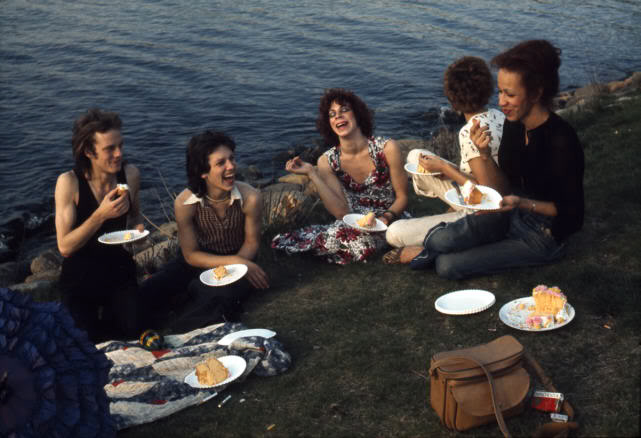
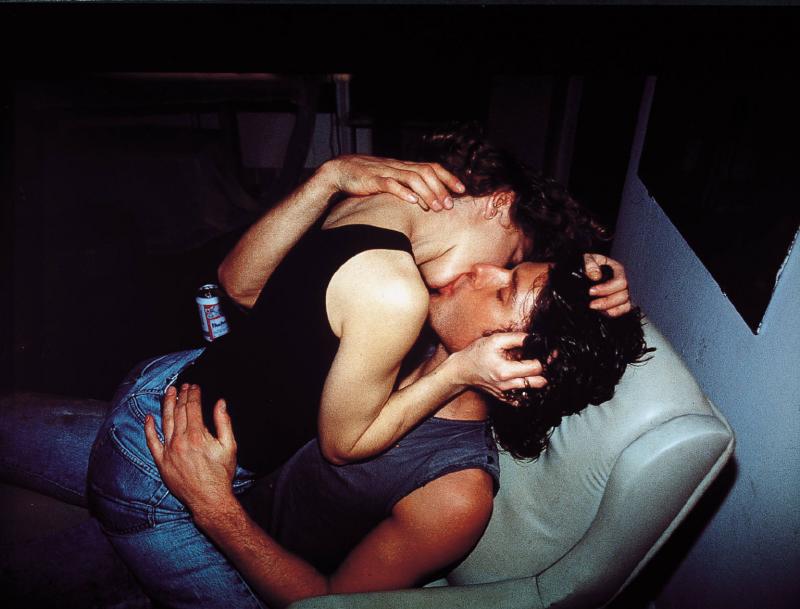
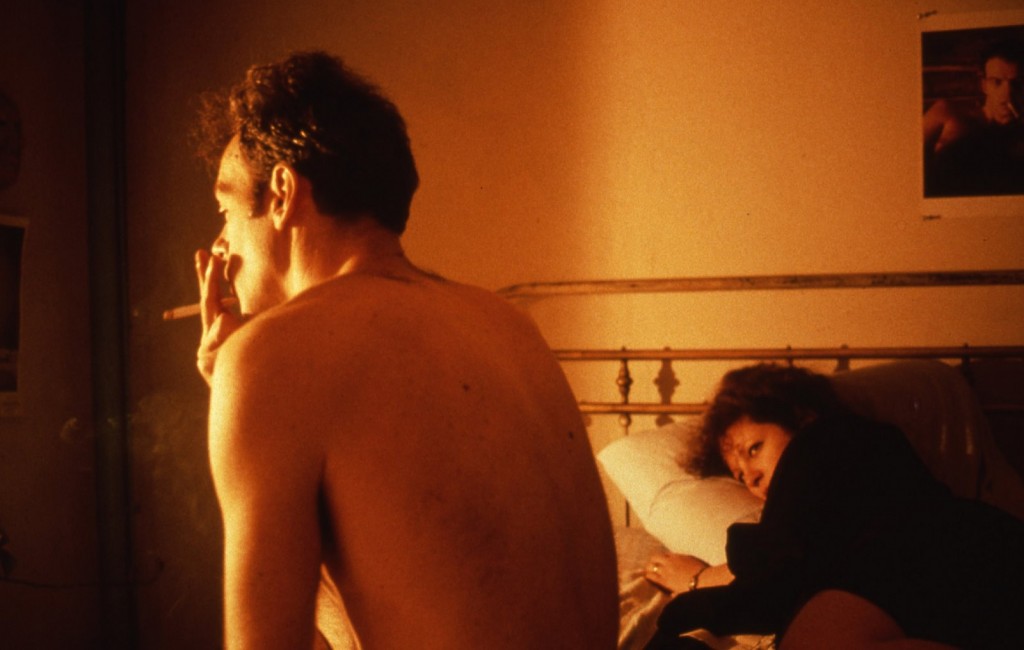
©NAN GOLDIN

– Matt Johnston

Categories
GUEST POST REFLECTION

Niall McDiarmid on ‘The Ballad of Sexual Dependency’, a personal reflection

Thanks to Niall McDiarmid for this personal reflection, for those that do not know Niall, you can check out his fantastic ‘Crossing Paths’ project here. And follow on twitter here – @niallmcdiarmid

In the late 90s I picked up a first edition of Nan Goldin’s Ballad of Sexual Dependency in a well-known secondhand shop on London’s King Road. Surprisingly it was only £6, a bargain as it transpired, piled among other reduced to clear gardening titles.

I had read of it but in those pre-internet days, not seen the work.  It seems odd to think that book dealers would overlook such a collectable title now but on a quick glance, it’s easy to understand why. The book has the feeling of a self-published, 5 year long personal photo-diary of a group of 20 somethings having a hedonistic lifestyle that started as fun but ended a little dark and dangerous. Snapshots, direct flash, sex, drugs, drag queens, domestic violence, good times, bad times are all there.

Although most of the pictures are captioned, I found myself flicking through trying to work out who was who, what the relationships between the characters were, how they happened to end up in New York, London, Brighton, Berlin etc. I have the feeling that over the 5 years there were many shots taken but the editing is really well done and it sits together like it all took place over a couple of weeks

There are echoes of predecessors like William Eggleston and Gary Winogrand in the work but to me really it seems like a new direction in photography that led to many others well-known names such as Wolfgang Tillmans, Terry Richardson, Corinne Day and Ryan McGinley.

Anyway, it’s a great book and worth a look if you haven’t seen it.

– Niall McDiarmid

©NAN GOLDIN


Categories
COMMENTS GUEST POST REFLECTION

Lloyd Spencer on ‘Ballad of Sexual Dependency’, a personal reflection

Thanks to Lloyd Spencer for this reflection on Goldin’s book. If you would like to share your thoughts, see here.

A fascinating, compelling book. “Diary” is correct as it is the rather seedy and dissolute life that provides the real interest. Writing compellingly about such a life requires more skill than taking photos. Finding the words for the chaotic collisions, the violence or traces of violence, deciding how much to quote or report, what perspective to adopt: photography doesn’t really pose any of these challenges.

Nan Goldin emerges as a competent photographer and someone who probably lived her life (or her life ‘then’) as a kind of unfolding photobook . . .

The result is a pretty unique work. But unique (unmatched) also in Goldin’s subsequent career…

– Lloyd Spencer

©NAN GOLDIN


Categories
BOOKS COMMENTS GUEST POST REFLECTION

Share your thoughts on Nan Goldin’s ‘Ballad of Sexual Dependecy’

Goldin’s ‘The Ballad of Sexual Dependency‘ is by no means an undiscovered work, and as we will highlight, has been discussed and talked about many times, in many formats before. But this book never fails to invoke response from those who have either seen it 100 times, or those who are viewing it for the first time.

And we would really love to here from as many members of the Photo Book Club community as possible, so feel free to share your views in Twitter, Facebook, or in the comments section below. We are also happy to post any personal reflections on this blog (these do not have to be in praise of the book!) just leave your reflection in the comments or in email to matt@photobookclub.org.

– Matt Johnston

©NAN GOLDIN